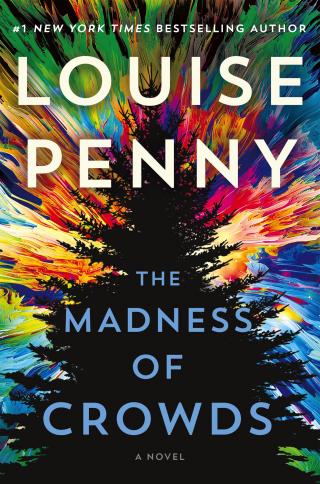
The Madness of Crowds
- Автор: Пенни Луиза
- Серия: Chief Inspector Gamache #17
- Год: 2021
- Язык: английский
- Год: St. Martin's Publishing Group
- ISBN: 9781250145284
- Жанр: Другие детективы

Электронная книга - «The Madness of Crowds». Краткое содержание книги:
You're a coward.
Time and again, as the New Year approaches, that charge is leveled against Armand Gamache.
It starts innocently enough.
While the residents of the Québec village of Three Pines take advantage of the deep snow to ski and toboggan, to drink hot chocolate in the bistro and share meals together, the Chief Inspector finds his holiday with his family interrupted by a simple request.
He's asked to provide security for what promises to be a non-event. A visiting professor of statistics will be giving a lecture at the nearby university.
While he is perplexed as to why the head of homicide for the Sûreté du Québec would be assigned this task, it sounds easy enough. That is, until Gamache starts looking into Professor Abigail Robinson and discovers an agenda so repulsive he begs the university to cancel the lecture.
They refuse, citing academic freedom, and accuse Gamache of censorship and intellectual cowardice. Before long, Professor Robinson's views start seeping into conversations. Spreading and infecting. So that truth and fact, reality and delusion, are so confused it's near impossible to tell them apart.
Discussions become debates, debates become arguments, which turn into fights. As sides are declared, a madness takes hold.
Abigail Robinson promises that if they follow her, ça va bien aller. All will be well. But not, Gamache and his team know, for everyone.
When a murder is committed, it falls to Armand Gamache, his second-in-command Jean-Guy Beauvoir, and their team to investigate the crime as well as this extraordinary popular delusion.
And the madness of crowds.
“And to blackmail him,” said Beauvoir. “To force him to support your work.”
“This whole thing started a few weeks ago, didn’t it?” Gamache said to Abigail. “When you found the letter Dr. Gilbert wrote to your father demanding payment. That’s when you realized what had happened to your mother.”
“And that he”—she glared at Gilbert—“was part of it. Yes.”
“You brought the letter with you, of course,” said Gamache, feeling his way forward now.
She nodded. “Debbie had it. I didn’t even want to touch it.”
Gamache turned to Gilbert. “How did you know she had it on her?”
“I didn’t. I had no idea that letter still existed. Not until we were at Colette’s and you brought out the other letter. The one sent to the local woman. That’s when she”—he nodded toward Abigail—“said she’d found a similar one. Before that I had no idea her mother had been part of Cameron’s experiments.” His gaze moved on to Colette. “Aren’t you going to say something? You’re going to let them accuse me of a crime you know I didn’t commit?”
“Do I know that, Vincent?”
“Of course you do.” The Asshole Saint was beginning to lose it.
Colette was quiet for a moment, then turned to Gamache.
“You said that this started a few weeks ago, when Abigail found the letter from Vincent among her father’s things. That might’ve been, to use your analogy, the hundredth monkey. The final push. But it started long before that.”
“Oui. I see that now. I’ve made a few mistakes. Some in judgment.” He held her eyes. “And some in logic. I thought of the murder of Debbie Schneider as a puzzle, like Jean-Paul’s. A jigsaw. I watched him do what we all do with jigsaws. We separate out the pieces, into colors, into patterns that match. Then we frame it. But this seemed to be two or three different puzzles mixed together. It didn’t make sense, until I changed the analogy. Until the rational puzzle became a thread of emotions. One end is tied to Debbie Schneider, the other to Ewen Cameron. And the thread that runs through everything that happened in between has a name. Abby Maria.”
Abigail sat back in her chair and stared at him. “Did Colette tell you?”
“Non. She kept your father’s confidence. All Colette would say is that he loved both his daughters, equally. More than life itself. I didn’t see it, couldn’t quite get there, even after we found the note he wrote you.”
Abigail turned to Colette. “You showed them?”
“No. They searched the house and found it.”
“It seemed to contradict what everyone said about your father,” said Gamache. “The letter appeared cruel, even vindictive. It seemed to lay part of the blame on you. You were, he said, part of the reason for what happened to Maria, and for his own suicide. He did what he did to free you.” Gamache shook his head. “I couldn’t reconcile the two. A loving father who kills one child and burdens another with a lifetime of guilt? How could this be love? How could love, real love, ever be a reason to murder?”
“I know how,” said Haniya.
Gamache looked at her and nodded. “Yes, you do. You survived for love. And you did what you did for love. And now, I think, I also understand.”
“Now it is now, and the dark thing is here,” said Gilbert, quietly.
“It’s not dark yet,” said Gamache. “But it’s getting there.”
Haniya gave a snort of laughter. “A cop who quotes Bob Dylan. You are dangerous.”
“Colette was right,” Gamache continued. “What Paul Robinson did, he did for love. But it wasn’t murder. Inspector Beauvoir here understood that before anyone else. He knew Paul Robinson could never kill his daughter. In fact, he died protecting his family. Abby Maria.”
Colette Roberge nodded. “Abby Maria.”
“Are you saying ‘Abby Maria’ or ‘Ave Maria’?” asked Haniya. “I don’t understand.”
“My mother called us that,” said Abigail. “Abigail and Maria. Abby Maria. It was a nickname, a term of endearment.”
Colette muttered something, and when everyone looked at her, she spoke up. “It was more than that. It was a bond. It bound you.”
“Yes. It meant our fates, our lives, were intertwined. I thought it could be broken, but I was wrong.”
Abigail looked exhausted. Drained. An animal tired of the plague. Of what had been plaguing her for decades.
“What’s this about Maria?” asked Haniya. “What happened to her?”
“Maria is, was, Professor Robinson’s younger sister,” Colette explained. “She was severely disabled. After Maria was born, Madame Robinson suffered postpartum depression. Her husband, Abigail’s father, was a scientist and had heard that Ewen Cameron was the best psychiatrist in the country, doing landmark research. So he got his wife in.”
“What Paul Robinson didn’t know,” said Beauvoir, “was that Cameron was conducting experiments on his patients, for the CIA and the Canadian government.”
“What sort of experiments?”
“Mind control. Brainwashing. He used LSD. Sleep deprivation. Electric shocks.”
Haniya’s mouth dropped and the scars deepened, as though maws had opened across her face. “He tortured his patients? This was allowed? Here? In Canada?”
“Tortured them, then sent them a bill,” said Lacoste. “Signed by Vincent Gilbert. One of Cameron’s residents.”
Haniya turned to Gilbert. “You knew?”
Vincent Gilbert stared at the planks of his floor.
“Madame Robinson, Abigail’s mother, eventually took her own life,” said Colette.
“Madame Robinson would refer to her daughters as Abby Maria,” said Gamache. “As though they were one person. It was meant as a sign of affection. And perhaps slightly more than that. She was, I’m guessing, a devout Catholic.”
“Yes,” said Abigail.
“And she committed suicide?” said Haniya. “Isn’t that a mortal sin?”
“Yes,” said Gamache, when Abigail didn’t answer. “A testament to just how broken she was. To the pain she suffered. She’d been driven out of her mind, out of her faith. She’d been driven to despair.”
“By you.” Abigail glared at Vincent.
In a swift movement, Gilbert bent down and grabbed the fireplace poker.
While everyone was momentarily distracted by that, Abigail picked up the rifle. And aimed it at him.
CHAPTER 46
Beauvoir brought out his gun.
“Non,” commanded Gamache.
Beauvoir didn’t lower the weapon. Holding it steady in both hands, he kept it on Abigail. Prepared to fire. Longing to fire.
Come on, come on. One little movement, please. Come on.
“There’s something you don’t know,” Gamache said to Abigail. His arms were out, trying to restore calm.
She was breathing heavily, the muzzle of the rifle lifting and falling with each breath. But she was so close to Vincent Gilbert she couldn’t miss. It was just a question of inhale or exhale. Chest or head.
“Your father made a copy of his suicide note.”
“So? You found the original at Colette’s.” She kept her eyes on Gilbert. “You’ve read it.”
“But Debbie hadn’t. I don’t think you wanted her to.”
Now Abigail’s eyes darted to Gamache. “Yes, she did. At the cottage, when Colette gave it to me.”
“You read it, Abby,” said Colette, taking a small step forward. “And you told Debbie what was in it, but she never actually read it.”