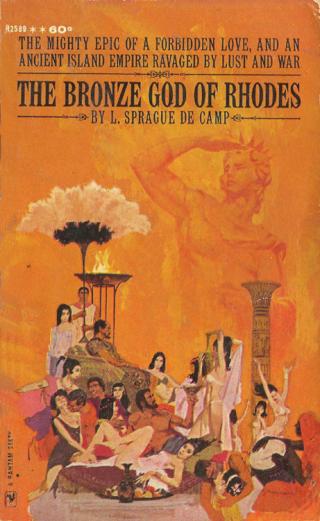
The Bronze God of Rhodes
- Автор: Де Камп Лайон Спрэг
- Год: 1963
- Язык: английский
- Год: Bantam Books
- Жанр: Научная фантастика

Электронная книга - «The Bronze God of Rhodes». Краткое содержание книги:
From the sea in thousands of ships they came, the brutal legions of Antigonos, a giant lusting for the power of Alexander the Great. For endless weeks and months they battered at the tiny island city, smashing it with monstrous weapons, crushing it with the terrible weight of their numbers.
Among the handful of grim defenders was one man who fought for a dream, a vision of a great statue that would stand above the highest towers as a monument to his city's grandeur.
He was Chares, soldier, adventurer, a man tormented by passion, a wanderer in strange, deadly lands—an artist who lived to see his incredible dream become one of the seven wonders of the world.
In the end we chose as our site the high ground west of the Great Harbor, where the foreign quarter lies.
Then there were the financial details. As nobody had ever built so large a statue, none knew what it would cost. The estimates started low and kept climbing as each new expense transpired. In the end I undertook to build the Helios for the cost of materials plus a fixed fee of two hundred talents, to be paid in installments.
The Council and I agreed that it were better to take my time in beginning the statue until I had learnt everything I needed to know. Meanwhile I had plenty to keep me busy. The new theater was taken in hand again, and I was told to go ahead with the statues of the playwrights. The city also ordered a statue of King Ptolemaios for the Ptolemaeion, as well as several smaller statues to decorate this edifice. Business was so brisk that I hired a couple of full-time assistants for the studio.
Summer had come again when a familiar voice spoke through the door of my busy studio: "Is it that Master Chares still works here now?" There stood a tall, red-haired, mustached man wearing Keltic trousers and tunic of a gaudy checkered pattern, with squares of red, yellow, and blue.
"Kavaros!" I cried, clasping his hand. "I thought you'd gone back to live among your wild countrymen in Getika."
"That I did, that I did. But things are not what they used to be. My poor father was dead. Some dirty murtherers from the Trokmoi had slain him, and for no reason at all, just because he had taken a few heads from their tribe to hang over his gate. A new chief leads the clan, so it is no longer a chief's son that I am. Then there was a bit of an argument with a man who thought that my wife Grania here"— he indicated a tall, beautiful, golden-haired woman in the doorway—"ought to belong to him. And besides, sir, to tell the truth, I am after being spoilt by life in a great city. A man can buy so many nice things that he cannot get in the Keltic country."
"But what will you do in Rhodes?"
"I am thinking you will need a pair of strong arms to help with the heavy lifting and moving for your new statue. I will work as I did before, but as a free man, of course. I leave the pay to you; as a gentleman you will be fair."
So I took on Kavaros at two and a half drachmai a day: a fair rate of pay for a starter. Although he still had his old faults, he soon made himself indispensable nonetheless.
After the contract with the city had been signed, you might think that I could start work at once. But as Hippokrates the physician once said, art is long, life short, opportunity fleeting, experience deceptive, and judgment difficult. I did not intend to spend years in putting up my statue, to have the first blast of Boreas tumble it down. Hence it took eleven years of painstaking preparation before I could actually begin the construction of my Helios.
After months of work on my lesser contracts, of wandering about the foreign quarter to see just where the Colossus would look best, of making and discarding models, and of covering tablet after tablet with calculations, I set sail for Argos. It was spring of the second year of the 119th Olympiad, when the allied kings were closing in upon Antigonos and his son Demetrios.
I had to wait over three days in Argos for a party for Corinth to be made up. Brigandage was rife in Hellas, and few roads were safe for solitary travelers.
A hard day's muleback ride through the rugged, scrub-covered hills of Argolis brought us into sight of the Gulf of Corinth. Here I left the party and, with my new Colchian slave, took the coastal road westward. The first stars to light their tapers saw me banging on Lysippos' door in Sikyon.
"Well, well!" cried the old man, with a gap-toothed grin. "Do not tell me that Chares of Lindos has gone all these years unhanged! I remember you well. Talent you had, but' you were the snottiest little bastard I ever dealt with."
"I still am, you old tyrant," I replied, "but I've learnt to hide it. Have you reached your goal of fifteen hundred statues yet?"
"No, but I shall, even though age has slowed me. The boys do most of the work now." He raised his voice. "Daïppos! Boêdas! Euthykrates! Here's one of our old apprentices, grown famous!"
The three young stalwarts rushed out and fell to wringing my hand and pounding my back. In the time of my apprenticeship my relations with Lysippos' sons had not been friendly. I suppose they feared that I might gain a lasting influence over their sire, to the detriment of their own careers. Now, however, their greeting was as hearty as one could have wished.
"Dinner is over," said Lysippos, "but our cook shall scramble something up for you. Come in, man, and tell us all about the great siege! Is that how you got that scar on your face?"
An hour and a skin of wine later we had finished with the siege and were asking about fellow artists. I said:
"What has become of Eutychides? You remember, he and I invented the revolving workstand when we apprenticed here."
Daïppos replied: "He has been in Samothrace, sculpturing a winged Victory for King Demetrios."
"Surely not to celebrate his Rhodian war!"
"No, this monument commemorates the defeat of Ptolemaios off Cyprus. They say this statue is a wonder; one expects it to soar away any instant. But what brings you to us?"
"I need advice," I said, "and if there be any articulates freer with advice than Lysippos and his sons, I have yet to hear of them." I told them of my contract for the Colossus.
"My main concern," I went on, "is whether so large a statue be possible. As the geometers have proved, when we expand a work, the areas increase as the square and the weights as the cube of the linear dimensions. At that rate, a point should be reached where a statue's ankles, if made to normal human proportions, could no longer support the statue."
"What you must do," said Lysippos, "is to concentrate the weight in the lower parts. You might make the feet and ankles of solid bronze; then the legs of thick bronze, say, a palm in cross section; and so on down to mere sheeting for the head and arms. Thus you will put the most strength where it is needed. You will also render the statue less liable to be blown over, as a pyramid is more stable than an obelisk."
"There's another thing," I said. "You erected a pillar on the windward side of your Tarentine Zeus, to break the force of gales. But it were hardly practical to put up a hundred-foot column beside my Colossus. So how shall I brace it against overset?"
Boêdas asked: "First tell me, what pose have you planned?"
"Erect, shading its eyes with its right hand, as I saw the god on that day of the siege."
"Any drapery?"
"I hadn't planned any. What wants a god of clothes?"
"Well, why not hang a cloak over the god's left arm, trailing to the ground? Then you can run up a third pillar through this cloak and tie it to the others by architraves. That will give three points of support, making the structure far stronger than one with only two."
"That's it!" I cried. "And I can make the third column thicker than the other two, for it will not be limited by the proportions of the human ankle. Moreover, I can run a smaller column from the architraves up into the head ..."
The discussion raged far into the night. The next day it continued while we paced about Lysippos' court, a swarm of Lysippos' grandchildren frolicking about our legs. We adjourned to Lysippos' studio, where I sketched in charcoal and clay while Lysippos and his sons criticized—and none too gently, either.
My stay lengthened into days and the days into ten-days. When we got the pose right, there still remained an ominous question: