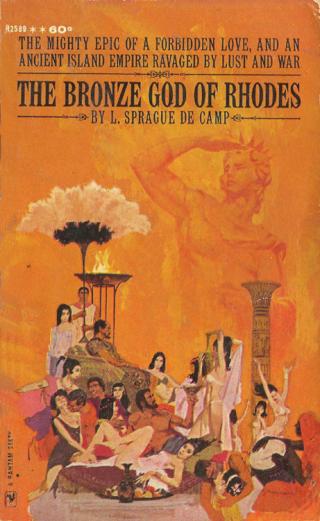
The Bronze God of Rhodes
- Автор: Де Камп Лайон Спрэг
- Год: 1963
- Язык: английский
- Год: Bantam Books
- Жанр: Научная фантастика

Электронная книга - «The Bronze God of Rhodes». Краткое содержание книги:
From the sea in thousands of ships they came, the brutal legions of Antigonos, a giant lusting for the power of Alexander the Great. For endless weeks and months they battered at the tiny island city, smashing it with monstrous weapons, crushing it with the terrible weight of their numbers.
Among the handful of grim defenders was one man who fought for a dream, a vision of a great statue that would stand above the highest towers as a monument to his city's grandeur.
He was Chares, soldier, adventurer, a man tormented by passion, a wanderer in strange, deadly lands—an artist who lived to see his incredible dream become one of the seven wonders of the world.
The wound left a conspicuous scar on my cheek; but, to tell the truth, I have been proud rather than regretful of that scar.
Io bathed me and scrubbed the dried blood off me. Later, when the women had left us alone for a moment, my father said: "What are you going to do, son, when peace finally comes?"
I spoke in a muffled voice through my bandages: "I'm going back to my studio. But I'll still help out with the foundry; don't worry about my abandoning the business. Where's Io?"
"She'll soon be back. What's the hurry?"
"I like to see her around. I never knew she was so good at nursing."
After my father and I had been put to bed for the night, I said: "Father! If peace come, I should be glad to wed Io as soon as it can be arranged."
"Oh? Why the change?"
"Put it this way. I once had a friend who did not wish to wed any Greek girl. They were, he thought, too tame and subdued, and would bore him. His mind was full of romantic notions of mating with some foreign wench of more wit and spirit, who would make life interesting.
"Well, he had a chance to know such a woman—quite well—and learnt that a very little of a vigorous, domineering dame goes a long way. In the end he was glad to settle down with a sweet, docile Greek girl of good family, earn a decent living, and rear a family."
"Oh," said my father. "Your friend learnt wisdom at last. Well, I shall see Genetor one of these days and take the matter up with him."
As it fell out, Genetor came to see us, wig awry and wringing his hands in piteous fashion.
"Oimoi!" he moaned. "Woe and destruction! Have you heard the conditions of peace that those god-detested politicians of ours have agreed to?"
"Surely not to let Demetrios' forces into the city!" I exclaimed.
"No, no, nothing like that. They have agreed, however, that we shall be allies of Kings Antigonos and Demetrios against all foes except the Ptolemaios."
"Why," said I, "those are just about the terms we offered him before the siege!"
"But that is not all. They have also agreed to give him a hundred hostages—the hundred richest citizens of the city. And naturally that includes me!"
"You poor fellow!" said my father. "That's the price of wealth."
"But still that is not all. Do you know what stipulation those intriguers and windbags have made? That no officeholders shall be included among the hostages! Oh, the perfidy of it! The rest of us must waste our lives in durance vile while these polluted rascals strut and swill, free men, in our beautiful city! They have taken care of themselves, all right!"
"Perhaps you ought to have run for office," murmured my father. The dexterity with which Genetor, when he had been made a full citizen, had nevertheless avoided all public offices and liturgies because of the financial burdens that these entail in maintaining ships, staging drams, and feeding the poor was a common joke in Rhodes.
"However," continued my father, "before you sail off with Demetrios, we ought to consider our children's wedding. This betrothal has run on more than long enough."
Genetor: "True, true. It were better to push it through now, before I am carried off into shameful captivity. In Ephesos, where I am not known, how could I make a decent match for my little girl?"
The beginning of the first year of the 119th Olympiad, when Pherekles was archon at Athens, saw the wedding of Chares of Lindos to Io daughter of Genetor. The marriage turned out exceedingly well, considering that the groom was not the easiest man in the world to live with.
A few months later I was sitting in my father's house, watching Io go about her wifely duties, wearing a blue-gray veil made from the remanent of Demetrios' original robe—nay more, actually going out of her way to try to please me, despite my shortcomings—I thought, what a fool you have been, Chares! This is the true love, built up piece by piece by time and mutual effort. That other thing, that emotional storm that seizes one on first sight and all but tears one to bits, is all very exciting, but it cannot compare with this for solid comfort. Treat the little creature well and she will repay you at a higher rate of interest than Elavos the Syrian ever charged.
The same season also saw Genetor and his wife, with the other hostages, departing on an Antigonian battleship amid many tears and lamentations. It saw King Demetrios sail away towards Hellas in his great two-masted elevener, followed by his whole vast fleet, still gorgeous with purple and gold. This mighty force, despite the skill of its sailors, the number and hardihood of its soldiers, and the demoniac ingenuity and determination of its dashing sea king, had been fought to a standstill by the people of one small, free, republican city.
We learnt that Demetrios might not even then have raised the siege but that his father had written urging him to make peace. King Antigonos had gotten wind of another alliance among Ptolemaios, Seleukos, Kasandros, and Lysimachos. These satraps, all of whom now called themselves kings, were determined to quash, once and for all, the boundless claims and pretensions of the Antigonids.
The pirates had already scattered, fearing the vengeance of Rhodes. Of those whom they had enslaved, few ever came home again. The war left many gaps in the ranks of my foes, my friends, and my kinsmen.
An embassy arrived from Rome, now a rising power, to congratulate Rhodes on her victory. In gratitude for Ptolemaios' help, the Assembly conferred upon the king of Egypt a series of honors almost as extravagant as those bestowed by the Athenians on Demetrios. The Rhodians addressed the Ptolemaios as "Savior," which title seems to have taken his fancy, for he adopted it officially.
BOOK X — KAVAROS
When I re-entered my studio for the first time in more than a year, I saw that I had my work cut out for me. My tools I had taken home, but other equipment too heavy to move— furnaces, anvils, tubs, troughs, and the like—was mostly broken or stolen. Refugees had camped here, using my scanty furniture for firewood, and gangs of boys had broken things up.
I was poking at the litter in a futile sort of way when I heard a step behind me. Before I could turn, a large hand grasped my shoulder and whirled me around. There stood Kavaros, wearing a plain but decent tunic, with wine on his breath and murder in his eyes.
"This for you!" he cried.
A fist crashed into my jaw, and down I went. The next thing I knew, he was cradling me in his arms and weeping over me.
"Ah, the poor little man!" he moaned. "Bad cess to me that struck him, and him so brave and clever and all!"
I tore loose. "Before I cut your heart out," I said, "would you mind telling me why you did that?"
"It was only to get even with you for all the times you beat me, sir. My honor demanded it."
"Honor! But you were a slave then!"
"Maybe I was to you, Master Chares, but to me I was still Kavaros son of Ortiagon, a chief's son and a Keltic gentleman. And I did not like the beatings any more than you would."
I was filled with mixed emotions. On one hand, I was furious with Kavaros, but on the other I had to admit the logic of his feeling as he did.
"Go walk! The wild Keltic race is too much for me," I said, rubbing my jaw, picking up the broom, and resuming my work. "I shall never understand them."
"It is truly sorry that I am, sir," he said. "If you would like a bit of a knock at me, go ahead and take it. Here, young master, indeed and you are doing it all wrong. Give me that broom."
The Kelt fell to work with a will. I think he stirred up twice as much dust and caused twice as much commotion as he needed to, but that was ever his way.
"It is like my great-grandfather and the enchanted bear," he said. "My ancestor was hunting in the Rhiphaian Mountains once when he came upon this big brown devil, who knocked the spear out of his hand with one paw and my ancestor into a snowdrift with the other. When my greatgrandfather dug himself out, there was the bear standing over him and growling like a thunderstorm that had got out of bed the wrong side that morning.