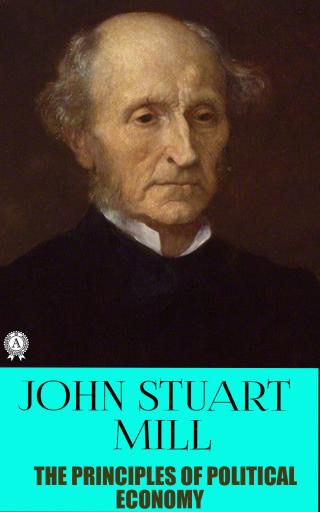
Principles Of Political Economy
- Автор: Mill John Stuart
- Год: 2022
- Язык: английский
- Год: Strelbytskyy Multimedia Publishing
- Жанр: Политика

Электронная книга - «Principles Of Political Economy». Краткое содержание книги:
Beside discussing descriptive issues such as which nations tended to benefit more in a system of trade based on comparative advantage (Mill's answer: those with more elastic demands for other countries' goods), the work also discussed normative issues such as ideal systems of political economy, critiquing proposed systems such as communism and socialism.
Along with A System of Logic, Principles of Political Economy established Mill's reputation as a leading public intellectual. Mill's sympathetic attitude in this work and in other essays toward contemporary socialism, particularly Fourierism, earned him esteem from the working class as one of their intellectual champions.
§ 3. Examination of the doctrine that an inconvertible Current is safe, if representing actual Property.
Projectors every now and then start up, with plans for curing all the economical evils of society by means of an unlimited issue of inconvertible paper. There is, in truth, a great charm in the idea. To be able to pay off the national debt, defray the expenses of government without taxation, and, in fine, to make the fortunes of the whole community, is a brilliant prospect, when once a man is capable of believing that printing a few characters on bits of paper will do it. The philosopher's stone could not be expected to do more.[248]
As these projects, however often slain, always resuscitate, it is not superfluous to examine one or two of the fallacies by which the schemers impose upon themselves. One of the commonest is, that a paper currency can not be issued in excess so long as every note issued represents property, or has a foundation of actual property to rest on. These phrases, of representing and resting, seldom convey any distinct or well-defined idea; when they do, their meaning is no more than this—that the issuers of the paper must have property, either of their own, or intrusted to them, to the value of all the notes they issue, though for what purpose does not very clearly appear; for, if the property can not be claimed in exchange for the notes, it is difficult to divine in what manner its mere existence can serve to uphold their value. I presume, however, it is intended as a guarantee that the holders would be finally reimbursed, in case any untoward event should cause the whole concern to be wound up. On this theory there have been many schemes for “coining the whole land of the country into money” and the like.
In so far as this notion has any connection at all with reason, it seems to originate in confounding two entirely distinct evils, to which a paper currency is liable. One is, the insolvency of the issuers; which, if the paper is grounded on their credit—if it makes any promise of payment in cash, either on demand or at any future time—of course deprives the paper of any value which it derives from the promise. To this evil paper credit is equally liable, however moderately used; and against it, a proviso that all issues should be “founded on property,” as for instance that notes should only be issued on the security of some valuable thing, expressly pledged for their redemption, would really be efficacious as a precaution. But the theory takes no account of another evil, which is incident to the notes of the most solvent firm, company, or government; that of being depreciated in value from being issued in excessive quantity. The assignats, during the French Revolution, were an example of a currency grounded on these principles. The assignats “represented” an immense amount of highly valuable property, namely, the lands of the crown, the church, the monasteries, and the emigrants; amounting possibly to half the territory of France. They were, in fact, orders or assignments on this mass of land. The revolutionary government had the idea of “coining” these lands into money; but, to do them justice, they did not originally contemplate the immense multiplication of issues to which they were eventually driven by the failure of all other financial resources. They imagined that the assignats would come rapidly back to the issuers in exchange for land, and that they should be able to reissue them continually until the lands were all disposed of, without having at any time more than a very moderate quantity in circulation. Their hope was frustrated: the land did not sell so quickly as they expected; buyers were not inclined to invest their money in possessions which were likely to be resumed without compensation if the revolution succumbed; the bits of paper which represented land, becoming prodigiously multiplied, could no more keep up their value than the land itself would have done if it had all been brought to market at once; and the result was that it at last required an assignat of five hundred francs to pay for a cup of coffee.
The example of the assignats has been said not to be conclusive, because an assignat only represented land in general, but not a definite quantity of land. To have prevented their depreciation, the proper course, it is affirmed, would have been to have made a valuation of all the confiscated property at its metallic value, and to have issued assignats up to, but not beyond, that limit; giving to the holders a right to demand any piece of land, at its registered valuation, in exchange for assignats to the same amount. There can be no question about the superiority of this plan over the one actually adopted. Had this course been followed, the assignats could never have been depreciated to the inordinate degree they were; for—as they would have retained all their purchasing power in relation to land, however much they might have fallen in respect to other things—before they had lost very much of their market value, they would probably have been brought in to be exchanged for land. It must be remembered, however, that their not being depreciated would presuppose that no greater number of them continued in circulation than would have circulated if they had been convertible into cash. However convenient, therefore, in a time of revolution, this currency convertible into land on demand might have been, as a contrivance for selling rapidly a great quantity of land with the least possible sacrifice, it is difficult to see what advantage it would have, as the permanent system of a country, over a currency convertible into coin; while it is not at all difficult to see what would be its disadvantages, since land is far more variable in value than gold and silver; and besides, land, to most persons, being rather an incumbrance than a desirable possession, except to be converted into money, people would submit to a much greater depreciation before demanding land, than they will before demanding gold or silver.[249]
It has been said that the assignats circulated without legal-tender power. They were received by the French treasury, and a law was passed condemning a man to six years in irons for exchanging gold or silver for assignats at a greater than the nominal or face value of the latter. The subsequent issues, called mandats, did not represent land, but were directly exchangeable for the land. Even that kind of money is no more valuable than a proportional amount of tax receipts for land. In a very short time mandats were worth 1/1000 of their face value, and assignats very much less. The assignats, moreover, were not limited in quantity to the money value of the lands they represented. By 1796, 45,000,000,000 francs of assignats had been issued.
§ 4. Experiments with paper Money in the United States.
The experience of the colonies before our Revolution is rich in warning examples of the over-issue of inconvertible paper money. Those of Rhode Island[250] and the Province of Massachusetts[251] are the most conspicuous, perhaps, because we have better knowledge of them, but other colonies suffered in as great a degree. The experience of the latter illustrates as well as any, perhaps, not only the general theory of inconvertible paper, but the device of supporting the paper by paying interest upon the notes. Although the issues since 1690 had depreciated, in 1702 £10,000 more notes were issued, because, as it was said, there was a scarcity of money. It is always noticeable that the more issues of paper money there are made, the more there is a cry of scarcity, much like the thirst of a hard drinker after the first exhilaration has passed off. On the new issues five per cent interest was paid, and even excises and imposts were set aside as security for their payment. The year 1709 saw a new expedition to Canada, and saw also the broken promises of the province, when £20,000 more notes were put out; the collection of the taxes with which to pay the notes was deferred in 1707 for two years; in 1709 deferred for four years; in 1710 for five years; in 1711 for six years. By 1712 they had depreciated thirty per cent, when the charm of legal tender was thrown around them, but to no purpose. The idea of value was not associated with them in people's minds, and they put no faith in promises. The usual result took place. People divided politically on the money question, and parties began to agitate for banks which should issue notes based on real estate, or for loans from the state to private persons at interest to be paid annually. Such facts show the train of evils following the first innocent departure from the maintenance of a currency equivalent to coin. The people forgot, or did not know, the nature of money, or the offices it performed. They did not understand that creating paper money did not create wealth. This experiment closed only in 1750 (March 31st), when the province had courage enough to resume specie payments. The effect was to transfer the West India trade from paper-issuing colonies to Massachusetts, and to produce a steady prosperity in her business interests.
248
For John Law's famous scheme (1718-1720) in France, called the “Mississippi Bubble,” the best authority is Levasseur's “Système de Law” (1854). Also consult M. Thiers's “The Mississippi Bubble” (translated by F. F. Fiske, 1859); Steuart's “Political Economy” (1767); and McLeod's “Dictionary of Political Economy,” article on “Banking in France.”
249
For the best brief account of the issues of assignats, see President A. D. White's “Paper Money Inflation in France.” See also F. A. Walker, “Money,” pp. 336-347; Bazot's “Assignats”; and Alison's “History of the French Revolution,” vol. ii, p. 606.
250
See “Some Account of the Bills of Credit or Paper Money of Rhode Island, 1710-1786,” in “Rhode Island Historical Tracts,” No. 8 (1880), by E. S. Potter and S. S. Rider.
251
See Felt's “History of Massachusetts Currency.” Consult also Minot, Hutchinson, and Gouge. Walker, “Money,” and Sumner, “History of American Currency,” have given considerable accounts of paper experiments in the United States, and should be well studied.