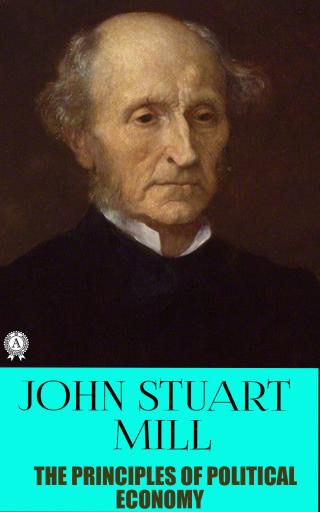
Principles Of Political Economy
- Автор: Mill John Stuart
- Год: 2022
- Язык: английский
- Год: Strelbytskyy Multimedia Publishing
- Жанр: Политика

Электронная книга - «Principles Of Political Economy». Краткое содержание книги:
Beside discussing descriptive issues such as which nations tended to benefit more in a system of trade based on comparative advantage (Mill's answer: those with more elastic demands for other countries' goods), the work also discussed normative issues such as ideal systems of political economy, critiquing proposed systems such as communism and socialism.
Along with A System of Logic, Principles of Political Economy established Mill's reputation as a leading public intellectual. Mill's sympathetic attitude in this work and in other essays toward contemporary socialism, particularly Fourierism, earned him esteem from the working class as one of their intellectual champions.
Although the State may not promise to pay a dollar, yet, wherever such paper money carries any purchasing power with it (which has very seldom happened, and then only for short periods), it will be found that there is a vague popular understanding that the State intends, at some time or other, to redeem the notes with value in coin to some amount. In the early cases of irredeemable money in our colonies, the income of taxes, or similar resources, were promised as a means of redemption. To some—although a slight—extent, the idea of value was associated with such paper. The actual quantity issued did not measure the depreciation. The paper did depreciate with increased issues. But only in so far as the increased issues proved to the community that there was less and less possibility of ever receiving value for them did they depreciate. In other words, we come to the familiar experience, known to many, of a paper money depending for its value on the opinions of men in the country. This was partially true, even of our own greenbacks, which were not fiat money, but promises to pay (although not then redeemable), as may be seen by the movement of the line in Chart XII (p. 359), which represents the fluctuations of our paper money during the civil war. The upward movement of the line, which indicates the premium on gold during our late war, of course represents correspondingly the depreciation of the paper. Every victory or defeat of the Union arms raised or lowered the premium on gold; it was the register of the opinion of the people as to the value to be associated with the paper. The second and third resorts to issues of greenbacks were regarded as confessions of financial distress; it was this which produced the effect on their value. It was not only the quantity but also that which caused the issue of the quantity. It is, of course, clear that the value of a paper money like the greenbacks, which were the promises to pay of a rich country, would bear a definite relation to the actual quantity issued; and this is to be seen by the generally higher level of the line on the chart, showing a steadily diminishing purchasing power as the issues increased. But the thing which weighed largely in people's minds was the possibility of ultimate redemption; and the premium on gold was practically a register of the “betting” on this possibility. In 1878, when Secretary Sherman's reserve was seen to be increasing to an effective amount, and when it became evident that he would have the means (i.e., the value represented by all the paper that was likely to be presented) to resume on the day set, January 1, 1879, the premium gradually faded away. The general shifting of the level to a lower stage in this later period was not due to any decrease in the quantity outstanding, because the contraction had been stopped in 1868, and that consequent on the resumption act in May, 1878.
Suppose that, in a country of which the currency is wholly metallic, a paper currency is suddenly issued, to the amount of half the metallic circulation; not by a banking establishment, or in the form of loans, but by the Government, in payment of salaries and purchase of commodities. The currency being suddenly increased by one half, all prices will rise, and, among the rest, the prices of all things made of gold and silver. An ounce of manufactured gold will become more valuable than an ounce of gold coin, by more than that customary difference which compensates for the value of the workmanship; and it will be profitable to melt the coin for the purpose of being manufactured, until as much has been taken from the currency by the subtraction of gold as had been added to it by the issue of paper. Then prices will relapse to what they were at first, and there will be nothing changed, except that a paper currency has been substituted for half of the metallic currency which existed before. Suppose, now, a second emission of paper; the same series of effects will be renewed; and so on, until the whole of the metallic money has disappeared (see Chart No. XIV, Chap. XV, for the exportation of gold from the United States after the issue of our paper money in 1862): that is, if paper be issued of as low a denomination as the lowest coin; if not, as much will remain as convenience requires for the smaller payments. The addition made to the quantity of gold and silver disposable for ornamental purposes will somewhat reduce, for a time, the value of the article; and as long as this is the case, even though paper has been issued to the original amount of the metallic circulation, as much coin will remain in circulation along with it as will keep the value of the currency down to the reduced value of the metallic material; but the value having fallen below the cost of production, a stoppage or diminution of the supply from the mines will enable the surplus to be carried off by the ordinary agents of destruction, after which the metals and the currency will recover their natural value. We are here supposing, as we have supposed throughout, that the country has mines of its own, and no commercial intercourse with other countries; for, in a country having foreign trade, the coin which is rendered superfluous by an issue of paper is carried off by a much prompter method.
Mr. Mill's statement, that, if paper be not issued of as low a denomination as the lowest coin, “as much will remain as convenience requires for the smaller payments,” will not hold true. During our recent experiment of depreciated paper, the depreciation was such as to drive out the subsidiary silver coins, by July, 1862, and we were forced to supply their place by a fractional paper currency. By an amendment inserted June 17, 1862, into the act authorizing a second issue of $150,000,000 of greenbacks, it was ordered “that no note shall be issued for the fractional part of a dollar, and not more than $35,000,000 shall be of lower denominations than five dollars” (act, finally passed July 11, 1862). Although there were no fractional notes, yet one-dollar notes drove out subsidiary silver, simply because the paper had depreciated to a value below that of the 345.6 grains of silver in two halves or four quarters of a dollar. By July 2d the disappearance of small coin was distinctly noted. Let the value of gold be represented by 100; and a dollar of small silver coin (345.6 grains), relatively to a gold dollar, by 96. Now, if paper depreciates to 90, relatively to gold, it will drive out the subsidiary silver at 96, in accordance with Gresham's law.
Up to this point the effects of a paper currency are substantially the same, whether it is convertible into specie or not. It is when the metals have been completely superseded and driven from circulation that the difference between convertible and inconvertible paper begins to be operative. When the gold or silver has all gone from circulation, and an equal amount of paper has taken its place, suppose that a still further issue is superadded. The same series of phenomena recommences: prices rise, among the rest the prices of gold and silver articles, and it becomes an object, as before, to procure coin, in order to convert it into bullion. There is no longer any coin in circulation; but, if the paper currency is convertible, coin may still be obtained from the issuers in exchange for notes. All additional notes, therefore, which are attempted to be forced into circulation after the metals have been completely superseded, will return upon the issuers in exchange for coin; and they will not be able to maintain in circulation such a quantity of convertible paper as to sink its value below the metal which it represents. It is not so, however, with an inconvertible currency. To the increase of that (if permitted by law) there is no check. The issuers may add to it indefinitely, lowering its value and raising prices in proportion; they may, in other words, depreciate the currency without limit.