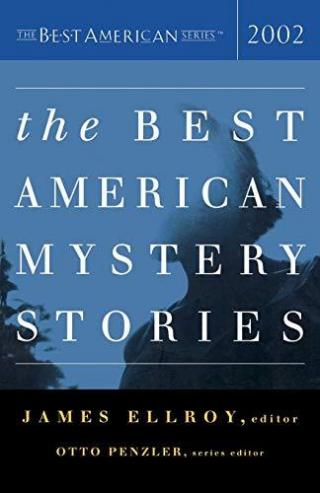
The Best American Mystery Stories 2002
- Автор: Грейди Джеймс, Камински Стюарт Мелвин
- Год: 2002
- Язык: английский
- Год: Houghton Mifflin Harcourt
- ISBN: 978-0-618-12494-7
- Жанр: Другие детективы

Электронная книга - «The Best American Mystery Stories 2002». Краткое содержание книги:
(What “sick, disgusting things” were done to my sweetheart, I don’t know. Another individual must have slipped into the greenroom between the time Roland fled and Babs died later that evening.)
The sick horror of mystery that remains unsolved.
You will ask: Did the killer never confess?
The superficial answer is no, the killer never confessed. For he did not (did he?) truly believe himself a killer; he was a good Christian boy. And he was (and is) a coward, contemptible. The more complex answer is yes, the killer confessed, and has confessed many times during his long and “distinguished” career. Each work of fiction he has written has been a confession, and an exultation. For, having committed an act of mystery in his adolescence, he understood that he’d proved himself and need never commit another; forever afterward, he would be an elegist of mystery, and honored for his style. Ladies and gentlemen, thank you for this new honor.
In the sudden silence, R_ self-consciously stacked the pages of his manuscript together to signal that “The High School Sweetheart: A Mystery” was over, as we in the audience, his friends and admirers, sat stunned, in a paralysis of shock and indecision. R_’s story had been compelling, and his delivery mesmerizing — yet, how should we applaud?
Robert B. Parker
Harlem Nocturne
From Murderers’ Row
Mr. Rickey was wearing a blue polka dot bow tie and a gray tweed suit that didn’t fit him very well. He took some time getting his cigar lit and then looked at me over his round black-rimmed glasses.
“I’m bringing Jackie Robinson up from Montreal,” he said.
“The other shoe drops,” I said. Mr. Rickey smiled.
“I want you to protect him,” he said.
“Okay,” I said.
“Just like that?” Rickey said.
“I assume you’ll pay me,” I said.
“Don’t you want to know what I’m asking you to protect him from?”
“I assume I know,” I said. “People who might want to kill him for being a Negro. And himself.”
Rickey nodded and turned the cigar slowly without taking it from his mouth.
“Good,” he said. “Himself was the part I didn’t think you’d get.”
I looked modest.
“Jackie is a man of strong character,” Rickey said. “One might even say forceful. If this experiment is going to work he has to sit on that. He has to remain calm. Turn the other cheek.”
“And I’ll have to see that he does that,” I said.
“Yes. And at the same time, see that no one harms him.”
“Am I required to turn the other cheek?”
“You are required to do what is necessary to help Jackie and me and the Brooklyn Dodgers get through the impending storm.”
“Do what I can,” I said.
“My information is that you can do a lot. It’s why you’re here. You’ll stay with him all the time. If anyone asks you, you are simply an assistant to the general manager. If he has to stay in a Negro hotel, you’ll have to stay there too.”
“I got through Guadalcanal,” I said.
“Yes, I know. How do you feel about a Negro in the major leagues?”
“Seems like a good idea to me.”
“Good. I’ll introduce you to Jackie.”
He pushed the switch on an intercom and spoke into it, and a moment later a secretary opened the office door and Robinson came in wearing a gray suit and a black knit tie. He was a pretty big guy and moved as if he were working off a steel spring. He was nobody’s high yellow. He was black. And he didn’t seem furtive about it. Rickey introduced us.
“Well, you got the build for a bodyguard,” Robinson said.
“You, too,” I said.
“Well, I ain’t guarding your body,” Jackie said.
“Mine’s not worth ten grand a year,” I said.
“One thing,” Robinson said, and he looked at Rickey as he spoke. “I don’t need no keeper. You keep people from shooting me, good. And I know I can’t be fighting people. You gotta do that for me. But I go where I want to go and do what I do. And I don’t ask you first.”
“As long as you let me die for you,” I said.
Something flashed in Robinson’s eyes. “You got a smart mouth,” he said.
“I’m a smart guy.”
Robinson grinned suddenly.
“So how come you taking on this job?”
“Same as you,” I said. “I need the dough.”
Robinson looked at me with his hard stare.
“Well,” Robinson said. “We’ll see.”
Rickey had been sitting quietly while Robinson and I sniffed around each other. Now he spoke.
“You can’t ever let down,” he said. He was looking at Robinson, but I knew I was included. “You’re under a microscope. You can’t drink. You can’t be sexually indiscreet. You can’t have opinions about things. You play hard and clean and stay quiet. Can you do it?”
“With a little luck,” Robinson said.
“Luck is the residue of intention,” Rickey said.
He talked pretty good for a guy who hit .239 lifetime.
It didn’t take long to pick up the way it was going to be.
Peewee Reese was supportive. Dixie Walker was not. Everyone else was on the spectrum somewhere between.
In St. Louis, a base runner spiked Robinson at first base. In Chicago, he was tagged in the face sliding into second. In St. Louis, somebody tossed a black cat onto the field. In Cincinnati, he was knocked down three times in one at bat. In every city we heard the word nigger out of the opposition dugout. None of this was my problem. It was Robinson’s. There was nothing I could do about it. So I sat in my corner of the dugout and did nothing.
My work was off the field.
There was hate mail. I couldn’t do anything about that, either. The club passed the death threats on, but there were so many of them that it was mostly a waste of time. All Robinson and I could do about those was be ready. I began to look at everybody as if they were dangerous.
After a double header against the Giants, I drove Robinson uptown. A gray two-door Ford pulled up beside us at a stoplight, and I stared at the driver. The light changed and the Ford pulled away.
“I’m starting to look at everybody as if they were dangerous,” I said.
Robinson glanced over at me and smiled the way he did. The smile said, Pal, you have no idea.
But all he said was, “Uh-huh.”
We stopped to eat at a place on Lennox Avenue. When we came in everyone stared. At first I thought it was Robinson. Then I realized they hadn’t even seen him yet. It was me. I was the only white face in the joint.
“Sit in the back,” I said to Robinson.
“Have to, with you along,” he said.
As we walked through the place, they recognized Robinson and somebody began to clap, then everybody clapped. Then they stood and clapped and hooted and whistled until we were seated.
“Probably wasn’t for me,” I said.
“Probably not.”
Robinson had a Coke.
“You ever drink booze?” I said.
“Not in public,” Robinson said.
“Good.”
I looked around. Even for a hard case like me it was uncomfortable being in a room full of colored people. I was glad to be with Robinson.
We both ordered steak.
“No fried chicken?” I said.
“No watermelon, either,” Robinson said.
The room got quiet all of a sudden. The silence was so sharp that it made me hunch a little forward so I could reach the gun on my hip. Through the front door came six white men in suits and overcoats and felt hats. There was nothing uneasy about them as they came into the colored place. They swaggered. One of them swaggered like the boss, a little fat guy with his overcoat open over a dark suit. He had on a blue silk tie with a pink flamingo hand-painted on it.