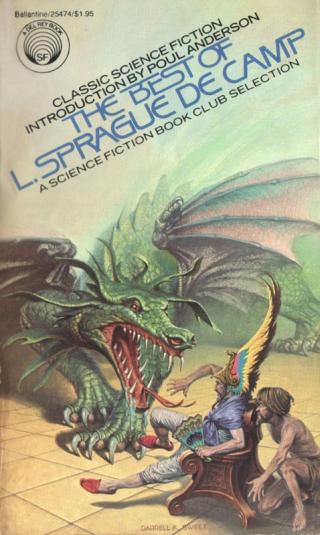
The Best of L. Sprague de Camp
- Автор: Де Камп Лайон Спрэг
- Год: 1978
- Язык: английский
- Год: Del Rey / Ballantine
- ISBN: 0-345-25474-0
- Жанр: Научная фантастика

Электронная книга - «The Best of L. Sprague de Camp». Краткое содержание книги:
*[Since this was written, the prestige of General American has risen; the affectation of British English by the theatrical profession has ceased; and the old New Yorkese dialect (pronouncing "oil burner" as "öil böina") shows signs of dying out. L.S. de C., 1977.]
Our grammar has been simplified about as much as it can be*, so that only limited changes are to be looked for therein. We still have some irregular plurals, such as child:children, mouse:mice, deer:deer; these are hangovers from Anglo-Saxon, which had several declensions of nouns forming the plural differently. Given enough time, they will probably be cleaned up: brethren, for instance, has been displaced by the regular brothers. Our irregular verbs, such as take :took, drink:drank, put:put are more numerous and will be harder to get rid of.
*For this undiluted blessing—the loss of a multitude of cases, forms, and rules—we are, probably, indebted to the fact that English was, for some centuries, the poor-man's tongue. The Normans invaded England, and made their language the tongue of all educated, refined people. For centuries, all who could write, wrote anything but English—usually Latin. The result was that English was freed of all grammarians, conservatives, and formulists. The farmers, peddlers, and country people proceeded joyfully to throw out large quantities of unnecessary verbiage that got in their way. By the time the grammarians again laid hands on the language, a lot of useful pruning had been accomplished.
Idiomatic word combinations such as make at, make away with, make bold, make good, make light of, make off, make off with, make out, make sure, make sure of, make up, make up to, make up with are the despair of foreigners learning English, as their meanings cannot be derived from a consideration of their component words separately. The makingof these combinations goes on all the time, and they are likely to cause our hero plenty of headaches.
Another change that may cause him difficulty is the dropping of understood words from sentences, as when we say "the man I saw" for "the man whom I saw," or "Going?" for "Are you going?" That's ellipsis, if you want a five-dollar word. We practice it when we write telegrams or newspaper heads. As with leveling and compression of words, we gain in speed at the expense of clarity. I recall once being puzzled by a headline reading "Little British Golf Victor." Did it mean that a horse named "Little British Golf" had won a race? No it transpired that a man named Little had won a golf tournament in England. Another read "Gold Hunt Started by Skeletons." Alas, a reading of the article dispelled my first cheerful picture of a crew of skeletons slogging off to the gold country with pick, pan, and packmule. All that had happened was that somebody had dug up some skeletons, quite inanimate, and this discovery had caused local gossip about the possible existence of a buried cache or hoard of gold. Of course, the head writer had meant: "The Starting of a Hunt for Gold Has Been Caused by the Discovery of Skeletons." He simply assumed that the reader would fill in all the missing words.
Again, the Chinese languages are a horrible example: one may say that the Chinese talk in headlines. The table showing the comparative conciseness of languages, in the early part of this article, indicates the extraordinary terseness of Cantonese; Annamese, another Indo-Chinese language, is second on the list. Pitkin's History of Human Stupidity cites the Chinese proverb "Shi ju pu ju shi ch'u"—literally "Miss enter not like miss go-out." Even a Chinese would be baffled by this unless he knew that it meant, "It is worse to imprison an innocent man than to release a culprit" As far as the actual words go, it might as well mean the opposite.
Suppose that as a result of a prolonged diet of headlines, English is reduced to a terseness like that of Cantonese. Our hero is being examined by the experts for whom the magistrate has sent. We'll neglect changes in pronunciation—I think you'll have had enough of my quasiphonetic spelling—and concentrate on changes in syntax.
Hero: Welcome to my cell, gentlemen. Your names please?
1st Expert: I Mack.
2nd Ditto: I Sutton.
Hero: Delighted; you know my name, of course. What do you want me to do?
Mack: From?
Hero: What?
Mack: No what, from.
Hero: Now, let's get this straight. You want to know where I'm from? That's easy; Philadelphia.
Sutton: No hear.
Hero: PHILADELPHIA.
Sutton: No mean no hear you; hear plenty. No hear Philadelphia.
Mack: Such place?
Sutton: Maybe. Ask more. Continent?
Hero: No, it's a city.
Sutton: No mean no. Philadelphia no continent, Philadelphia on continent. Six continent. Which?
Hero: I see—North America.
Mack: No North America Philadelphia.
Sutton: Crazy. Too bad.
Mack: Yes. Word-crazy. Too much word.
Hero: Say what is this? You two sit there like a couple of wooden Indians, and expect me to understand you from one or two words that you drop, and then you say I've got a verbal psychosis—
Mack: Proof. Escape. Fingerprint. Check, sanitarium.
Sutton: Right. Interest. Health. Too bad. (They go out.)
But actually, I doubt whether headlines will ever bring the language to this sad state. Their influence is probably confined to popularizing a few uncommon words, such as laud, flay, which are preferred to praise and denounce because of their shortness.
Changes in vocabulary are difficult to foresee, though we can classify, if we can't prophesy, them. When we have a new meaning to express, we can do any of several things: we can invent a new word out of whole cloth, like gas, hooey. We can combine Latin or Greek roots to make a word, like Ornithorhynchus, telephone. We can combine parts of existing English words, as in brunch (Hollywood slang for an eleven o'clock meal). We can borrow a word from another modern language, either in something like its original form, as with knout (Russian), khaki (Hindustani), or corrupted, as with crawfish (Old French écrevisse), dunk (German tunken). Most often, we pile the new meaning on some unfortunate existing English word, which thereafter does double, triple, etc., duty. Thus short has acquired the meanings of a short circuit, a short story, a short movie such as newsreel, a short shot in artillery fire, a type of defect in iron castings, etc. Next to pronunciation changes, vocabulary changes will be the most baffling of our hero's troubles with Twenty-Fifth Century English. Perhaps he'd better take a course in sketching before starting his time journey: when words, both spoken and written, fail, he can fall back on pictures!
Words also become obsolete and disappear. Sometimes we adopt another way of saying the same thing, because of convenience, fads, or reasons unknown. Where we once said "I height Brown," we now say "I am called Brown" or "My name is Brown." (Germans still say "Ich heisse Braun.") The old second-person singular pronoun thou has become obsolete, the plural you being used instead.
Again, words may disappear because the things they refer to disappear. Thus hacqueton is obsolete, because nobody has used a hacqueton (a padded shirt worn under armor) for some centuries. Buggy and frigate, to name a couple, will probably follow hacqueton in all vocabularies save those of historians and specialists, unless"somebody finds new meanings for them. Thus clipper has been saved by a transfer of its meaning to a modern object.