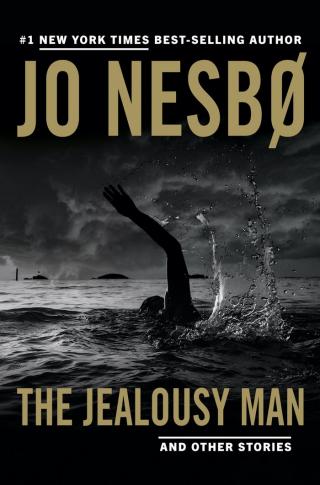
The Jealousy Man and Other Stories
- Автор: Несбё Ю
- Год: 2021
- Язык: английский
- Год: Alfred A. Knopf
- ISBN: 978-0-593-32100-3
- Переводчик: Robert Ferguson
- Жанр: Криминальные детективы

Электронная книга - «The Jealousy Man and Other Stories». Краткое содержание книги:
A detective with a nose for jealousy is on the trail of a man suspected of murdering his twin; a bereaved father must decide whether vengeance has a place in the new world order after a pandemic brings about the collapse of society; a garbage man fresh off a bender tries to piece together what happened the night before; a hired assassin matches wits against his greatest adversary in a dangerous game for survival; and an instantly electric connection between passengers on a flight to London may spell romance, or something more sinister.
With Nesbø’s characteristic gift for outstanding atmosphere and gut-wrenching revelations, The Jealousy Man confirms that he is at the peak of his abilities.
‘I understand.’
‘It will appear to be a development of the hadesitt project, and for practical reasons be relocated to Africa.’
‘Africa?’
‘We own a building in El Aaiún, in the Spanish Sahara. It’s Off-Broadway. Avoid the prying eyes of industrial spies and the media. We’ll explain that it’s closer to the source.’
‘I see. Like the Manhattan Project, a lot of brains isolated in a desert.’
‘Yes,’ he said and looked out of the window. ‘Only that was to invent a bomb capable of wiping out the human race. While this is—’ he looked directly at me — ‘the exact opposite, right?’
The Bomb
The smell of diesel and bars of white sunlight each time the wind moves the carpets. It’s been many years now since the last electric car ended up on the scrapheap and they reopened the oil wells in the Sahara. Somewhere out there a siren is wailing; I don’t know if it’s an ambulance, a police car or one of the military emergency-response vehicles.
Two bangs, in quick succession. Fire and answering fire, or a double puncture at one of the roadblocks? Hopefully it’s about the colonial overlords chasing the guerrillas, or the other way round, and not about me.
El Aaiún always has more questions than answers.
The watch on my wrist is ticking. A present from Klara on our wedding day. I know it’s slow, but it’s not slow enough.
Three months after the company’s decision I, along with twenty-two hand-picked researchers and three semi-trailers filled with laboratory equipment, was in place in El Aaiún. Officially the project was known as HADES2, internally it was referred to as Ankh. Researchers are used to working under conditions of confidentiality, and no one knows more than they need to know to do their jobs, but I was aware that they knew the price they could ask for disclosing information about the project to one of our competitors might be temptingly high. For that reason I had, through the chairman of the board Daniel Egger, a former colonel who still had connections in the military, acquired a memory-shredder which had made the trip out with us. Each member of the team had signed a contract agreeing to subject themselves to it once they had submitted their final reports. The memory-shredder had been developed during the Great War, when the military were given exclusive rights to develop and use technology above the third degree. It was used by officers who possessed information they no longer had any use for, but which could be exploited by the enemy if the officer were taken prisoner. Because even if the officer could withstand the torture or followed standing orders and took his life with the cyanide pill they all carried, our enemies in the Russo-European Confederation had developed Exor, which was even then capable of extracting the memory from a dead and physically destroyed brain. The memory-shredder versus Exor. It was like an image of the technological warfare, move and counter-move, that had brought the world to such a wretched state, and led to the banning of technology in civilian life after the war. Yes, those of us in the health service are occasionally permitted to use the memory-shredder to remove memories in the psychiatric treatment of trauma patients, but this only ever applies to a member of the elite.
Research projects are like films or building projects; they’re never finished on time, or within the budget.
But Ankh was.
That was chiefly because I, as head of the project, had at two critical junctions taken risky decisions concerning the way forward, and focused all our resources on these. If just one of them had turned out to be a blind alley it would have killed off the whole project. My assistant as head of research, Bernard Johansson, who was the only one besides me who had enough of a total overview to question my decisions, asked: ‘What’s your hurry, Ralph?’
He thought both times that we should have split into two groups at these crossroads, the way things had been done in the Manhattan Project. And he was right; we had the personnel, the money and the time for it. They had the time for it. The fact that I didn’t have wasn’t something I could share with Johansson. What I could share with him was the euphoria once we realised we had found it, the ultimate medicine.
It was — as is so often the case once you’ve got your answer — surprisingly simple. But complicated too, in that it demanded a new way of thinking. Evolution’s way is for certain species to survive through producing new, healthier, better adapted individuals, with the older variants getting scrapped and dying out. But if the cell renewal in an existing individual is so comprehensive that the ability to learn is also updated then, metaphorically speaking, there is nothing to prevent an individual from giving birth to itself over and over again. Where normally a baby has to be taught everything from scratch, this reborn individual will appear complete with experiences that give it a crucial advantage in the struggle for existence. So why didn’t such a species already exist? I think perhaps the answer is that it has taken time to develop a species intelligent enough to solve the mystery, but since all mysteries are solved sooner or later then we — meaning nature — have all along been on the right track. Intelligence is natural, the survival instinct is natural, ergo eternal life is natural.
That, at least, was what I was trying to convince myself of as I raised my head from the microscope at six o’clock one ice-cold morning in El Aaiún, looked at Bernard Johansson and whispered: ‘We’ve found it.’ And at the same time sublimated the question: ‘Exactly what have we done?’
We pulled back the curtain and looked out over the desert. As the shimmering red rim of the sun rose over the horizon Johansson said that this was the dawning of a whole new day for mankind. While I thought how that sun must have looked like the flash from the first successful detonation of an atom bomb in the New Mexico desert in 1945.
‘Nobel Prize?’ said Johansson.
Maybe. Definitely. But a whole new day for mankind wasn’t what I was looking for.
We dismantled the laboratory at top speed, left just a few things behind, including the shredder, crated up the mice and headed back home to Europe.
The Mice
‘These,’ I said into the darkness, ‘are the twenty African pygmy mice used in the test.’
I depressed the lever on the projector and a new image appeared on the screen. ‘When the experiment started they were all one year old, which corresponds to the average lifespan of the pygmy mouse. We gave ten of them injections. Two months later they were all still alive, while the ten who did not receive injections were all dead.’
There was a coughing from the darkness. Kopfer and I were the only ones in the company boardroom, the other eleven chairs for the time being unoccupied. And yet he’d seated himself some distance away from me.
‘Correct me if I’m wrong, Jason, but what this boils down to is a chemical formula. A long one, certainly, but all the same, a formula.’
‘The formula contains one hundred and fifteen symbols,’ I told him.
‘And this is not written down in some scholarly paper or on a computer, it’s only—’ in the darkness I caught a movement, as though he were tapping his index finger against his temple — ‘in your head.’
‘Everything from El Aaiún has been shredded, including the memories of those who did not have A-code clearance. Which means, everyone except me, Bernard Johansson and Melissa Worth.’
‘Melissa...?’
‘Worth. The laboratory head.’
‘OK. But I hope you realise the board is not going to stake the whole of the company’s future on the fact that you have managed to prolong the lives of a handful of mice by a few months.’