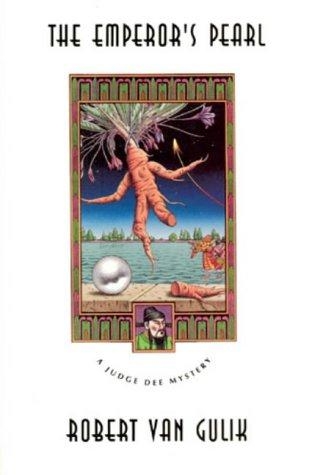
The Emperor's Pearl
- Автор: ван Гулик Роберт Ханс
- Серия: Judge Dee #9
- Язык: английский
- Жанр: Другие детективы

Электронная книга - «The Emperor's Pearl». Краткое содержание книги:
In The Emperor’s Pearl, the judge discovers that these two deaths are connected by an ancient tragedy involving a near-legendary treasure stolen from the Imperial Harem one hundred years earlier. The terrifying figure of the White Lady, a river goddess enshrined on a bloodstained altar, looms in the background of the investigation. Clues are few and elusive, but under the expert hand of Robert van Gulik, this mythic jigsaw puzzle assembles itself into a taut mystery.
“If you have not yet discovered Judge Dee and his faithful Sgt. Hoong, I envy you that initial pleasure which comes from the discovery of a great detective story. For the magistrate of Poo-yang belongs in that select group of fictional detectives headed by the renowned Sherlock Holmes.”—Robert Kirsch, Los AngelesTimes
“The title of this book and the book itself have much in common. Each is a jewel, a rare and precious find.”—AtlantaTimes
'Murdered! How could that happen? Who did it? Where was she when . . .'
Judge Dee raised his hand.
'As to your last question, you know the answer to that, Mr Kou. For it was you who sent her to that lonely place.'
'Lonely place? What lonely place? Heavens, why didn't she listen to me! I implored her to tell me at least where she was going, but she . . .'
'You had better begin at the beginning, Mr. Kou,' the judge interrupted him again. 'Here, drink a cup of tea first. This must be a terrible shock to you, of course. But if I don't get all the details here and now, I'll never catch the villain who murdered her.'
Kou swallowed a few mouthfuls, then asked in a calmer voice:
'Who did it?'
'A man as yet unknown.'
'How was she killed?'
'By a dagger thrust into her heart. She didn't suffer, she died at once.'
Kou nodded slowly. He resumed in a soft voice:
'She was a remarkable woman, sir. She had an uncanny talent for judging antiques and, especially, precious stones. She always assisted me in my antiquarian studies, she was such a charming companion . . .' He looked forlornly at the shelves of carved blackwood that stood against the side wall to the right of the door and carried a tastefully arranged display of porcelain and jade pieces. 'All that was done by her,' he went on, 'and she also made the catalogue. When I bought her four years ago she was illiterate, but after I had taught her for a year or two she had learned to write a very good hand indeed . . .'
He broke off and buried his face in his hands.
'Where did you acquire her?' Judge Dee asked gently.
'She was a slave-maid in the house of old Mr Tong I-kwan. I ...'
'Tong I-kwan?' Judge Dee exclaimed. That was the signature added to the inscription he had seen in the hall of the haunted house! And she had told him that she and the man she was going to meet there knew the property thoroughly! He resumed: 'I take it that Tong I-kwan was the father of Tong Mai, the murdered student?'
'Indeed, sir. Amber was an orphan, and old Mrs Tong had grown quite fond of her. Four years ago when Tong I-kwan was obliged to sell all his possessions, he wanted a good house for Amber, and offered her to me. Since I have no children, I bought her for four gold bars, intending to adopt her as my daughter. But she grew more beautiful every day; she had an exquisite grace, like that of a jade statue; she . . .' He rubbed his hand over his eyes. After a while he added: 'Since my First Lady is . . . has a chronic disease, two years ago I married Miss Amber, as my second wife. Of course I am somewhat older, but our common interests . . .'
'I quite understand. Now, what about that errand you sent her on?'
Kou slowly emptied his teacup before he replied:
'Well, it was like this, Your Honour. She had recommended Tong Mai to me as a useful person for hunting out antiques. She knew him well of course, because they had grown up together. Two days ago she told me that Tong Mai had come upon a very rare and extremely valuable antique, a . . . vase. That vase was one of the finest in existence, and the price was ten gold bars. She said it was really worth double that amount, or more. Since it was a famous piece, coveted by many other collectors, Tong didn't want it to become known that he was selling it to me. She said he had promised to hand it to her in a safe place, known to both of them. She would go there tonight, after the races. I tried to make her tell me where it was. A young woman all alone, carrying all that money. . . . But she insisted that it was absolutely safe. . . . Then, tonight, when I saw that Tong was dead, I knew that she would wait for him in vain. I had expected to find her back here already when I came home. When she didn't come, I became worried. But I couldn't do anything, for I didn't even know where their meeting place was. . . .'
'I can tell you that,' Judge Dee said. 'Their rendezvous was the deserted Tong mansion, in the forest near Marble Bridge Village. She did not know that Tong was dead. Another person who knew about the transaction went there in Tong's place. That person murdered her, and stole the money and the, ah . . . vase. It was a vase you said, wasn't it?'
'The deserted house! Almighty Heaven, why did she . . . Well, the place was familiar to her, of course, but . . .' He dropped his gaze.
Judge Dee gave his host a searching look. Then he asked:
'Why do people say that the house is haunted?'
Kou looked up, startled.
'Haunted? Oh, that is because of the Mandrake Grove, sir. Many centuries ago this area was a swampy, thickly-wooded region, you know, and the river was much broader than it is now. This district was the centre of the cult of the River Goddess. Fishermen and boatpeople used to come from far and near to worship her. The Mandrake Grove was a large forest at that time; in the middle stood a beautiful shrine with a colossal marble statue of the goddess. Every year a young man was sacrificed on the altar. Then, however, the Grand Canal was extended through this region, and the forest cleared. Only the grove surrounding the shrine was left untouched, in deference to the beliefs of the local people. But the government ordered the discontinuation of the human sacrifices. The next year there was a disastrous earthquake that destroyed part of the shrine, and during which the priest and his two acolytes were killed. The people said that the goddess was angry. Therefore they abandoned the shrine and built a new one, on the riverbank in Marble Bridge Village. The pathways leading through the Mandrake Grove were soon overgrown, and no one has dared to enter that grove since. Not even the gatherers of herbs venture inside, although the roots of the mandrake that gave the grove its name are supposed to have powerful medicinal properties and fetch a high price on the drug market, as Your Honour knows.'
Kou frowned, he seemed to have lost the thread of his narrative. He cleared his throat a few times, refilled the teacups, and then went on:
'Well, ten years ago, when old Mr Tong began building his villa close by the Mandrake Grove, the local people warned him that it was sheer folly to disturb the neighbourhood of the sacred grove. They refused to work for him, saying that the White One would resent the intrusion, and that there would be droughts and other disasters if Tong did not desist. But old Tong was an obstinate fellow and, as a northerner, he did not believe in the goddess. He imported labour from another district and built his villa. He moved in with his entire family and stored there his collection of antique bronzes. I went to see him a few times and found his bronzes of exceptional quality. It's very hard to find good bronzes nowadays, you know, it's a great pity that . . .' His voice stopped mid-sentence. He sadly shook his head, then pulled himself together and resumed: 'One summer evening, four years ago, after a hot and sultry day, old Tong was enjoying with his family the cool evening air, sitting in the walled-in garden, in front of the East Pavilion. Then suddenly the White One appeared among the trees of the Mandrake Grove, right opposite them. Old Tong told me about it later; it was terrible. . . . She was naked under a white, blood-stained dress, and her long, wet hair was hanging over her face. Raising her claw-like hands covered with blood she came for them, uttering a piercing howl.'
'Tong and the others sprang up and ran away as fast as they could. The violent storm that had been threatening all that day suddenly broke loose, there were flashes of lightning and terrific thunderclaps, followed by torrential rain. When Tong and the members of his household came stumbling into the village, drenched to the skin and their clothes torn by the branches, they were more dead than alive.
'Old Tong decided of course to abandon the house at once. Moreover, the next day he heard that his firm in the capital had gone bankrupt. He sold the house and the land to a wealthy drug-dealer in the capital, and left.'