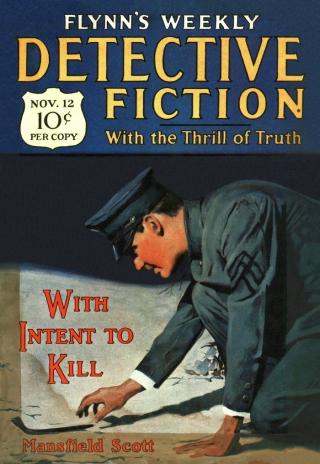
Flynn’s Weekly Detective Fiction. Vol. 28, No. 3, November 12, 1927
- Автор: Alexander R. W., Ames John
- Год: 1927
- Язык: английский
- Год: The Red Star News Company
- Жанр: Другие детективы

Электронная книга - «Flynn’s Weekly Detective Fiction. Vol. 28, No. 3, November 12, 1927». Краткое содержание книги:
Some of the old-timers have had indictments against them so many times that they can recite the form of them by heart. Indeed, I have met many jail prisoners who were as well versed in the criminal law as lawyers on the outside making many thousands of dollars a year by proving that their client wasn’t there when it all happened.
It isn’t usually necessary, however, for the court to bide its time to punish a refractory “culprit.”
The judge is usually chosen because of his fistic ability, and when occasion demands his honor is not above laying aside the dignity with which he is invested, stepping down from the bench, and smacking the defendant in the jaw, thus speeding the course of justice and rendering undue delay unnecessary. Or, if his honor appears to be getting licked, his clerk and bailiff, and possibly one or two other attaches of the court will step in to aid him.
There is, therefore, little doubt about the ultimate result, although I knew one prisoner, a strapping six-foot surveyor, who had got into trouble through passing a bad check, who licked the judge and attaches of the court individually and collectively, then drew a line in the jail corridor and threatened to lick any man who crossed it.
As a result he had a private jail during the balance of his stay. But a case like this is decidedly unusual and it takes a scrapper of extraordinary ability to maintain such a position.
Hardened old-timers will often enter into the spirit of the court, when they haven’t money, and agree, by hook or crook — usually, it is unnecessary to say, by crook — to get some luxury for the boys.
Thus, one I know promised that he would get a quart of whisky for the gang. He was placed “on probation” for three days, with the understanding that if he didn’t make good, he would be compelled to work out his sentence.
The jail windows, on one side, opened out into a small court, the windows having a thick iron mesh screen over them to prevent the passing in of any contraband. The mesh was very fine, giving a space of but a small fraction of an inch. But the prisoner made good.
He “flew a kite” — as the prisoner calls a contraband letter — out to a pal, and a day or so later the pal appeared at the window with a cornucopia made out of heavy glazed paper.
He held the wide part of the cornucopia, which was filled with a quart of whisky, outside the bars, leaving the other end, which had a very small opening, just inside the mesh. He then tilted it and the delighted prisoners inside allowed the beverage to trickle into their tin cans.
Another moneyless prisoner agreed to give the court a squab dinner. No one expected him to make good, as this was an almost impossible undertaking. The prisoner asked for a week’s probation, which an indulgent court granted, more out of curiosity than any other motive, to see what the prisoner would do.
The latter immediately got busy. Borrowing a box from the jailer, the prisoner took it apart, put it piece by piece through the bars, and reconstructed it on the outside, working by sticking his hands through the bars, and incidentally almost “beaning” a citizen below by dropping the hammer upon one occasion.
After the box was completed, he secured it to the bars with a string, then made a pigeon trap out of it by tilting the box, holding it up with a small stick and scattering bread crumbs and other food inside. It was not long until the pigeons began to arrive.
When one got inside the box he would pull the string attached to the small stick, the box would drop and the pigeon would be trapped. He kept them alive until he had got five or six, when he killed them and fried them on a shovel over a small spirit lamp.
I know of one case in which a prisoner made his experience with the kangaroo court pay dividends. The jailer told me this story just a few weeks ago. The incident happened during a murder trial which had aroused nation-wide interest.
The woman charged with the murder — incidentally she was subsequently acquitted — was confined in a small town jail. The jailer had been pestered to death by reporters wanting an interview with her, which the jailer refused to grant, as he had been threatened by the district attorney with the loss of his position if he permitted any one to see her.
One day a frowzy-looking “bum” was brought to the jail to serve ten days for vagrancy. The jailer took him down to give him the usual bath, when he noticed that, despite his filthy exterior, his underclothing was immaculately clean.
He immediately jumped to the conclusion that he was a newspaper man who had had himself committed in order to see if he could get to talk to the accused woman for a few moments. So he determined to take him “over the jumps.”
Not only did he give him the most disagreeable jobs in the institution, but he “tipped off” the kangaroo court, which immediately began work to make his ten-day stay as miserable as possible.
He was charged by the court with every offense under the sun. In fact, the eyesight of the court officers became so keen that they were able to see things which never happened. The reporter took the tormenting in good part, paying the fifteen or twenty dollars which he was assessed in various fines.
But when he got out he sold an article on his experiences for five times the amount. This is the only instance I ever heard of where a prisoner made money out of a kangaroo court, and this “prisoner” probably has set a record.
But the kangaroo court is used not only to get money for the general fund out of which to buy luxuries, but also to provide amusement for the boys and alleviate some of the boredom of jail confinement.
Usually, of course, this amusement is at the expense of some half-wit or “prison simple,” and sometimes the humor will be of a decidedly cruel nature. Often, however, it is just merely harmless fun. Prisoners, particularly the unsophisticated ones, will be tried on all kinds of ridiculous charges.
Thus, the kangaroo court in a jail which I used to visit frequently once tried a prisoner who wasn’t “all there” on the charge of stealing a chicken and a pig. Before he was brought up for trial one of the prisoners opened a pillow, took out a handful of feathers, sprinkled them over the back of the “accused,” put a considerable quantity in his pocket, stuck a few in his shoes, and so on.
Then, when he denied the theft, his honor directed that a search be made. When the accused prisoner saw the feathers taken off him, he promptly — and seriously — admitted the theft of the chicken, but denied positively that he had stolen the pig. He had just sense enough to know that they couldn’t find any hog feathers on him.
This horse play, owing to peculiar conditions existing in some of the jails of the country, often sounds like comic opera.
For instance, in some of the smaller county jails, particularly through the South where most of the prisoners are mountaineers and countrymen known to the sheriff — and from whom he gets his political support — a prisoner is often intrusted with the key to the jail during the sheriff’s absence, and I have, on dozens of occasions, on my regular visits of inspection for the government, been shown through the jail by a prisoner.
And, strange as it may sound, in many of these jails escapes are practically unknown, as these mountaineers have a curious sense of honor. They’ll violate every liquor law that was ever put on the statute books, but once they’re put on their honor not to escape, they can be absolutely depended upon.