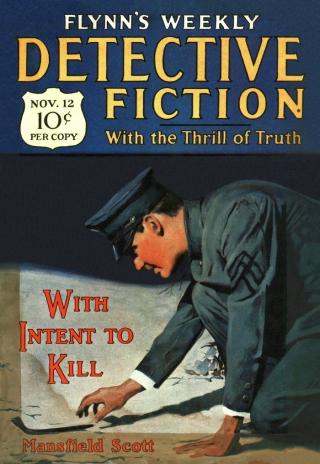
Flynn’s Weekly Detective Fiction. Vol. 28, No. 3, November 12, 1927
- Автор: Alexander R. W., Ames John
- Год: 1927
- Язык: английский
- Год: The Red Star News Company
- Жанр: Другие детективы

Электронная книга - «Flynn’s Weekly Detective Fiction. Vol. 28, No. 3, November 12, 1927». Краткое содержание книги:
If, during the four years I had known him, he had broken the law — and most certainly I had known him to break it — it was never for his own gain, but always to right a wrong. Ruggles’s sins were always benevolent.
How successful he had been, until now! Until now, it had seemed to me that he must always succeed — as if nothing could check his successful advance against these predatory animals he opposed. But I knew, in my heart, that I should have anticipated the present moment when his buried past had risen up to thwart him and defy him.
What could I do to help him? Closing my eyes and letting my head rest on my hand, I tried, for what seemed weary hours, to work some way out of it for Ruggles, some escape for him from Markley and those four other members of the band.
The realization of what it seemed to me must be Ruggles’s unescapable fate: his arrest, disgrace, and conviction, had wearied me — made me want to sleep until the end of the world.
It was absolutely still in the room. Markley’s snores still penetrated the door of the bedroom, but Ruggles, I was thankful to see, was sleeping as peacefully as a child.
Sleep called to me. I wanted nothing in the world so much as sleep. Rising, I went to the wall switch, turned it, and felt grateful for the soothing darkness which instantly settled on the room. Feeling my way back to my chair, I settled myself in it again, closed my eyes, and, as before, rested my head on my hand.
I must have slept — it might have been for moments only, or it might have been for hours; then a strong hand roused me.
“Yes,” I said. “All right. Only don’t turn your flash light right in my eyes, Ruggles.”
I sat up, only to be thrown down and pinned to the back of my chair. The gun I had snatched for and found was tom from my fingers. The wall switch was turned, and the flooding electric glare showed me a sight which bewildered me:
Ruggles was not on the couch and he was not in the room; instead, were Markley and four other men, one of whom relaxed his inexorable grip on me as another covered me with his gun.
“Garrison did a good piece of work on ’im, I’ll say that, anyway, fer ’im,” one of them said, after examining my face with patient and searching scrutiny. “Garrison was always good at this. You know yourself, Cottrell.”
“Sure, I know,” the man addressed as Cottrell said. “If it wasn’t fer those clothes o’ yours, Markley, I’d feel like asking this bird here to pay me that bunch of bucks you owe me.”
There was a grim laugh; then they began to talk among themselves of some job they were scheming out. No one spoke to me; they regarded me, from time to time, just as their eyes happened to fall on me; but it was clear that, for the time, they regarded me merely as a piece of furniture.
This gave me an opportunity of studying them in detail; and little by little, from their talk, I became able to place them: the lanky, black-haired man of perhaps forty was Cottrell; Mueller was light-haired and blue-eyed, younger, and stouter, a very powerful man, I set him down.
Hilliard, stooping and small of build, and quick as a cat in his nervous movements, was blue-eyed, too, a much older man, probably in his late fifties — an English crook, I judged, from his general cut and accent.
Branley I was sure was a Frenchman, for all his Saxon name: he was fat and bearded, without a trace of color in his sallow cheeks, and with deep-set furtive eyes which told of a treacherous, brooding nature.
Fortune, or fate, rather, had placed me where I could identify now all the five members of the band with which, in what capacity only Ruggles and they knew, my friend and companion of so many thrilling and dangerous hours, had been associated.
This was the dubious crew on whom Stannistreet had urged Ruggles to “get the dope”; and, even at this dangerous moment, when I was powerless in their hands, I thought of the singularity of this fate.
Stannistreet had asked Ruggles to get the dope; but it was I, the less famous and clever of the two of us, who, by my own ill luck, had been enabled to secure it.
Their talk ran on. I could not get the thread of their plan, but it was evidently clear enough to them. Markley left the engineering of it to Mueller, who seemed to be the brains of the five.
Then Markley helped himself to another cigar from my humidor and said to his pals: “You all might as well fill your pockets with these. No one will smoke them if we don’t.” And as they acted on his suggestion, he looked about the room reflectively, and went on: “It’s no wonder Ruggles took a shine to this place. He’ll think of it, now he’s left it.”
“I wonder where he’ll show up next,” Hilliard said.
“He’ll keep under cover awhile,” Mueller said slowly, “then come out with a moniker and in a business as far away as he can get from the one we ran him out of.”
“But we’ll run into him, some time or other,” Branley said, “and, when we do, we’ll know what to do with him.”
“You said it,” Markley agreed with savage emphasis. “We’ll find him, one of these days, and then make sure of it. He can’t give us away to the bulls without giving himself away, but we’ll all feel safer, once he’s knocked off.”
That seemed to them all to sum the situation up as far as Ruggles was concerned. And the first part of it fitted in with the conclusion which suddenly had come to me: Ruggles had decided on flight as the only way out of his predicament.
And I agreed with him: here were five men, all of whom could, and would, in an extremity, bring Ruggles’s freedom to an end by telling his story to the police. Not all of Ruggles’s long and extraordinary service in suppressing crime would help him then. It would be merely a matter of innocent or guilty, and the law would decide what my friend’s fate would be.
Yes, flight had been the only course for him. For, if he stayed, he would have to aid Markley, the murderer, in escaping; and that in itself would have made Ruggles guilty of a felony.
“Yes, your friend, Mr. Ruggles, has gone,” Markley said, reading my thoughts with his heavy-lidded eyes. “I woke up in there,” jerking his head toward our extra bedroom, “after one of the best little naps I ever had; and when I came in here with these pals o’ mine waiting at the front door as they’d agreed to be, your light was turned off and you were asleep in that chair you’re in now; and your friend, Ruggles, had gone.”
“Out the back window,” Hilliard said; “we’d have nailed ’im if he’d come out the front!”
“Front or back,” Markley went on evenly, “he’s gone; and he’s left you in a fix he didn’t figure on. It’s time you knew what your job is, Crane,” he went on with that savage humor which, already, I had come to associate with him.
“You’re going to knock off Stannistreet to-night — Mr. Stannistreet, the detective, who’s known as Henry Fowler, at the apartment he rents at 144 Perry Street.
“You’re going to knock off Stannistreet before the world’s an hour older, Crane; and these pals o’ mine, who the bulls don’t know, are going to come in and catch you red-handed, and give you up to the bulls, then make their getaway to where I’ll be waiting — and the five of us will just naturally pull our freight out of this nice little town you got here.”
That was it, then — a plan so hideous that it made my blood run cold — a plan, too, which from its very boldness and shrewdness bid fair to succeed.
They had more brains than I had given them credit for, these devils who now leered so triumphantly at me; they had seen their chance to use the trump card which Ruggles unsuspectingly had placed in their hands: his having made me up so exactly to resemble Markley.
The facts came over me with a numbing force; made-up as I now was, Stannistreet and his men would simply laugh at me if I went to them and told them that I was not Markley.