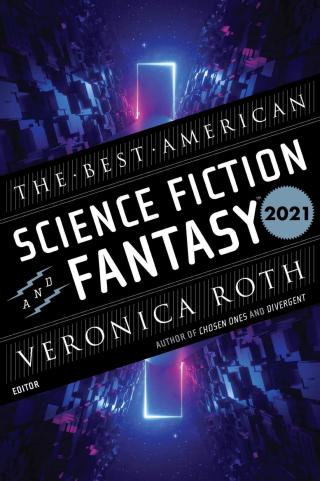
The Best American Science Fiction and Fantasy 2021
- Автор: Рот Вероника, Адамс Джон Джозеф
- Год: 2021
- Язык: английский
- Год: HMH Books : Mariner
- ISBN: 9780358470076
- Жанр: Малые литературные формы прозы

Электронная книга - «The Best American Science Fiction and Fantasy 2021». Краткое содержание книги:
This year’s selection of science fiction and fantasy stories, chosen by series editor John Joseph Adams and bestselling author of the Divergent series Veronica Roth, showcases a crop of authors that are willing to experiment and tantalize readers with new takes on classic themes and by exchanging the ordinary for the avant-garde. Folktales and lore come alive, the dead rise, the depths of space are traversed, and magic threads itself through singular moments of love and loss, illuminating the circulatory nature of life, death, the in-between, and the hereafter.
The Best American Science Fiction and Fantasy 2021 captures the all-too-real cataclysm of human nature, claiming its place in the series with compelling prose, lyrical composition, and curiosity’s never-ending pursuit of discovering the unknown.
The cursed path wasn’t long, but the going was slow and treacherous. There were many dangers even among the leafless trees, thin and stark as skeletons.
You think you’ll make it, solitary woman? the trees whispered.
The widow bristled, but ignored them, knowing the stories. The trees just wanted to keep her for themselves. She kept going.
We’re sorry. We’re lonely. We need a friend. Please. Stay, stay, stay, they whispered to her back as she walked. They sounded sincere.
But she knew how to tune out demanding voices. She once was a mother to a large family.
So she passed through that whispering forest, never even considering their offer. Because what would be the point of her journey, her memories, her grief, her fight to survive, if she stopped now?
This was my mom’s favorite story. She had me later in life. I was my parents’ only kid and she rarely talked about her past, no matter how much I questioned and begged. She told stories instead.
Sometimes, I thought if someone were to cut me open, it wouldn’t be entrails that spilled out, but stories. Hundreds of family tales and movies. I loved old movies. Especially ones with happy endings.
It’s thirty km to the ocean on the mountain, said the note Nat left on the bathroom mirror. She preferred to communicate via notes, which thrilled me. There’s something slow and deliberate and loving in having a conversation on snatches of paper. It was easier trying to communicate via anecdotes.
Thirty kilometers, I thought. I can do that in a day. It was a two-hundred-kilometer ride from my decimated hometown to Nat’s house using a ruined state highway that was mostly potholes and splintered tarmac. It took me four days to get there. So, I thought, How bad could thirty klicks be?
Very bad, I realized an hour into my journey. The trail’s incline rose steadily and the trees began to thin out, but the rain stayed consistent, insistent, making the path a slurry of mud. The path eroded the farther I went.
I kept going because I didn’t want to go back and disappoint my mom’s ghost. Or Nat. Nat, who let me stay at her house for weeks, even though we’d only hung out at the farm/exchange market in my town’s overgrown community park. Where I’d barter things I’d salvaged from the abandoned mall like shirts, shoes, once, a bottle of strawberry vodka I found stashed behind a register, in exchange for some of her peaches or raspberry jam. Nat, who handed me a note that said Come by my house, if you go to the ocean. Which was how I knew, she was full of stories too.
Eventually, it was easier to dismount and walk aside my bike. The path was all mud and treacherous footing and stank of rot. But at least the trees didn’t whisper. They were all cut down. I was in a forest of stumps that seemed more like a graveyard or a silhouette of something beautiful and lost.
I kept going. A fog was rising and every creak of my bicycle or crunch of my boot sounded unnaturally loud.
Maybe that’s why I heard the voices.
It took a moment to realize it wasn’t the stumps of trees talking. That’s how entrenched the widow’s story is in me. No, it wasn’t the trees. There was someone there in the thickening mist. Or rather, judging from the pitch of voices, several someones. The low, steady hum behind the voices told me these someones had drones overhead.
I held perfectly still. Waiting, calculating. They were hunting something. I knew this because everyone these days was hunting or scavenging or scrounging something in this graveyard of civilization. I hoped it was just deer, but I heard stories of worse. There’s always a worse story.
I shifted my weight slightly and my bike creaked. The voices in the mist halted. I couldn’t see them, but I could imagine, and I imagined the people they belonged to peering through the fog toward me. Waiting, calculating.
“Hello?” one said.
“Hi,” I answered in a voice just above a whisper.
A shot rang out.
I dove to the ground. My bike fell on me, jars rattling. Suddenly, all the worst stories were ringing in my ears. People are crazy territorial these days. Woods are a breeding ground for cults. Some people will eat anything they find. I didn’t know where the shot came from or how close it’d been to me. But I didn’t care. It was too close. Too close. I was alive, unharmed, but too close, and the voices and drones were getting closer. Louder.
I didn’t think. My hands were shaking, full of reeking mud. But I didn’t think. I unbuckled my helmet and hurled it as hard as I could downhill, away from the direction I was headed. It was a prayer. And a plea. It was all I had. The helmet bounced and crashed against the stumps once, twice, three times. Then it went silent.
For a moment, the voices and the drones went silent too.
Somewhere in the mist, a voice swore and boots crunched as they turned. (Too close.) The drones whined as they changed directions. The hunters began to move away.
I lay there in the mud, for a minute, maybe two, barely breathing. Listening and hoping and pleading that I’d get to tell this story one day, however it ends. The hunters’ voices were getting softer. So, as quickly and silently as I could, I got on my bike again and began to pedal. I had to keep going. I’ve never pedaled uphill so hard. My bike groaned and my heartbeat pounded in my ears. My tire rolled over something squishy, and the stink of rot overwhelmed me. But I didn’t stop to look. I didn’t stop. I could hear the voices swearing again in the distance. The fog was thick, but not thick enough. Not enough.
I had to keep going. So, I bent forward and rode.
I rode so hard, so blindly, I didn’t realize when I’d left the stumps behind.
And crashed into something worse.
One time, someone who’d lost something he loved found himself on the cursed path, despite promising himself he would never go to the ocean on top of the mountain. From stories, he knew there were many dangers on this road, but the one that worried him most was the stork. He needed to befriend it so it could guide him through the last and most dangerous part of the path. Making friends was never the lost lover’s strong point.
But the stork wasn’t what he expected. The great bird was mud-drenched and depressed, with wings so matted, it could no longer fly. Its legs were caked in dirt, thick enough to glue it to the rocky ledge it perched on.
“Splendid. Another grief-stricken person who wants my help,” said the stork. “Turn back. Believe me, you won’t find what you’re looking for.”
“How do you know that?” the lover said.
“Everyone who comes this way has lost someone. They don’t want to die the same way and want me to help them,” said the stork, miserably. “Am I wrong?”
The lost lover didn’t answer.
The stork sighed. “You can’t stay here. Go home or keep walking. Else, you’ll get stuck like me.”
The lover looked down. He was, in fact, sinking into the mud. He wrenched his feet free. “I think I can help you,” he said.
“How? My wings are too muddy to fly. Others have tried.”
“Not your wings.”
From his pack, the lost lover pulled out a small spade. He began digging methodically around where the bird was trapped, and then used his fingers to gently pry the caked earth from its legs.
“You’re very patient,” the stork observed.
“I’m a farmer,” he said. “I’m used to pulling things out of the mud.”
The stork laughed at this, and the lover smiled.
When it was finally free, the stork danced in place, shook out its great, dirty wings, and sighed. “I can’t fly, but I will show you the way,” it said.