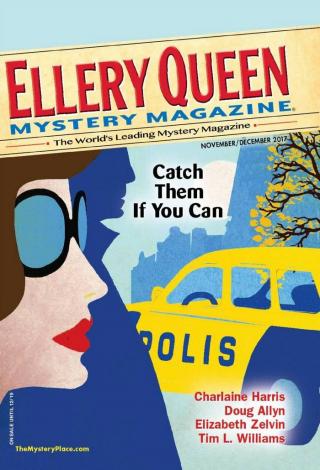
Ellery Queen’s Mystery Magazine. Vol. 150, Nos. 5 & 6. Whole Nos. 914 & 915, November/December 2017
- Автор: Фузилли Джим, Харрис Шарлин
- Год: 2017
- Язык: английский
- Год: Dell Magazines
- ISBN: 0013-6328
- Жанр: Другие детективы

Электронная книга - «Ellery Queen’s Mystery Magazine. Vol. 150, Nos. 5 & 6. Whole Nos. 914 & 915, November/December 2017». Краткое содержание книги:
“This is rigged!” I scream. “Those are the winning numbers and so what if I bought the ticket last week? I should get something!”
Suddenly, a beefy security guard is at my side. “Ma’am, you’ll have to leave.”
“Excuse me,” says Sue, stepping out from behind the window. “See that gentleman and woman at the last window?” She points at Max and Jo. “I would love to know how come you both have the winning numbers, but only their ticket has the correct date. Coincidence?”
“No coincidence,” Jo calls from the other side of the room. “She stole it off his fridge. All she saw was dollar signs. She didn’t bother looking at the date.”
Everyone in the room looks at me, people murmur, whisper. I’m shaking with rage. Now Max comes toward me, pushing his stupid walker along. “If you had paid attention to anything in the years you’ve known me, you’d realize that last week’s ticket is always the one on the fridge. I don’t toss it until the current drawing is over. Just one more gambler’s superstition.”
With that, he turns away from me. Sue hands me my license, the outdated ticket, my form, then looks at the guard. “Escort her out, please.”
Around me, the crowd breaks into applause.
The guard touches my arm and urges me toward the door. “You bastard!” I yell, and lunge toward Max and slam into him from behind.
His walker slides away from him and he pitches forward, crashes into a woman in line, and bedlam erupts. The security guard rushes up behind me, throws me to the floor, pins me there with his knee. He handcuffs me, yanks me to my feet, and shoves me into a chair.
“The police are on the way!” Sue shouts. “Please calm down, folks. We’ll get to your claims as quickly as possible.”
A siren wails somewhere nearby.
7
We pressed assault charges against Anne and the Tallahassee cops took her away. That was two weeks ago. I don’t know how long they’ll keep her, but the check has been deposited in my account. Dad closed out his accounts, and we’ve listed the house for sale.
It’s unlikely that Anne will find us. Tomorrow we fly to Tuscany to look for Dad’s special place.
© 2017 by T.J. MacGregor
The Bad Guys
by Richard Chizmar
Richard Chizmar is the coauthor (with Stephen King) of the bestselling novella “Gwendy’s Button Box” and the founder/publisher of Cemetery Dance magazine and the Cemetery Dance Publications imprint. His award-winning fiction has appeared in dozens of magazines and has been collected in book form. His latest collection is A Long December (Subterranean Press).
“I’m scared,” the dying cop said.
“You’re gonna be okay. Help’ll be here soon.”
“I’m dying.”
I shook my head. “No, you’re not. You’re gonna be okay.”
My partner of fifteen years coughed and blood bubbled from between his lips. I lifted his head higher, my fingers slick with our sweat. My other hand remained pressed against the bullet wound in his chest, a warm scarlet glove.
“You get him, Ken? You get the bad guy?”
I nodded, glancing at the crumpled figure lying on the other side of the dark parking lot. “I got him.”
He coughed again. A mist of blood sprayed my face.
I didn’t know what else to do. Head up so he doesn’t choke. Pressure on the wound to control the bleeding. I keyed the radio unit hanging on my vest. “Dispatch, where the hell’s my ambulance?”
“Accident on twenty-two. ETA six minutes.”
I didn’t know if he had six minutes.
As if he were reading my mind, he closed his eyes and his head went heavy in my hand. “Hang on, buddy. Ambulance on the way.”
I looked up at the deserted road leading into the warehouse parking lot. I knew my 10–00 would be answered by every officer in the area, but we were way out in the middle of nowhere. In another ten minutes, this place would be a circus. I just prayed it wouldn’t be too late.
“I took... it.”
His voice caught me by surprise, and I wasn’t sure I’d heard him right. I looked down and his eyes were open — wide open and fierce. “What? What’d you—”
“I... took the money.”
My entire body went numb. My stomach clenched.
“The money and...” He started to cough again, and then he was moaning in pain. An awful sound.
“Don’t talk, buddy. It’s okay. Don’t—”
“Have... to.”
I didn’t want to hear it. Not another damn word.
“The money... the guns,” he whispered, his eyes closing again. “I took. Parker’s... innocent.”
Rookie Donald Parker. Home on administrative leave these past three weeks pending investigation.
Sirens now in the distance.
He heard them too. He opened his eyes, and my heart broke. My partner. My best friend.
I couldn’t help it. I thought of his wife asleep at home. Jillian. Now that the kids were old enough, she’d just gone back to work at the elementary school. She was excited to teach again. Aaron, his ten-year-old son. His old man had been showing him how to throw a curveball. Kayla, his eight-year-old daughter. He’d just built her a two-story playhouse in the backyard. He’d painted it pink, and she called it her castle. I never once wondered where the money had come from.
The sirens were louder now. Closer.
“It doesn’t matter,” I said, knowing even then it was a lie. “Don’t say a word to anyone.”
He surprised me by lifting his head. His lips moved, but I couldn’t hear what he was saying. I bent closer.
He reached up with a blood-streaked hand and grabbed my arm. “I... I’m sorry.”
He held my gaze, tears spilling from his eyes and running down his cheeks. I started crying then too. Silently, the way men like us are supposed to cry.
I heard the wail of sirens and the screech of tires on gravel behind me. I looked over my shoulder and saw a trio of patrol cars. More on the way in the distance. Still no ambulance.
I looked back at my partner and knew it would be too late. His eyes were open and sightless. His body limp. I watched as his lifeless hand slipped from my arm to the gravel below.
I heard the slam of car doors and rising voices.
I took his hand in mine and squeezed it. I thought of his wife and kids at home and the knock on their door that was coming later that night.
I thought of the funeral service. The dress blues and white gloves. The news helicopters and procession to the cemetery.
And then I thought of the body camera I was wearing — and how I would have to find a way to disable it. Damaged in the exchange of gunfire. When I dove behind the car.
I glanced at the bad guy lying dead across the parking lot. It would be ruled a good shooting. I would be okay.
I would be okay.
© 2017 by Richard Chizmar
Bad Bargain Lane
by Peter Turnbull
Author of more than forty novels, most of them mysteries or police procedurals, Peter Turnbull is also a prolific short-story writer and a winner of the Edgar Allan Poe Award for best short story, or “The Man Who Took His Hat Off to the Driver of the Train” (EQMM 3–4/11). He joins us this month with another case in his popular Hennessey and Yellich series.
The house had gone comfortably beyond being a little of a local eyesore to be tolerated and had achieved the status of being a well-known landmark. “Turn left at the house with the overgrown garden” might, for example, be the advice given to a stranger seeking directions. The house itself, brick-built and solid, was not particularly old, being built in the nineteen thirties as part of the suburban development of York between the two world wars. It was a detached property and occupied a position on the corner of the main road where a narrower road led into a housing development which dated from the nineteen sixties. The houses amid which it stood were proudly upkept by their owners, all amidst lovingly tended gardens. In complete contrast, the house on the corner was badly neglected, with many tiles missing from the roof, with paint sufficiently faded and peeling that it revealed natural wood beneath, and an elderly Jaguar, once a prestigious motorcar, had been allowed to decay in the driveway beside the house, helped on its way by local youths who had smashed the windscreen in an act of wanton vandalism, running away into the night thinking the act was a huge joke. The house had been the home of two elderly men, a father and son, both of whom had retreated from life but had been sustained by a reasonable income from an unknown source, a pension or an estate, which paid money into an account on a month-by-month basis. No one knew the details, and their only caller was the postman, who fought his way up their drive through the overgrown shrubbery to deliver their mail, which never consisted of anything but unsolicited junk mail and fuel bills. Then, one autumn, both men had died, one after the other. It was rumoured that the son had gone first and the father had simply lost the will to live, but when the police forced entry following calls from concerned neighbours, who had reported the house lights not being switched on for three consecutive nights, both men had been found deceased, with no suspicious circumstances, both sitting in armchairs opposite each other in a cluttered living room. The house had then been cleared upon council orders (no will having been found), any valuable items auctioned, and any money raised put into a trust fund together with the money obtained when the house was sold on the open market, to be kept until such time as a next-of-kin was found, or approached the local authority. The house drew interest from potential buyers attracted by the low price and also from those who had building skills and time to restore the house and bring out the best in it. It was run-down, neglected, but free of damp and rot and was structurally sound.