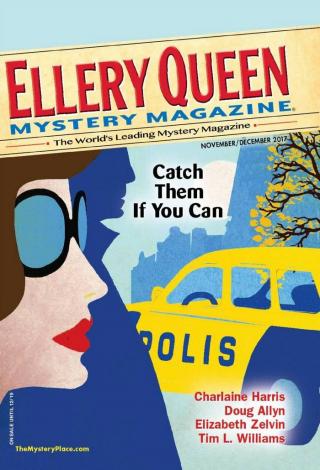
Ellery Queen’s Mystery Magazine. Vol. 150, Nos. 5 & 6. Whole Nos. 914 & 915, November/December 2017
- Автор: Фузилли Джим, Харрис Шарлин
- Год: 2017
- Язык: английский
- Год: Dell Magazines
- ISBN: 0013-6328
- Жанр: Другие детективы

Электронная книга - «Ellery Queen’s Mystery Magazine. Vol. 150, Nos. 5 & 6. Whole Nos. 914 & 915, November/December 2017». Краткое содержание книги:
When I open my eyes, he’s grinning. He flips the gun to show me the clip is missing, and I clutch the door handle to stop myself from either fainting or beating him silly.
“You should have seen the look on your face, man. Priceless, brother. It was priceless.” He giggles and shakes his head. “I’m sorry, man. I just couldn’t resist.”
I wipe my mouth on the back of my wrist, take a second for my heartbeat to settle. “You’re an ass,” I say. “One of the biggest jerks I’ve ever met. You’re a frigging idiot, Wendell.”
“I know it,” he says, struggling to keep from laughing. “But I can’t help it. I was born that way.” He punches my shoulder. “I was just playing, man. You’re not really mad, are you?”
I reach over, turn off the engine, and yank the keys from the ignition. “You frigging jerk,” I say.
“What are you doing? Give me my keys.”
“No way,” I tell him. “If you’re drunk and high enough for this crap, you’re not driving me anywhere.”
“Oh, come on. You used to have a sense of humor.”
“I’m not mad,” I say, figuring one more lie won’t hurt anything. “But this way you can drink yourself stupid before I drop you at the courthouse door, and I don’t have to worry about you running us into a tree or off an embankment.”
He puffs his cheeks with air like a kid considering a troubling math problem and then nods. “Yeah,” he says. “Okay.”
“And give me the damn gun.”
“It’s not loaded. I lost the clip like six months ago.”
I speak to him like a patient father explaining cause and effect to a thick-headed kid. “Let’s say you forget about it and walk into the courthouse with a gun in your pocket. Do you think any of those deputies are going to ask you about whether or not it’s loaded before one of them puts a bullet in you? I swear to God, Wendell. You never use your head.”
“Yeah, I guess you’re right,” he says. “Thanks for looking out.”
When he hands me the pistol, I lock it in his glove compartment and then tell him we need to change places. His eyes grow wide and panicked. For a moment, it looks as if he means to jump out and make a run for it.
“It’s not time yet, is it?” he says. “I’ve still got awhile.”
“We’re not going anywhere,” I say. “But I don’t want to have to drag your butt from underneath the wheel if you pass out.”
He runs his hand over the stubble on his jaw and chin. “Last time I was in there, they locked up this eighteen-or nineteen-year-old kid in the cell next to mine. He bawled all night, man. I mean wept. Guys were shouting for him to shut up. The jailer came in and warned him to quieten down, but he kept at it. Then, real deep in the night, he just stopped crying and didn’t make another sound.”
“Christ,” I said. “He killed himself.”
“Nah. He didn’t kill himself. He just wore out and went to sleep, I guess.”
“Okay.”
“Hold on. The next morning, we were in the rec room after breakfast, playing cards and watching television, the way you do in jail. Anyway, I guess they didn’t do much of a search on him the night before — maybe because he was just a kid locked up for public intoxication or maybe because, hell, those numb nuts at the jail are just lazy. Whatever the reason, he managed to smuggle in a pocketknife, and he pulled it out in the rec room. Walked right up to Rex Payton, who was in the cell next to mine, and cut his throat. Just like that, man. One second Rex is watching Password and the next he’s bleeding out on the floor.”
“Why?” I ask, trying not to remember some of the guys I saw buy it in Vietnam.
He shrugs. “I don’t know. He never said a word, just dropped the pocket-knife, sat down beside Rex, and went back to weeping. That’s when I swore I was never going back to jail. But hey, so much for good intentions.” He drains the rest of his beer and belches. “What the hell. You want to change sides, let’s do it. I need to take a whizz anyway.”
He reaches into the floorboard for a fresh beer, then opens his door. A gust of cold air hits me, and I want to change my mind and stay right where I am. But I know I can’t put this off any longer, so I pull the .38 from my pocket and step outside. He’s standing in front of the Jeep, shoulders hunched against the wind, when I point the gun at his stomach.
“Christ, Jerry. You’re even stealing my jokes now.”
“Sorry, Wendell,” I say. “I’m not playing.”
“Hey, man, what the hell are you doing?” he asks.
But he figures it out on his own just before I pull the trigger.
By the time I make it home, my face and my lips are numb, and the cold has worked its way through my parka and lodged deep in the marrow of my bones. Walking a direct path down the haul roads to the state highway would have been bad enough on a day like this, but I couldn’t even allow myself that luxury. Instead I looped through the mines, hiking fields, and woods, descending into deep, briar-choked ravines and climbing slag heaps and sandstone hills until I came out at Bern Eason’s abandoned farm a quarter of a mile from our house. Now, I’m half frozen and covered in cuts and scratches and so tired I can barely stumble forward.
I stop at the rusted oil drum at the edge of our yard and look down at the smoldering embers. I pick up a broken branch, rake the ashes, hoping that I’m wrong, but I’m not. All that’s left of the giraffe is its shiny, button eyes.
When I open the kitchen door, the heat is a fist that staggers me. I unzip my parka, shrug it from my shoulders, and hang it on the back of a kitchen chair. Later, I’ll need to burn my coat and gloves for caution’s sake, but I figure that can wait at least a little while. I tug my flannel shirt from my jeans and pull the oversized manila envelope from where I wedged it between my stomach and belt, pitch it on the table. Then I grab a stray can of Old Milwaukee from the fridge, sit down in a kitchen chair, and hold the envelope in my hand. Six thousand dollars minus a few hundred he threw away on drugs and women and beer.
The money makes it better, makes it easier to not think about what I had to do to Wendell between the first shot in his stomach and the final one to his head. Instead I focus on what came afterwards — the moment I rolled his corpse into the pit’s cold, black water, the drive to his place to retrieve the manila envelope from the toolbox he’d wedged in the crawlspace beneath his house, the drive back to the River Queen mines where I ran his Jeep off an embankment a mile or so from where I’d killed him. I go through it once and then replay it again, looking for any detail I might have missed, any trap I might have left for myself.
I know I’m being foolish. Tonight’s snowfall will cover whatever mistake I might have made. Besides, this isn’t New York or Chicago or San Francisco. In this part of Kentucky, no one asks many questions when a parttime criminal and a full-time loser like Wendell turns up dead.
I leave my empty beer can on the table and head for the bedroom, so tired and sore I can barely manage more than an old man’s shuffle. It’s nearly noon, but the shades are drawn and Dianne’s huddled beneath the covers.
“You’re freezing,” she says when I touch my foot to her warm leg.
“You burned the giraffe?”
“I didn’t want it here,” she says. “I figured every time I looked at it I’d remember. Who needs that?”
I kiss her shoulder blade. “He just really wanted Joni to have it.”
“He always wanted,” she says. “That was his problem.”
“Yeah,” I say. “But a stuffed giraffe for six thousand dollars seems like a pretty good deal.”
She takes a deep breath and lets it out in an exasperated sigh. “It wasn’t just the money. You know that, Jerry. We could have stolen it from him if it was the money I was most worried about. This was for Joni. No matter how good his intentions or how much he believed he loved her he would have hurt her. No one deserves to have a father like that. Trust me on that.”