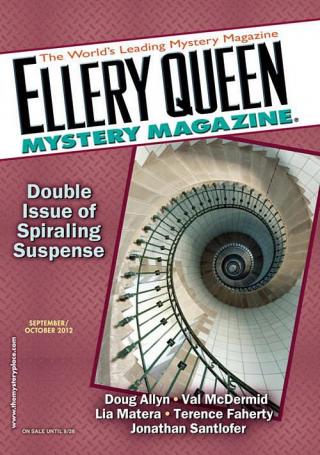
Ellery Queen’s Mystery Magazine. Vol. 140, Nos. 3 & 4. Whole Nos. 853 & 854, September/October 2012
- Автор: Макдермид Вэл, Манфредо Лу
- Год: 2012
- Язык: английский
- Год: Dell Magazines
- ISBN: 0013-6328
- Жанр: Другие детективы

Электронная книга - «Ellery Queen’s Mystery Magazine. Vol. 140, Nos. 3 & 4. Whole Nos. 853 & 854, September/October 2012». Краткое содержание книги:
She felt hot tears spill down her cold cheeks. It was misty out here, though, and she kept her face still. Maybe he wouldn’t notice.
“I don’t judge you.”
“Your Quaker tenets, I suppose?” She saw him wince, as if the words hurt him.
“To be clear: You left the Kingstons’ that morning... to avoid a similar bargain? What he might ask in exchange for a letter and a ticket home?”
He became a blur to her in the lamplight and mist. She couldn’t pretend she wasn’t crying now.
“Can’t you let me walk away?” she said. “You weren’t sent to Seattle to find me. You’re here for the strike. You don’t have to say you saw me.”
Would this sound to him like an admission that she took the jewels? Nothing she’d said before described a crime. But this, begging for mercy, told a different story.
She tried to steady herself. To remember what was at stake. Mario was watching this display. That wound things more tightly. If she could persuade the marshal, if he let her go, it would save his own scalp. And if Mario suspected betrayal? She might have to find a way to save her own.
“Many times I’ve thought back on our conversation in Chicago,” Killy said.
He gripped her hands more tightly. She sensed something delicate and complicated was going on. If she could only understand it, maybe this would end here, after all.
“I’d have liked to buy you dinner then,” he continued. “And I’m of two minds what to do now, in all honesty. Given that I’ve wished more than once...”
She stared up at him, stunned. “You’re not...? Are you inviting me—?”
“I believe I am.”
She could feel the warmth from his face, he’d bent so close.
It was absurd and horrible. If she accepted the invitation, walked with him away from the crowd, Mario would be right behind.
She looked over her shoulder, wishing she could spot him. If only she could shake her head — do something — to keep him back.
But there was no sign of him in the ebb and flow around the trolley. Except for people bustling to or from it, there was only one man, leaning against a building. He was smoking, his face was turned so he appeared to be looking across the street. But he wasn’t, she could see him watching her in the glow of his cigarette.
Another lawman. She could spot them a mile away. And so could Killy, no doubt.
The second lion. If she said no to the marshal, he had only to beckon.
She caught the scent of Killy’s bay rum, felt the warmth of his fingers laced with hers. She tried to summon a smile. She couldn’t at first.
Then she said, “I know a place we could go. A cafe on Elliott Bay, near Pike Place Market.”
The streets were dark and narrow there.
3.
Marshals were a common sight on trains now. At each transfer, Ella saw a pair board and walk through the cars. Sometimes they ordered porters to load mail or even luggage onto government trucks. Occasionally, they asked passengers for identification. (Ella had false papers, but wasn’t asked to show them.) Passengers sighed patiently, knowing it was no use objecting to delays. There was no mystery about the cause. In the eight months since Ella’s last trip, there had been wave after wave of bombings, including one in her old neighborhood. A. Mitchell Palmer was Wilson’s Attorney General now, and he’d been targeted twice. In April, a package bomb was intercepted before reaching him. In June — just seven weeks ago — a hand-carried parcel of dynamite blew the façade from his fine rowhouse. Newspapers blamed Anarchists, of course. Ella didn’t know if she believed it. She didn’t trust a word she read, especially after Seattle.
When Mario picked her up at the last stop in Virginia, not ten miles from Union Station, Seattle was the first thing they discussed. He was in a 1914 Oakland, a roomy if battered car. Even before he bragged about it — only five years old, a bargain for someone like him who could fix anything — he said, “Be’, Antonella, che bellezza, Seattle. Everybody still happy, eh, from the strike? È vero?”
“Happy during the strike — you saw that.” He’d seen more than Ella, in fact — she’d been too afraid of running into Marshal Killy again. But no one, not even a shut-in, could have missed the crowds singing, strangers hugging, people calling each other brother and sister. “Not after. You saw the papers?”
“Giornali — lying all a time. Wilson, he shuts down the giornali who don’t lie.”
“We laughed about it at first.” Headlines crowed that workers broke like spoiled children under Mayor Hanson’s rod. They went slinking back to their jobs after just a few days, defying union bosses who’d steal food from their tables. “Why would people believe propaganda instead of their own eyes?”
But the papers kept insisting it was so, and Ole Hanson lectured all across the country, bragging that he’d broken labor’s back. The elation in Seattle soon faded, replaced by a sense of futility. There had been no more general strikes, not anywhere.
Ella couldn’t stand to think about it anymore.
She changed the subject. “Why can’t Nicky meet us at your new place?”
“I don’t have this house when I talk to Nicolino, bella. For you, we find. Close to where Nicolino says to go. We stay just for now, leave it after.”
“You did all this for me?”
“Antoné, we happy to do. Little break for us. Someplace police, they no come all a time, ‘What you know about this, what you know about that?’”
On the phone, Mario said he’d found an abandoned farmhouse. It belonged to a soldier who didn’t make it back from the war. It was private, at the end of a dirt lane half overgrown with hedges. But its old-fashioned gaslights still worked, and it had furniture. “Little dirty, not so bad. Maybe a few mouse.” Some of the old faces would be there, he’d promised, glad to lie low after weeks of roustings over the bombs. The Saccos got questioned in Stroughton, Coacci in Cohasset, Salsedo in Brooklyn.
“Do I have to go to the Westfields’, though, to see Nicky?” she asked. Mario couldn’t fob her off now, claiming a faulty phone connection. “Why would he be going there? He can’t have an invitation to their party. I’ve seen their Dupont Circle house — it’s five stories tall. Imagine what their country house is like.”
“I don’t know, Antonelluccia mia.” Mario’s voice, as ever, was kind, gentle. But Ella felt wary — she knew after Seattle that there was another side to him. “Nicky, he no calls again. I know only what I say you already. He tells me, ‘You see my Antonella, you send her this party. I want to see my Antonella again.’”
“He didn’t know I’d left D.C.?”
“He says, ‘I gonna be at this party. Want to see my bella.’ More than this, ’Nellucia, I don’t know.”
“But this farmhouse you found? You said it’s only fifteen miles from the party? Maybe we could get him to come there.”
“He calls again, we tell him. Just two minutes we talking, me and Nicolí. Cost too much, the long distance. Operator she wants more money, he no has it, I no have. But is okay, you no want to go. He’s calling again, someday. We got your new address now, we tell him, eh?” He cast her a reproachful look.
She’d moved from her attic apartment after seeing the marshal in Seattle. She hadn’t told her friends in common with Mario. It had disgusted her, what he did to Killy that night. It was her own fault, she’d asked him to help. And maybe he’d saved her, she wasn’t sure. But for weeks she couldn’t get it out of her thoughts. Even now it cost her sleepless nights.