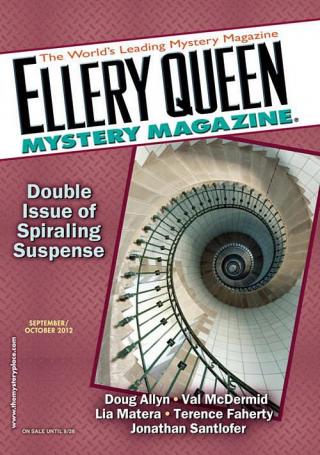
Ellery Queen’s Mystery Magazine. Vol. 140, Nos. 3 & 4. Whole Nos. 853 & 854, September/October 2012
- Автор: Макдермид Вэл, Манфредо Лу
- Год: 2012
- Язык: английский
- Год: Dell Magazines
- ISBN: 0013-6328
- Жанр: Другие детективы

Электронная книга - «Ellery Queen’s Mystery Magazine. Vol. 140, Nos. 3 & 4. Whole Nos. 853 & 854, September/October 2012». Краткое содержание книги:
“Are you arresting me? Or just toying with me before you devour me?”
His laugh was low and chilly. “The game hunter, for all his prowess, was eaten alive. But the colonel soldiered on. Every night he positioned himself in a tree to wait. It was weeks before he got off a clean shot at the first lion. Hit it, all right, but it didn’t fall. It vanished.”
The first lion vanished. In this twisted allegory, was Ella the first lion? And Mario the second? Or was the marshal talking about Nicky?
She felt as if she’d scream from the stress. Surely the marshal hadn’t boarded her train in Chicago just to ask what she knew about Kingston. Whatever her employer told Palmer, it couldn’t possibly involve her. She’d been delirious with flu when Mr. K. left R Street. No, if Palmer phoned a marshal, it was either about the stolen jewels or about Nicky. But which?
Killy leaned closer to Ella, his eyes just inches from hers. “The wounded lion didn’t die. He waited till the dead of night, then came back. The colonel shot it again. And again, it retreated. Then came back. Shot again. And a third time. And again. And again. Varying intervals between attacks so they’d come as a surprise.”
Was he warning her not to run? Telling her he’d never stop finding her?
“In the end,” he said, “it took five enormous bullets — firepower made to bring down charging elephants.”
“Let me go,” she said. “I’ve told you what I know about Mr. Kingston, which is nothing. He wasn’t there when I was brought back in. I never saw him again.”
“But the second lion,” Killy continued, “was even worse. For weeks, the colonel tracked him. And all the while, the rail line sat useless without a bridge over the river. Do you understand what I’m saying?”
She held her breath. She didn’t understand. He seemed to think he was telling her something, but what?
“The colonel put five bullets into that beast too, one after another. But like the first man-eater, it didn’t fall. It kept charging him, up there in his tree, as if he were throwing pebbles. He pumped in another three, reloading at a speed he prayed would save his life. Even so the lion died ravaging the tree limb just beneath his feet.”
“Is there a moral?” She could barely get the words out.
“I don’t know if I’d call it that. But it’s hard to know exactly who’s stalking whom.” He glanced past her again. “It’s a matter of your perspective. Don’t you think so? We talked last time about the Sedition Act. It’s a common belief here, with the unions, that the government uses the law to hunt their members. Along with aliens, Anarchists—”
“Of course it does! The entire leadership of the I.W.W. is in prison. I can’t count how many people I know myself, put in jail or onto boats. Or beaten with impunity by vigilantes. You don’t deny there are lynchings almost every day. Yet Congress won’t outlaw them. The President praises the Ku Klux Klan. So whatever you’re driving at, with this story of yours? If it’s meant as a parable, you’re the lions.”
He shook his head. “Have you a notion how many bombs we’ve intercepted? And worse, not intercepted? Packages mailed to judges and senators and bureaucrats... as if these men open their own mail. You were a servant once. Would you fancy living without your two hands, your face a mass of scars? Does anyone but a beast place a bomb in an armory or a church, where it might kill anybody unlucky enough to pass by? Where you have a law, yes, the enforcement may be flawed. Its provisions may be too broad. But at least its intent is to offer security. To keep people safe. A bomb, though? It may as well be a man-eater. It comes at a person in that way. Suddenly. Without measure or remorse.”
“You think that’s not true of lawmen? My mother was killed when a sheriff named McRae deputized anyone he could find, anyone with malice and a gun, to meet a ferry boat of union women and men. Going to parade and sing for the shingle-weavers. Eleven solid minutes they fired into a docked boat. And the strikers at Ludlow? The National Guard shot them while they slept. Torched their tents — wives and children burned alive. Those aren’t the actions of beasts? Why not? Because they had uniforms and not tiger’s stripes? Because they had badges?”
Around them, the drizzle made passersby seem indistinct. As if they mattered not at all. As if only this mattered, only deciding who was the hunter and who the man-eater.
The marshal drew a long breath. “You worked at a shirt factory before you went to the Kingstons,” he said. “You had no other references. Why should they choose a factory girl to care for their children?”
“I–I’d taken care of children before.” This turn of conversation startled her. She tried to gather her wits. Was there a trick inside the question? Certainly Mr. K. hadn’t taken Palmer into his confidence on this. “Children in our tenement.”
“You should tell me the truth.” Killy’s hands slid down her arms. He took both her hands in his. It shocked her. She had the strange fancy he wasn’t baiting a trap but rather offering a lifeline. When she didn’t reply, he said, “All right, then, how about this. At the Kingstons’, why did you call for the wagon? It was an expense for you, wasn’t it? And you were going anyway. Why not simply walk away?”
“I couldn’t do that. Abandon little Muriel and John to the mice? And Cook and Maid, who were so kind to me? To think of them with flies— No. I had Cook’s coins. It wouldn’t have been right to leave her there and use them for... for myself.”
Her confusion twisted deeper. One minute, the marshal seemed to be talking about Nicky. About enforcing the law, as if there were no difference between draft dodgers and bombers. The next, he was asking again about the Kingstons. About money. As if he had Mrs. K.’s jewels in mind.
If only she knew which crime he suspected. Which pitfalls she should avoid.
Somewhere close by, she knew, Mario was watching them. What would he make of this? She and a marshal quibbling back and forth like drunks at a speakeasy. And the marshal holding her hands? (What did she herself make of it?) Would Mario suppose she was offering Killy information?
Her stomach knotted.
Killy stared down at her as if reading a book in her eyes.
“You should let me go,” she said. “I’ve hurt no one. I cared for all of them, all who got sick after me. I tried my best to keep them alive. Cook and Maid were my friends. And I loved the children. It’s true I didn’t stop to think how it would be for Mr. K. To come home and find no trace of them, no note. But I... I just couldn’t stay longer.”
“After two years there, you leave without a reference? And no means of support?”
So it was the jewels, then. Ella stood very still. She felt the danger as if it breathed down her neck. The marshal had Kingston’s word that the gems were missing. She’d left no address or request for wages from the estate. And she’d lied to someone she knew was a lawman. They’d need no more than that to convict her. She’d get years in prison, or at best, deportation to a country she’d left as an infant. A country where she knew no one. Where girls like her starved or sold their bodies on the street.
She suddenly understood what Killy was trying to draw from her. But did he consider it a defense? Or was he just looking for a reason to feel disgust? Justification for what he knew she’d find in prison?
“You think you’ve guessed it,” she said. “Why I didn’t stay to collect a reference. Well, you’re right. Yes, I was just a factory girl. And no, Mr. K. would never have hired me if I hadn’t... Well, he called it an ‘accommodation.’ You’ll say I should have stayed at the factory, I’m sure, to preserve my precious honor. But my lungs were already hot with cotton dust. My honor would have left me begging in an alley, one more coughing girl.”