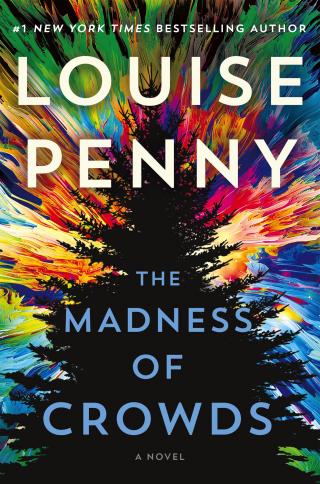
The Madness of Crowds
- Автор: Пенни Луиза
- Серия: Chief Inspector Gamache #17
- Год: 2021
- Язык: английский
- Год: St. Martin's Publishing Group
- ISBN: 9781250145284
- Жанр: Другие детективы

Электронная книга - «The Madness of Crowds». Краткое содержание книги:
You're a coward.
Time and again, as the New Year approaches, that charge is leveled against Armand Gamache.
It starts innocently enough.
While the residents of the Québec village of Three Pines take advantage of the deep snow to ski and toboggan, to drink hot chocolate in the bistro and share meals together, the Chief Inspector finds his holiday with his family interrupted by a simple request.
He's asked to provide security for what promises to be a non-event. A visiting professor of statistics will be giving a lecture at the nearby university.
While he is perplexed as to why the head of homicide for the Sûreté du Québec would be assigned this task, it sounds easy enough. That is, until Gamache starts looking into Professor Abigail Robinson and discovers an agenda so repulsive he begs the university to cancel the lecture.
They refuse, citing academic freedom, and accuse Gamache of censorship and intellectual cowardice. Before long, Professor Robinson's views start seeping into conversations. Spreading and infecting. So that truth and fact, reality and delusion, are so confused it's near impossible to tell them apart.
Discussions become debates, debates become arguments, which turn into fights. As sides are declared, a madness takes hold.
Abigail Robinson promises that if they follow her, ça va bien aller. All will be well. But not, Gamache and his team know, for everyone.
When a murder is committed, it falls to Armand Gamache, his second-in-command Jean-Guy Beauvoir, and their team to investigate the crime as well as this extraordinary popular delusion.
And the madness of crowds.
“No. I accused you of being human. Of defending your family. And while we’re at it, you accused me of allowing thousands of young men and women to be compromised because I don’t want to get involved.”
They stared at each other. Seething. Each had lost their hard-won composure.
My God, thought Gamache, pulling back from the edge. This’s how it starts. This’s what Abigail Robinson does, even from a distance. Just discussing her can sow the seeds of anger. And, with it, fear.
And yes. He was afraid. That her statistics and graphs would take root. That people would come to believe, to support, the insupportable.
He took a deep breath. “I’m sorry, Colette. What I said went too far.”
She was quiet. Not yet ready, it seemed, to offer her own apology.
“Why did the University agree to this booking?” he asked.
“You’re asking me? I don’t okay events.” Still snippy.
“And why did Professor Robinson choose to come here?”
“Why not?”
“Don’t you find it curious that while all her other lectures were out west, when she does come east, it’s not to the University of Toronto. Not to McGill or the Université de Montréal. Not to a big venue in a major city, but to a small university in a small town.”
“The Université de l’Estrie has a very good reputation,” said the Chancellor.
“C’est vrai,” he said, nodding. “It’s true. But it’s still surprising.”
His voice, though, had grown detached as he followed a train of thought. One that hadn’t occurred to him until now. He’d been so distracted by the moral, legal, logistical issues that he hadn’t paused to wonder why the Université de l’Estrie.
“Maybe the other places refused her,” he said, thinking out loud.
“It doesn’t matter,” she said.
He sighed. “I’ve struggled with this, Colette. Gone back and forth in my mind, until last night. That’s when I watched her most recent lecture and the aftermath. How the spectators turned on each other. Is she breaking the law? Is it hate speech?” He ran his hands through his hair. “No. But it’s already led to some very, very ugly confrontations.”
“Which is why I asked for you. I know it would be beyond campus security to protect Abigail.”
“Abigail?”
“Yes, that’s her name, isn’t it? Abigail Robinson.”
“Oui. But you used the familiar. Not ‘Professor Robinson.’” He uncrossed his legs and leaned toward her. “Do you know her? Personally?”
And now something else occurred to him.
“Is that why she chose the Université de l’Estrie? Did you invite her?”
“Are you kidding?”
“Non.”
The Chancellor stared at him. Then relented.
“You’re right, I did know her. Years ago. But I didn’t invite her here.”
“How do you know her?”
“I don’t see how it matters, but since you ask, I knew her father. We did some studies together. He was a statistician too. A friend. He asked me to look after Abigail when I was a guest lecturer in Oxford. She went there to read Maths.”
“What was she like?”
“Does it matter?”
“It helps to know the personality of the one I’m protecting. Are they aggressive? Fearful? Compliant? Will they listen to instructions or argue?”
Chancellor Roberge gazed over his shoulder and into the past.
Seeing the bright young men and women, barely more than boys and girls, ranged in front of her. They were just beginning to realize a hard truth. While they’d easily outpaced the other students in their schools back home, here at Oxford they’d struggle just to keep up. They’d gone, in the blink of an eye, from exceptional to average.
Many did not thrive, couldn’t adapt. But Abigail had managed to adjust quite quickly.
“Unlike most of her cohort, who could be maladroit, she was easy to like,” said Colette. “She didn’t come from an affluent background. It was a home that valued intellectual achievement. She was focused, likable.”
“Ambitious?”
“No more than you,” said Colette with a smile.
“And her work?”
“Was exceptional.” Now that they were talking about academics, Chancellor Roberge relaxed. “I’m not sure if you realize that mathematics isn’t linear. It’s a curve. And in the brightest, most nimble minds, it arcs around to meet philosophy, music, art.” She laced her fingers together. “They’re intertwined. If you listen to Bach, it’s as much a work of math as music.”
Gamache had heard this before. Had listened as Clara Morrow, their friend and neighbor and a gifted painter, had mused on just such a convergence. Perspective. Proportion. Spatial reasoning. Logic and problem solving. And portraiture.
“A friend of ours quotes Robert Frost,” he said. “A poem begins as a lump in the throat. The artists I know feel the same way. Do mathematicians?”
This was, the Chancellor knew, more than a casual question. It was a hand grenade. An interesting one, but potentially explosive nevertheless.
“I wouldn’t say that. I think for mathematicians, statisticians, the lump in the throat comes at the end. When we see where our work has taken us.”
“And how it can be perverted?” When Colette didn’t answer, he said, “Do you think Professor Robinson has a lump in her throat when she looks at her graphs?”
“You’ll have to ask her. Look, I’m not defending her.”
“It sounds like you are. Letting this lecture go on is wrong,” he said. “I’ve gone over and over the laws on censorship. On what constitutes hate speech. If I could cancel it on those grounds, I would. And it’s possible that tomorrow, at the lecture, I’ll be able to cancel it on public safety grounds, but for now, I don’t have cause.”
His words hung in the warm air between them, as the fire muttered and shouts of joy drifted up from the rink on the frozen lake.
A goal had been scored, but for which side?
And then the room settled back to silence.
“I’m asking you,” said Armand, his voice low. “Begging you, Colette, to call it off. Use any excuse. The building’s heat is off. The workers need their holidays. A bureaucratic mistake was made in taking the booking. Please. This is not going to go well, for anyone.”
The Chancellor studied the man in front of her. She’d known him for decades. Seen his rise through the ranks. Seen his great fall.
And seen him put himself together again and go back to doing a job that was far more than a job for him.
It was written on his face. The lines and creases. Not age. Not all, anyway. They were a map of his life. Of his beliefs. Of the stands he’d taken and the blows he’d suffered.
She could see it in the deep scar at his temple.
No, this man was no coward, but he was, as he admitted, afraid.
But then so was she.
Rising to her feet, Colette Roberge said, “I will not cancel the event, Armand.”
Chief Inspector Gamache had known, before he’d even left his study, that this was a battle he almost certainly would not win. Still, while he didn’t leave this home with a concession, he did take away more information than he’d arrived with. Including that the Chancellor had known Abigail Robinson. Well enough to still call her by her first name.
He wondered if one of the Christmas cards on the bookshelves and along the mantelpiece was signed Abigail.
He couldn’t see how it mattered, but then no information was wasted.
“Thank you, Madame Chancellor, for hearing me out.”
“I’m sorry to have dragged you into this. I can see it’s causing you discomfort.”
“It goes with the territory.”
“When you have a grandchild with Down syndrome,” she said.