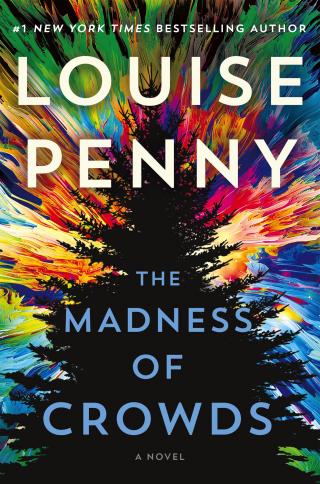
The Madness of Crowds
- Автор: Пенни Луиза
- Серия: Chief Inspector Gamache #17
- Год: 2021
- Язык: английский
- Год: St. Martin's Publishing Group
- ISBN: 9781250145284
- Жанр: Другие детективы

Электронная книга - «The Madness of Crowds». Краткое содержание книги:
You're a coward.
Time and again, as the New Year approaches, that charge is leveled against Armand Gamache.
It starts innocently enough.
While the residents of the Québec village of Three Pines take advantage of the deep snow to ski and toboggan, to drink hot chocolate in the bistro and share meals together, the Chief Inspector finds his holiday with his family interrupted by a simple request.
He's asked to provide security for what promises to be a non-event. A visiting professor of statistics will be giving a lecture at the nearby university.
While he is perplexed as to why the head of homicide for the Sûreté du Québec would be assigned this task, it sounds easy enough. That is, until Gamache starts looking into Professor Abigail Robinson and discovers an agenda so repulsive he begs the university to cancel the lecture.
They refuse, citing academic freedom, and accuse Gamache of censorship and intellectual cowardice. Before long, Professor Robinson's views start seeping into conversations. Spreading and infecting. So that truth and fact, reality and delusion, are so confused it's near impossible to tell them apart.
Discussions become debates, debates become arguments, which turn into fights. As sides are declared, a madness takes hold.
Abigail Robinson promises that if they follow her, ça va bien aller. All will be well. But not, Gamache and his team know, for everyone.
When a murder is committed, it falls to Armand Gamache, his second-in-command Jean-Guy Beauvoir, and their team to investigate the crime as well as this extraordinary popular delusion.
And the madness of crowds.
The man relaxed. “I imagine this isn’t exactly what you want to be doing either.”
There was truth in that. When he’d arrived at the old gym, Armand had sat in his car and checked messages. Reine-Marie had sent a photo from lunch at Clara’s. It was of their daughter, Annie, and her baby, Idola, who was wearing reindeer antlers.
He’d smiled and touched Idola’s face lightly with his finger. Then he’d put his phone away and gone into the building.
The sooner he got started, the sooner he could get home. There might even be some pie left.
“Why they agreed to this booking I don’t know,” the caretaker said as he showed the Chief Inspector around. “Two days before New Year’s. And last-minute too. I got the email just last night, for Christ’s sake. Fucking inconsiderate, excuse my English. Who is this person anyway? Never heard of her. Is she a singer? Will they need more than just a microphone? I haven’t been told anything.”
“She’s a visiting lecturer. Her talk will be in English. A podium and mic should do it.”
Monsieur Viau stopped and stared at him. “A lecture? In English? They pulled me away from a day skiing with my family because someone wants to give a talk?” His voice was rising with each word. “Are you kidding me?”
“Sadly, I am not.”
“Jesus,” said the caretaker, “were there no walk-in closets she could’ve rented? And why’re you here? A Sûreté officer? What does she talk about?”
“Statistics.”
“Oh, for God’s sake, this place’s going to be empty. What a waste of time.”
Gamache climbed onto the stage and looked out at the room.
He agreed with the caretaker. If they got fifty people, he’d be surprised. But Armand Gamache was a careful man. Three decades of looking at the bodies of surprised people did that.
“I’ll get the room dividers ready, Chief,” said Monsieur Viau.
They left the stage and walked to the main entrance, where frost had encroached and encrusted the door handles.
“Do you happen to have blueprints of the building?”
“In my office.”
Viau returned with scrolls, which he gave to Gamache. As the caretaker prepared to lock up and leave, he studied the cop.
He’d recognized the name, of course, when Gamache had called for the appointment. And he recognized the man himself when he’d arrived. It was strange to see someone in person who he’d seen so often on television, throughout the pandemic and before. While Monsieur Viau had heard that the head of homicide for the Sûreté lived in the region, they’d never actually met, until now.
What he saw was a large man. Slightly over six feet tall. Even with the parka, it was clear he wasn’t fat, but he was substantial. Mid to late fifties, he guessed. Gray hair, curling slightly around his ears. And, of course, the unmistakable scar, deep at his temple.
The cop’s face, the caretaker noticed, wasn’t so much wrinkled as lined. And Viau could guess where those lines had come from.
They stepped outside, and though they were braced for it, the bitter cold still stole their breaths. It scraped the flesh of their faces and made their eyes water. Their feet crunched on the snow as the caretaker walked the Chief Inspector to his car.
“Why’re you really here?” Viau asked.
Gamache squinted into the sun. So much light was bouncing off the drifts that his companion was almost lost in the glare.
“That’s exactly what I asked my superior,” he said with a smile. “To be honest with you, Monsieur Viau, I don’t really know.”
But then Armand Gamache hadn’t yet done his research on the person who’d be standing at the podium. And what she, and her statistics, would be saying.
Now, with the event about to begin, Chief Inspector Gamache looked over the heads of the crowd and found Monsieur Viau standing at the far end, by the doors. In shock, as he leaned on his mop and watched the people pour in.
Gamache had used the plans he’d been given to work out that the official maximum standing capacity would be six hundred and fifty. He’d rounded it down to five hundred, believing that they wouldn’t get close.
But as he’d done more research, Gamache became less and less sure.
He’d spent his evenings after everyone else had gone to bed watching videos of lectures given by Professor Robinson. Many of which had, in the past few weeks, gone viral.
What could have been a dry recital of statistics had become a near messianic message to a population hungry for, desperate for, hope.
Though the pandemic was now over, it had left behind a population worn down. People were tired of being self-disciplined, of self-isolating. Of social distancing and wearing masks. They were exhausted, shell-shocked, from months and endless months of worrying about their children, their parents, their grandparents. Themselves.
They were battered and bruised from losing relatives, losing friends. Losing jobs and favorite haunts. Tired of being isolated and driven near crazy with loneliness and despair.
They were tired of being afraid.
Professor Abigail Robinson, with her statistics, proved that better times were ahead. That the economy could recover, stronger than ever. The health care system could meet all their needs. That there would never be a shortage of beds, equipment, medicine again. Ever.
And instead of being asked to make a hundred sacrifices, the population would be asked to make just one.
It was in that “just one” that all the trouble lay.
Her report had been commissioned by the Canadian government for its Royal Commission into the social and economic consequences of the pandemic. Into the choices and decisions made. Professor Robinson, a senior academic and head of the department of statistics at a western university, had been tasked with correlating the figures and making recommendations.
She had come up with just one.
But, having read the report, the members of the Royal Commission had refused to let her present it publicly.
And so, Professor Robinson had decided to do it herself. She’d held a small seminar for fellow statisticians. It was streamed online so others who couldn’t get there could also see.
Armand had found it and watched as Abigail Robinson had stood in front of her charts and graphs. Her voice was warm, her eyes intelligent as she talked about fatalities and survival and resources.
Others had also found it. Not just academics, but members of the public. It had been shared and reshared. Professor Robinson had been invited to do other talks. Larger talks. And larger still.
Her message boiled down to four words, now emblazoned on T-shirts and caps and big round buttons.
All will be well.
What had started as a dry research project, destined for a government file cabinet, had slipped its moorings. Gone public. Gone viral. A fringe movement had taken off. Not yet mainstream, but Gamache could see it was just a matter of time. Like the pandemic itself, Robinson’s message was spreading quickly. Finding people vulnerable to just this curious mix of hope for the future, and fear of what might happen if they didn’t do what Robinson was suggesting.
All shall be well. And all shall be well. And all manner of thing shall be well.
It was a quote from one of Gamache’s favorite writers, the Christian mystic Julian of Norwich. Who’d offered hope in a time of great suffering.
But, unlike Julian of Norwich, Professor Robinson’s brand had a dark core. When Robinson said All will be well, she did not, in fact, mean everything. Or everyone.
Other buttons were beginning to appear at her events, sold to raise money for what had gone from a study to a cause to, Gamache could see as he sat in his quiet study with the Christmas tree lit in the living room, a crusade.