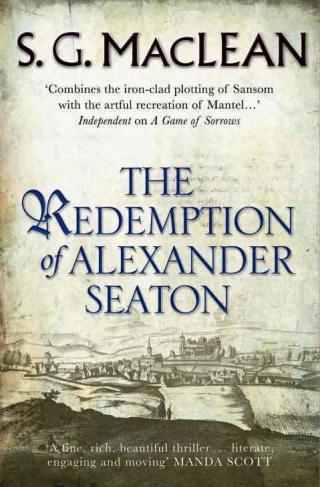
The Redemption of Alexander Seaton
- Автор: Маклин Шона Дж.
- Серия: Alexander Seaton #1
- Год: 2009
- Язык: английский
- Год: Quercus
- ISBN: 1847247911
- Жанр: Исторические детективы

Электронная книга - «The Redemption of Alexander Seaton». Краткое содержание книги:
Is the young man merely drunk or does his tottering walk suggest something more sinister?
When he collapses, vomiting, over the two whores who find him on that dark wet night, they guess rightly that he’s been murdered by poisoning.
So begins this gripping tale set in the town of Banff, Scotland in the 1620s. The body of the victim, the provost’s nephew and apothecary’s apprentice, is found in Alexander Seaton’s school house. Seaton is a school master by default, and a persona non-grata in the town – a disgraced would-be minister whose love affair with a local aristocrat’s daughter left him disgraced and deprived of his vocation. He has few friends, so when one of them is accused of the murder, he sets out to solve the crime, embarking on a journey that will uncover witchcraft, cruelty, prejudice and the darkness in men’s souls.
It is also a personal quest that leads Alexander to the rediscovery of his faith in God as well as his belief in himself.
Among her many strengths, Shona MacLean is brilliant at evoking period and place. You feel you are in those cold, dark, northern rooms, eavesdropping on her characters. You are totally involved in the rich, convincing world she has re-created.
I turned left where Back Path met High Street, where some of the grander ones planned their houses away from the bustle of the marketplace and town, and headed up towards the Sandyhill Gate. The wind was not in my face, as it could often be, and it was a pleasant walk. I had no need to rush – Charles was out of the tolbooth, away from the danger of the sheriff’s judgement now, and those I sought would not be abroad until it grew dark. I had the time to rest a moment where the road for Strathbogie skirted the foot of the Gallowhill, and to look upon the town of my birth. At the end of its journey from the mountains of the Cairngorm, past the teeming woods of the Deerpark, the clear waters of the Deveron came straight as an arrow, an arrow of fine silver, at the sea, where it broadened out to meet the world. Under a sky that was endless, the great promontories of Tarlair and Troup Head towered over all that might come from the east, and looked to the north and west, where the long golden stretch of the links invited us to our leisure. And our town nestled there, snug back from the west bank of the river, stretching towards its new harbour works at Guthrie’s Haven. Narrow winding streets, tentacles reaching up towards the castle, Caldhame, the Boyndie road and the Sandyhills, met together at the heart of the town. The kirk and the marketplace, the tolbooth and the laird of Banff’s palace, its long green garden stretching almost to the Greenbanks where the scholars played on this, another unlooked-for holiday. The tall town houses of the merchants jostled with the tenements filled with the poorer folk, the lower craftsmen, the day labourers, the indwellers. A tight, sometimes meandering network of vennels and alleyways, houses, workshops and backyards locked the streets together, a maze that ran through gardens, round wells, into courtyards, pigsties, stables, kailyards, middens. Such was Banff, a place so blessed by God in harvest of land and sea, gone rotten at the heart. And at that heart, I was. A huge cloud began to pass over the sun and the air instantly cooled. I quickened my pace towards the Sandyhill Gate and the codroche houses.
They were not houses really, but shambling, windowless shacks of wood, turf and thatch of the sort the council was striving to banish from the town for fear of fire. They were set back a good bit from the road, up the hillside where a small burn ran down by the rowans and bramble bushes. No one from the town ventured to the codroche houses. The kirk session and council fulminated often against them and their inhabitants, but they were never levelled, never cleared. Filled with beggars, thieves and whores, the detritus of poverty that gave a name to all the fears of the good townspeople. The provost had told me why he tolerated them: they were weeds – weeds that we knew and could control, weeds that would prevent other, invasive weeds coming in and taking root. Weeds that could be managed. Yes, but I also suspected that up here, out of sight, the codroche houses could be, in the minds of my fellow townsmen, a place in which all the evil that was in their town could repose, a reason for them not to look in their neighbour’s face, in their own heart, and see it there instead.
As I approached the huddle of shacks a trio of mangy, hungry dogs came towards me, snarling quietly. A small, filthy child, a girl perhaps, in thin rags, ran into one of the houses from the hen house where she had been gathering eggs. A young man – it might have been her father – soon emerged, a large stick in his hand. I did not know him. He did not call off the dogs. ‘What do you want?’ he asked.
‘I am here to see Lang Geordie,’ I said.
His suspicion was all the greater.
‘Lang Geordie sees no one. What is your business?’
‘None of yours.’
I kept my face steady but my heart was pounding and the dogs knew it. They crept closer, and at any moment, at a word from the beggar man, they would be at my throat. More figures had emerged from the houses, two or three other young men, little more than boys, a gaggle of dirty children, a young woman holding a baby, another big with child. Perhaps a dozen pairs of eyes fixed me with cold hostility. The closest dog let out a long growl and was about to spring when a low snarl in some tongue, some vagabond’s cant I did not understand, came from the doorway of the main shack. The dog cowered back with a yelp, as if struck, and then slunk away with its companions. The gathering of people at the doorway parted and surveying me, as he supported himself on two crutches, was Lang Geordie.
The man must have been nearly seven feet tall, a giant almost. He had the wild hair and beard of an Old Testament prophet. The brandings on his cheek, marking him out as a ‘sturdy beggar’, repulsed on pain of death from some other town, only served to inspire greater fear in those who came upon him. I stood there, my chest still heaving from the encounter with the dogs, and waited.
‘If it is not the Devil’s apprentice,’ he said at length, with a hoarse laugh. His followers also laughed, some of the hostility in their eyes being replaced by a ready mockery, but only some. The young men continued to watch me with a clear and studied intent. ‘What do you want of me? Are you here for the whores? The word on the roads is that you prefer a higher class of siren in your bed.’ Again a laugh, more real now, from the gathering.
So I had made Katharine the talk of the beggars and the thieves on the roads and hovels of the north. It was little wonder her friend Isabella Irvine despised me. I made no response to the jibe. ‘It is yourself I am here to see.’
All jocularity was gone now from Lang Geordie’s face. He was studying me carefully, weighing me up. I think he had some notion then of what my business was. He uttered something in the cant to his people and they dispersed slowly to the places from which they had come, all but two of the younger men who continued to stand near him, on either side of the only door of the hovel. Lang Geordie gave them some instruction, too and then looked at me again. ‘Then come in, Mr Seaton, come in.’ I went carefully past the dogs and in between the two guards, stooping low, although not as low as Lang Geordie. Once inside, my eyes could scarce make out a thing. The door had been shut behind me and the only light came from the round smokehole in the middle of the roof and from the open fire itself. As my eyes grew accustomed to the gloom I could discern figures, shapes, huddled in various parts of the one long room that constituted the whole dwelling. A young woman stirred a pot of something – some broth of seaweeds – over the fire; an older woman, coughing as she did so, sang in an alien tongue to a baby in dirty swaddling; two small children scrabbled after something in a corner – a mouse or a rat. On a trestle bed at the far end of the room lay another woman, also coughing. The floor was beaten dirt and I knew not what I would find when I set one foot in front of the other. The stench and squalor were beyond my experience: even the tolbooth jail could scarcely compare with this. Lang Geordie ordered the woman up from the bed – the dwelling’s only furnishing – and as he took his seat there himself I saw that she was not a woman, but little more than a girl – fourteen, perhaps. She was wearing a tattered dress that I knew I had seen before, too large by far around the bosom and the hips. A whore’s dress; Mary Dawson’s dress. The vagabond chief saw me looking at the girl. ‘You can have her for a price – after our business is done,’ he said, very steady, with no insinuation.