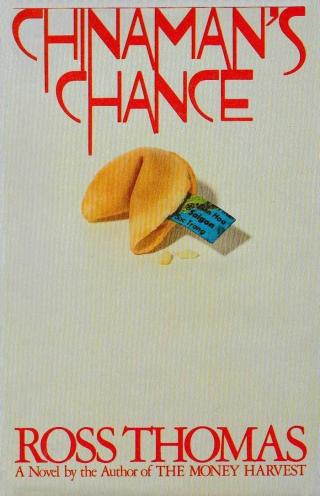
Chinaman’s Chance
- Автор: Томас Росс
- Серия: Arthur Case Wu #1
- Год: 1978
- Язык: английский
- Год: Simon & Schuster
- ISBN: 978-0-671-24070-7
- Жанр: Политические детективы

Электронная книга - «Chinaman’s Chance». Краткое содержание книги:
“They don’t shine much.”
“They’re not supposed to. They sort of glow, but they don’t shine. The only place shoes are supposed to shine, kid, is in the Marine Corps, although sometimes I like a good spit shine on my loafers. And that’s the other thing — these aren’t loafers. They lace up. Loafers, and boots that zip up, and shoes that buckle, and pimp flash shoes with five-inch heels — well, they indicate a weak moral fiber.”
“A what?”
“A weak moral fiber,” Overby said very seriously. “I mean, if you’re too lazy to lace up your shoes, there’s gotta be something wrong with you.”
“Jesus, Otherguy, I feel I oughta be writing all of this down.”
If it was sarcasm, Overby chose to ignore it. Instead, he put on the dark blue suit that he had held up throughout his lecture. The suit had some very faint gray stripes, and when Overby had it on and its vest buttoned — except for the final button, of course — he looked very much like a smart, hard, tough, prosperous banker from a medium-sized city — which was exactly what he wanted to look like.
“Well, whaddya think, kid?” he said.
McBride examined him carefully. “The suit,” he said finally. “It don’t fit.”
“One size too large,” Overby said. “Like maybe I had the guts and determination to take a little weight off and keep it off, right?”
“Yeah, maybe.”
“So what does that tell you about me?”
McBride nodded slowly. “Yeah, I see, like maybe you’re the kind of guy who does what he sets out to do.”
“Exactly. One size too large. Remember that.”
“What about out there?” McBride said, unconsciously imitating Overby’s westward nod that embraced the entire Pacific. “Is this the way you do it out there too?”
“Not exactly, kid. I’ll have to show you when we get there. But out there,” he said, his voice almost dreamy, “well, out there it’s kind of different.”
As Artie Wu was getting dressed that morning in his bedroom in the house on Ninth Street in Santa Monica, his wife had summoned his children to observe and learn.
“Watch Daddy, darlin’s. He’s puttin’ on his gittin’-outa-here-and-gittin’-us-some-money suit.” Agnes Wu had expertly copied both the voice and the admonition from the wife of an Anadarko, Oklahoma, tool pusher whom she had known in Aberdeen.
It was a resplendent outfit that was intended to be noticed, and Solly Gesini noticed it immediately and the man it clothed as soon as Artie Wu climbed out of Durant’s Mercedes coupe.
Jesus, Gesini thought, it’s gotta he the Chinaman. And the other guy, the skinny one, must be Durant.
The cream-colored raw-silk suit and its double-breasted vest with black silk piping fitted Wu to perfection. Stretched across the enormous mound of stomach, made even more pronounced by the vest, was a heavy gold watch chain. Wu’s glistening white shirt had been hand tailored in Singapore out of handkerchief linen with a high, rounded, almost Hoover-like collar. His tie was severely narrow and no-nonsense black. Dash, if that, indeed, were needed, was supplied by the black-banded Panama hat with the enormous brim turned down all the way around.
“Hell, Artie,” Durant had said when he picked Wu up that morning, “you forgot your ivory-handled fly whisk.”
It was a little after nine when Wu and Durant got out of the Mercedes, which they had parked in a two-hour meter zone on Seashore Drive across from the Sandpiper Apartments.
As they jaywalked across the street, Wu glanced at the fat gold watch that he kept tucked away in a vest pocket. “We’re going to miss Otherguy,” he said.
“He doesn’t need any last-minute advice.”
“No,” Wu agreed. “Not him.”
“But McBride?”
Wu shrugged. “We’ll see.”
McBride, after his early-morning lecture by Overby, was visibly impressed by Wu’s attire when he let the two men into apartment 1229. He studied it all for several moments, trying to decide who Wu was supposed to be. He had no trouble with Durant in his conservative lightweight glen plaid with the blue shirt and black knit tie. Durant was exactly what he seemed to be: smart, competent, and a little hard. Even, perhaps, a trifle ruthless. But Wu... well, Wu, McBride decided, was something else. So he gave up and asked.
“What the fuck are you supposed to be, Artie?”
Wu smiled and made his eyes become two curved sparkling slits. “Mysterious, knowledgeable, highly intelligent, and a bit eccentric. Mild eccentricity, by the way, inspires confidence.”
“No shit?”
“No shit.” He turned to Durant. “You want to call him?”
Durant glanced at his watch. “Okay.” He went over to the phone, dialed I number, and asked for Chief Oscar Ploughman.
Lt. Marion Lake of Homicide watched as Ploughman let his private outside line ring twice. Then the police chief said, “This has gotta be them,” picked up the phone at the end of the third ring, and said hello. When Durant asked for Chief Ploughman, the chief said, “You’ve got him.”
“This is Durant. You said for us to call.”
“I’m going to give you all I can,” Ploughman said.
“All right.”
“Breadstone Avenue. Somewhere in between the 2100 and 2300 blocks.”
“That’s all?” Durant said.
“That’s all,” Ploughman said, and hung up. Then he smiled a large, yellow smile and turned to Lt. Lake. “Let’s give ’em until three o’clock.”
“Then?”
“Then you get over there and find out for sure.”
Lt. Lake nodded. “Who do you think I oughta be this time?”
Ploughman thought about it as he studied Lake for several moments. “A reporter,” he said finally. “You do that pretty good.”
When Durant hung up the phone he turned to Eddie McBride. “Okay, here’s what we’ve got. She’s somewhere in the 2100 to 2300 blocks on Breadstone Avenue. And that’s all we’ve got. You know what to do?”
McBride nodded slowly. “I’ve been talking to Otherguy about it. He gave me a lot of ideas. I’ll hit the bars and the stores and dry-cleaning shops and things like that and ask questions.”
“And if you find her?” Wu said.
“I call you guys.”
“Right. Now, we’re going to be at a meeting between one and two-thirty probably. But we’ll be back here after that.”
McBride cleared his throat a little nervously. “How do I look?” he asked, his voice full of self-consciousness.
The two men inspected the well-cut jacket, the dark slacks, the tasseled loafers, and the gray oxford-cloth shirt with the slightly loosened foulard tie. Durant thought McBride looked about as believable as Steve McQueen would look playing a reporter, but he didn’t say what he thought. Instead, he said what Eddie McBride wanted to hear: “You look like a reporter, Eddie. A smart one.”
McBride looked at Wu for further confirmation. Wu nodded slowly, even judiciously. “Get me rewrite, sweetheart,” Wu said.
“What the fuck’s he talking about?” McBride asked Durant.
Durant smiled. “A very old play.”
“You look great, Eddie,” Wu said. “Just right.”
As if in need of additional evidence, McBride opened the door of the living-room closet and examined himself in its full-length mirror, pulling the loosened tie down another careful half inch.
While McBride was inspecting himself in the mirror, Durant said, “When you and Simms — or Childester — were lifting the money in Saigon, did you help him make the actual switch?”
McBride shook his head, still examining himself in the mirror. “Nah, he had that part all done. What he needed me for was to take down the screens over the air-conditioning ducts. We had exactly two minutes the way he had it figured.”