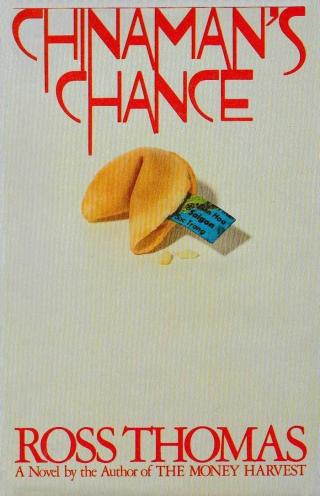
Chinaman’s Chance
- Автор: Томас Росс
- Серия: Arthur Case Wu #1
- Год: 1978
- Язык: английский
- Год: Simon & Schuster
- ISBN: 978-0-671-24070-7
- Жанр: Политические детективы

Электронная книга - «Chinaman’s Chance». Краткое содержание книги:
Chapter 31
On that following morning, the first day of summer, a Monday, Randall Piers was at his desk at seven o’clock after having walked and run the six greyhounds for their usual mile along the beach.
Piers tried the large cup of coffee that Whitlock, the butler, had left for him on the desk. It was good — very good, in fact — but still not quite as good as the coffee made by the tall, lean man with the scars. Thinking of Durant, Piers remembered how the day before, Sunday, Lace Armitage had described Durant’s impotency. She had made it a sad, even poignant story, and her obvious compassion and sympathy had irritated Piers a little, and still did, although he was careful not to let it show.
When Piers had married Lace he had known what he was getting into, because she had told him very carefully and with much graphic detail, explaining that she wanted him to know exactly what to expect.
“I just can’t seem to help it,” she had said. “I try, but somehow it happens anyway.”
“But you want to do something about it?”
“Of course I do.”
“Then we’ll work on it,” he had said.
And they had, and things had seemed to be getting better until this business with Silk started. After Silk disappeared, things had gone to hell again. Randall Piers very much wanted to find his sister-in-law because he had decided that it just might somehow save his marriage, and he was very much in love with his wife.
After another sip of coffee, Piers rang for his executive assistant. Hart Ebsworth came in a moment later and took his usual seat.
“Well?” Piers said.
“It cost.”
“How much?”
“The Senator said to tell you that as far as he’s concerned he doesn’t owe you a thing now.”
“He thinks it’s worth that much, huh?”
“That much.”
“So what did he come up with?”
“Just the bare bones,” Ebsworth said. “But it cost him plenty, or so he said. But you know how he lies.”
Piers nodded.
“Durant and Wu had a contract to furnish supplies to a hush-hush hit-and-run outfit in Cambodia. There was a girl involved, Durant’s girl. She was a reporter, French. She got killed along with some CBS guy, and Durant got captured. That’s how he got the scars. Wu went in and got him out. Then they went to Scotland. And that’s it, except for one thing.”
“What?”
“The hit-and-run outfit. It was a bunch of CIA-paid mercenaries, illegal as hell. The guy who ran it was one Luke Childester. The Dirty Duke, they called him. Well, when the war ended, Childester went sour, turned renegade or something, and now he’s running things for Imperlino in Pelican Bay using his real name, which is Reginald Simms. It seems Imperlino and Simms went to school together. Bowdoin.”
Piers turned his swivel chair slightly and stared out at the ocean, which had gone pewter gray under the overcast. “And suddenly Wu and Durant just happen to turn up in Malibu and we just happen to meet on the beach, Wu and I.”
“They worked it pretty slick, didn’t they?”
“Yes, very slick. Are they connected with the CIA now — or anybody else?”
“The Senator says they’re not. Swears they’re not, in fact.”
“Well.”
“What’re you going to do?”
Still staring at the ocean, Piers said, “Do? I’m going to let them find Silk, that’s what I’m going to do.”
At seven-thirty that morning Solly Gesini arrived at the asphalt-covered parking lot across the street from the Sandpiper Apartments and bought four spaces for his Oldsmobile 98 from the surly attendant, parking it himself. The spaces that he bought gave him a clear view of the apartment building’s entrance and almost instant access to the lot’s exit.
Next to him on the Oldsmobile’s front seat was a stack of country-Western tapes. He chose one and shoved it into the tape deck. Gesini liked country-Western music, mostly because he could understand the words, which usually told a story, and that too he liked.
Next to the tapes on the seat was an almost frozen six-pack of Tab. The Tab was for his weight, and the five packets of M & M chocolates next to the Tab were for his hunger. Gesini felt that they sort of balanced things out. He popped open a can of Tab and held it between his knees while he tore open one of the M & M packets and tossed a handful into his mouth, letting them melt a bit before he washed them down with a swallow of the cola.
Gesini then settled back in the seat, his eyes fixed on the apartment entrance, his soul soothed by the country-Western music, his inner needs satisfied by the diet cola drink and the candy-coated chocolates, and his mind pleasantly engaged by the interesting task that lay ahead, which was the murder of Eddie McBride.
Across the street and up on the twelfth floor in apartment 1229, Eddie McBride was sprawled half dressed in an easy chair in the living room. He had a cup of instant coffee in one hand and a Camel in the other as he listened with no little interest to Otherguy Overby’s lecture on the proper dress, appearance, and grooming of the successful mountebank.
Overby stood in the center of the living room dressed in shorts, shoes, a white shirt, dark tie, and no pants. He held a suit up by a hanger, as though offering it for McBride’s inspection and possible purchase.
“Now, look what I got on, kid. A white shirt, custom made, with no breast pocket and never, never any fucking initials where the pocket’s supposed to be. You wear initials, it means you’re not sure who you are and that you gotta have something to remind you — and probably everybody else. Now the tie. Whaddya think about the tie?”
McBride shrugged. “It’s dark, not much color.”
Overby shook his head. “It’s ugly. That’s the important thing. Ugly, but expensive. What you gotta do is find the ugliest, most expensive tie you can, like this one, which cost me sixty-five bucks. But somebody else sees me wearing it and they think, ‘Hey, there goes a guy who can afford expensive bad taste.’ Not flash, kid, but expensive, conservative bad taste. There’s a hell of a difference.”
“Yeah, I think I know what you’re saying,” McBride said, and sipped his coffee, not taking his eyes off Overby.
“Now the shoes and socks — what about them?”
McBride shrugged again. “Black shoes, black socks, the high ones that come up almost to your knees.”
“Okay, first the socks. You sit down and cross your knees and you’re wearing short socks and you show a little patch of white, hairy leg and lemme tell you something, there’s nothing nastier looking. I mean nasty. The way it affects some people it’d be better if you took your cock out and waved it around. I don’t know why, but that little white, pasty patch of hairy leg — unless you got just one hell of a tan — looks diseased to most people. So whatever you’re talking about, they’re not gonna be listening. Instead, they’re gonna be thinking about that horrible disease on your leg. Okay?”
“Sure,” McBride said. “Okay.”
“All right, now the shoes. Guess how much they cost?”
McBride looked at them. They were ordinary-looking black low-cut shoes with capped toes — the kind once referred to as Oxfords. McBride decided to go high on his estimate. “Eighty-five bucks,” he said.
Overby shook his head, pleased by his pupil’s low guess. “Two hundred and forty-eight dollars,” Overby said.
“For them?” McBride didn’t believe it.
“Handmade by a little old English guy in Hong Kong. He must be close to a hundred now and he makes ’em just like they did thirty, forty, even fifty years ago. Now what else about ’em, except that they’re kinda ugly?”