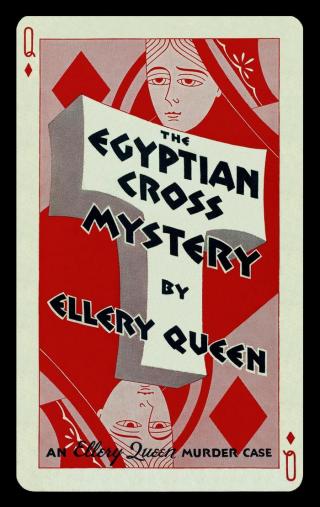
The Egyptian Cross Mystery
- Автор: Куин (Квин) Эллери
- Серия: Ellery Queen #5
- Год: 1932
- Язык: английский
- Год: Frederick A. Stokes Company
- Жанр: Классические детективы

Электронная книга - «The Egyptian Cross Mystery». Краткое содержание книги:
“Damn it,” groaned Ellery, hanging up, “what are we going to do now? We haven’t any time to dawdle!” He dashed to a window and looked out. The rain seemed to be steadily increasing in force, coming down in torrents; lightning flashes streaked the sky; the thunder was almost incessant. “Listen,” said Ellery, turning back. “You’ll have to remain behind, Professor!”
“I really don’t like the idea of your going there alone,” replied Yardley reluctantly. “Especially in this storm. How are you going to get there?”
“Never mind. You stay here and try your damnedest to get in touch with Vaughn and Isham.” Ellery leaped to the telephone again. “Mineola flying field. Quick!”
The Professor rubbed his beard uncomfortably as Ellery waited. “Oh, I say, now, Queen, you can’t be thinking of going up in a sky like this.”
Ellery waved one hand. “Hello, hello! Mineola? Can I charter a fast plane for a southwestern flight at once?... What?” His face fell, and after a moment he put down the telephone. “Even the elements are conspiring against us. Storm came up from the Atlantic and is traveling west and south. The Mineola man says it will be bad in the Alleghenies. They won’t send a plane up. What the devil can I do?”
“Train,” suggested Yardley.
“No! I’ll trust the old Duesie! Have you a slicker or a raincoat I can borrow, Professor?”
They raced into the Professor’s hall and Yardley opened a closet and brought out a long slicker. He helped Ellery into it. “Now, Queen,” he panted, “don’t go off half-cocked. That’s an open car, the roads will be bad, it’s a terribly long drive—”
“I shan’t take unnecessary chances,” said Ellery. “Luden should cover things, anyway.” He hopped forward and opened the door, and the Professor followed him into the vestibule. Ellery was silent, and then offered his hand. “Wish me luck, old man. Or rather wish Van luck.”
“Go ahead,” grunted the Professor, pumping Ellery’s hand up and down. “I’ll do my best to find Vaughn and Isham. Take care of yourself. You’re certain about it now? It isn’t an unnecessary trip?”
Ellery said grimly: “There was only one thing that kept Krosac from killing Megara for the past two weeks. That was — he didn’t know where Van was. If he killed Megara finally, it must be that he discovered the Old Pete ruse and the mountain hideaway. Extorted the information from Megara, probably, before he killed him. It’s my job to prevent a fourth murder; Krosac is undoubtedly on his way to West Virginia at this moment. I’m hoping that he took time out to sleep last night. Otherwise—” He shrugged, smiled at Yardley, who looked longingly after, and then dashed down the steps in the buffeting downpour, under the lightning, toward the driveway at the side where the garage and the old racing car lay.
Mechanically Professor Yardley consulted his watch. It was exactly one o’clock.
27. The Slip
The Duesenberg clawed its way through New York City, scrambled downtown, darted through the Holland Tunnel, dodged in and out of traffic through Jersey City, slipped through a maze of New Jersey towns, and then straightened out on the road to Harrisburg, shooting ahead like an arrow. Traffic was light; the storm had not abated; and Ellery alternately prayed to the gods of chance and played havoc with the speed laws. His luck held; he shot through town after town in Pennsylvania unpursued by motorcycle police.
The old car, which afforded no protection from the rain, was flooded; and he himself sat with soaked shoes and a dripping hat. Somewhere in the car he had salvaged a pair of racing goggles; and he made a grotesque figure in linen suit covered with a slicker, a light felt hat which sopped about his ears, amber goggles over pince-nez spectacles, and a grim look about him as he sat hunched over the enormous wheel rocketing the car through the storm-lashed Pennsylvania countryside.
At a few minutes to seven that evening, with the rain still driving steadily — he seemed to be traveling in its wake — he slid into Harrisburg.
He had no luncheon and hunger pinched his flat stomach. He parked the Duesenberg in a garage with specific instructions to the mechanic, and strode off in search of a restaurant. Within an hour he was back at the garage, had checked his oil, gasoline, and tires, and made his way out of town. He remembered the route well, sitting there behind the wheel, cold and clammy and uncomfortable. Within six miles he was through Rockville and arrowing straight ahead. He crossed the Susquehanna River, and flashed on. Two hours later he passed the Lincoln Highway, sticking stubbornly to the road he was on. The rain persisted.
At midnight, chilled, exhausted, his eyelids refusing to function, he pulled into Hollidaysburg. Again a garage was his first stop; and after a lively conversation with a grinning mechanic he left on foot for a hotel. The rain lashed against his wet legs.
“Three things I want,” he said from stiff lips in the little hotel. “A room, my clothes dried, and a call for seven tomorrow morning. Can you produce?”
“Mr. Queen,” said the clerk, after consulting Ellery’s signature on the register, “you watch me.”
The next morning, considerably refreshed, in dry clothing, stomach full of bacon and eggs, the Duesenberg roaring along, Ellery pressed forward on the last lap of the journey. Evidences of the storm’s havoc flashed by him — uprooted trees, swollen streams, wrecked cars abandoned by the roadside. But the storm, which had raged all night, had abated suddenly in the early hours, although the sky still lowered, the color of lead.
At 10:15 Ellery piloted the roaring Duesenberg through Pittsburgh. At 11:30, under a brightening sky, with the sun making valiant efforts to illuminate the peaks of the Alleghenies all about, Ellery brought the Duesenberg to a grinding stop before the Municipal Hall in Arroyo, West Virginia.
A man in blue denim whom Ellery vaguely remembered was sweeping the walk before the entrance to the Municipal Hall.
“Here, mistuh,” said this worthy, dropping his broom and clutching at Ellery’s arm as he dashed past, “where you goin’? Who you want t’see?”
Ellery did not reply. He ran quickly through the dingy hall to the rear, where Constable Luden’s office lay. The constabulary door was closed; and as far as he could see, Arroyo’s civic citadel was empty of life. He tried the door; it was unlocked.
The man in denim, a stubborn look on his loutish face, had shuffled after him.
Constable Luden’s office was unoccupied.
“Where’s the Constable?” demanded Ellery.
“Whut I been tryin’ t’tell ye,” said the man doggedly. “He ain’t here.”
“Ah!” said Ellery with a sagacious nod. Luden, then, had gone on to the hills. “When did the Constable leave?”
“Mond’y mornin’.”
“What!” Ellery’s voice overflowed with astonishment, woe, and a surging realization of catastrophe. “Good heavens, then he didn’t get my—” He darted forward to Luden’s desk. It was a mess of untidy papers. The man in blue put out his hand in blank protest as Ellery began to toss the Constable’s official correspondence — if it was official correspondence — about. And, as he had with dread expected, there it lay. A yellow-enveloped message.
He tore it open, and read:
CONSTABLE LUDEN ARROYO WEST VIRGINIA FORM POSSE IMMEDIATELY AND GO TO HUT OF OLD PETE PROTECT OLD PETE UNTIL MY ARRIVAL NOTIFY CRUMIT KROSAC RETURNING IF ANYTHING HAS HAPPENED BY TIME YOU REACH HUT PICK UP KROSAC TRAIL BUT LEAVE SCENE OF CRIME INTACT