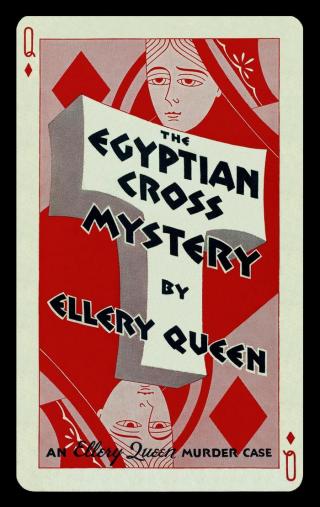
The Egyptian Cross Mystery
- Автор: Куин (Квин) Эллери
- Серия: Ellery Queen #5
- Год: 1932
- Язык: английский
- Год: Frederick A. Stokes Company
- Жанр: Классические детективы

Электронная книга - «The Egyptian Cross Mystery». Краткое содержание книги:
“What’s bothering you?” he asked gently. “Surely the thought couldn’t have entirely escaped you.”
“It’s as if it never was, except for the most ridiculous sensation.” Ellery puffed furiously at a cigarette. “You know those intangible feelings? Something leads you a chase through all the back alleys of your brain, and you never once get more than a blurred glimpse of it. That’s the way it is with me. If I could catch it... It’s important. I have the overwhelming feeling that it’s important.”
The Professor tamped tobacco into his pipe bowl. “A common phenomenon. I’ve found with myself that concentration on the capture of the idea is futile. A good plan is to erase every thought of it from your mind and talk about other things. It’s surprising how often the method works. It’s as if, by ignoring it, you tantalize it into popping out at you. Out of nowhere the full, clear picture of what you’ve been trying to recollect will appear; created, it would seem, out of irrelevancies.”
Ellery grunted. A thunder clap shook the walls of the house.
“A moment ago — fifteen minutes ago—” continued the Professor with a sad smile, “you said that you were as far from a solution today as you were three weeks ago. Very well. Then you face failure. At the same time you’ve made reference on several occasions to conclusions which you’ve reached, not obvious on the surface, unknown apparently to Isham and Vaughn and myself. Why not go over them now? Perhaps there’s something which in the exclusive concentration of your analysis has eluded you, but which will become clear if you express your thoughts in words. You may take my word for it — my whole life has been inextricably tied up with just such experiences — that there is a vital difference between the cold seclusion of independent thinking and the warm personality of a tête-à-tête discussion.
“You mentioned checkers, for example. Evidently the Bradwood study, the checker table, the disposition of the pieces, had a significance for you which completely escaped the rest of us. Go over it aloud.”
Under the flow of Professor Yardley’s deep and soothing voice Ellery’s keyed nerves relaxed. He was smoking more quietly now, and the lines of strain on his face had softened. “Not a bad plan, Professor.” He shifted to a more comfortable position and half-closed his eyes. “Let me tackle it this way. What story did you piece together from Stallings’s testimony and the checker table as we found it?”
The Professor thoughtfully blew smoke toward his fireplace. The room had appreciably darkened; the sun had disappeared behind a barrage of black clouds. “Many theories unsupported by concrete evidence have come to mind, but I see no logical reason for doubting the surface appearance of the data.”
“And that is?”
“When Stallings last saw Brad — presumably he was the last person except the murderer who did see Brad — Brad was seated at his checker table playing checkers with himself. There is nothing unusual or incongruous about this; Stallings testified that he often did it, working out moves for both sides — as only an enthusiast and expert will — and I myself can confirm this. Then it would appear that after Stallings’s departure, and while Brad was still playing with himself, Krosac gained access to the study, killed Brad, and so on. Brad had in his hand at the time he was killed one of the red checkers, which explains how we found it near the totem post.”
Ellery rubbed his head wearily. “You say — ‘gained access to the study.’ Just what do you mean?”
Yardley grinned. “I was coming to that. You remember I said a moment ago that I had many theories unsupported by evidence. One of them is that Krosac — who, as you’ve repeatedly held, may be someone very close to us — was Brad’s expected visitor that night, which explains how he got into the house. Brad, of course, being ignorant of the fact that some one he thought a friend or acquaintance was in reality his blood enemy.”
“Unsupported!” Ellery sighed. “You see, I can outline this instant an indestructible case for one theory. Not a stab in the dark, Professor, not a conjecture, but a conclusion reached by clear logical steps. The only trouble with it is — it doesn’t thin out the fog in the slightest.”
The Professor sucked thoughtfully at his pipe. “Just a moment. I haven’t finished. I can offer another theory — again unsupported by evidence, but as far as I can see just as likely to be true as the other. And that is, that Brad had two visitors that night: the person whom he expected, and for whose visit he sent his wife, stepdaughter, and household away; and Krosac, his enemy. In this case the legitimate visitor, whether he came before or after Krosac — which is to say, while Brad was still alive or when he was already dead — naturally kept silent about his visit, not wishing to be implicated in any way. I’m surprised no one has thought of this before. I’ve been expecting you to propound it for the past three weeks.”
“So?” Ellery took off his pince-nez glasses and placed them on the table; his eyes were red and bloodshot. A lightning flash momentarily illuminated the room, painting their faces a ghastly blue. “Great expectations.”
“Don’t tell me you didn’t think of it!”
“But I’m not. I never mentioned it because it isn’t true.”
“Ha,” said the Professor. “Now we’re getting it. Do you mean to sit here and tell me you can prove there was only one visitor to that house on the murder night?”
Ellery smiled feebly. “You place me in an uncomfortable position. Proof is after all dependent not so much upon the prover as upon the approver... It’s going to be slightly complicated. And you remember what that French moralist with the improbable name, Luc de Clapier de Vauvenargues, said: ‘Lorsqu’une pensée est trop faible pour porter une expression simple, c’est la marque pour la rejeter.’ [2] But I’ll get to it in due course.”
The Professor leaned forward expectantly, and Ellery continued, replacing the pince-nez on the bridge of his nose: “My point depends upon two elements: the disposition of the checkers on Brad’s table and the psychology of expert players. Do you understand the game, Professor? I recall you said that you had never played with Brad, or words to that effect.”
“That’s true, although I understand the game. Rather a dub at it. I haven’t played for years.”
“If you understand the game, you’ll understand my analysis. When Stallings entered the study, before quitting the house, he saw Brad beginning a game with himself, saw two moves of the opening, in fact. It was this testimony which led our friends astray. They assumed that because Brad was playing with himself when Stallings last saw him, he was still playing with himself when he was murdered. You fell into the same error.
“But the pieces on the table told an entirely different story. What was the disposition not only of the checkers in play but of those which had been ‘captured’ and taken off the playing board? You will recall that Black had captured nine red pieces, which lay in the margin between the board itself and the edge of the table; that Red had captured only three black pieces, which lay in the margin on the opposite side. Obviously, then, to begin with, Black was vastly superior to Red.
“The board itself, remember, held three kings, or double pieces, for Black, plus three single black checkers; and a meager two single pieces for Red.”
“What of it?” demanded the Professor. “I still don’t see that it means anything except that Brad was playing a game with himself and had worked out a series of moves most disastrous to his hypothetical opponent, Red.”
2
“When a thought is too weak to be expressed simply, that is a sign that it should be rejected.”