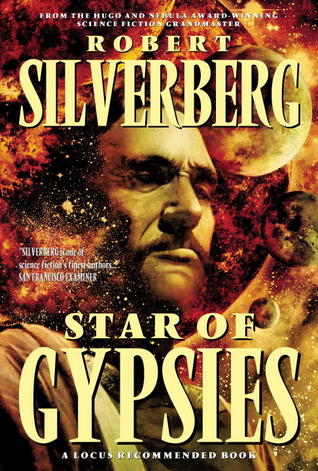
Star of Gypsies
- Автор: Силверберг Роберт
- Язык: английский
- Жанр: Научная фантастика

Электронная книга - «Star of Gypsies». Краткое содержание книги:
God is great under any of His names. These foolish Gaje will kill each other to show the superiority of their name for Him. And they will kill us too, unless we say the words they love. Very well. Allah is great. And Christ is our savior. Whatever they want. The One Word is: Survive.
ANOTHER LEAR WHO SURVIVES HERE? A FLAT HIDEOUS landscape. Mounds of dirty snow, bare trees. Barbed wire. This is a prison. I see Gypsies in prison uniforms, stripes, a brown triangle on the left breast. But some of them carry violins. They stroll from building to building, playing: prisoners of special privilege, wandering entertainers. There are other prisoners here, peering out hopelessly from their dismal shacks. Gaunt hollow faces, dark tragic eyes. Staring, weeping. Listening to the Gypsy violins.
I drift down beside one of the violinists and make myself visible. He gives me a strange look but goes on playing. A sad wild tune. You could sing to it, or you could break into tears. He plays me the sound of a question.
"Sarishan," I say. "I am Rom."
"Are you?" Cool, distant, barely seeming to care. "Yakoub son of Romano Nirano. Kalderash. And you?" A shrug. "Daweli Shukarnak. You are new here?"
"A visitor."
"A visitor," he says, as if the word has no meaning for him. "Well, enjoy your holiday."
He turns away and fiercely strikes his bow across the strings of his violin, making a terrible noise. I am reminded of the grinding sound of Pulika Boshengro's fiddle as he gave the signal for his henchmen to attack his kinsmen, and for an instant I feel like cringing. Like screaming.
"Wait," I say. "Is this place a prison?" "What do you think?"
"And those half-dead Gaje over there?" "Jews. This is a prison for Jews."
"But there are Rom here too?"
"There are some Rom, yes. They treat us a little better than they do the Jews. They feed us, and we play music for the other prisoners on Sundays. And for the Hitlari."
"The Hitlari?" I ask.
"The prison-camp keepers. The Nazis." He begins to play again, sweetly, a melancholy tune that tears at my heart. "They hate us and they hate the Jews, but they hate the Jews a little more. When they are finished killing the Jews, they will kill us. They want to kill everybody, the Hitlari, everybody who is not like them, and they will, sooner or later. They think they are being kind to us, killing us later. But what sort of life is this for a Rom, inside a prison camp? They have killed us already, penning us up in here." He looks at me as though seeing me for the first time. "You are really Rom?"
"You doubt me?"
"You speak the Romany strangely." "I come from far away."
"Well, go back there, wherever it is. If you can. Fly away and forget this place. This place is hell. This place is the house of the devil." "Tell me its name," I say.
"Auschwitz," he says.
IT'S VERY MISTY HERE. I MUST BE FAR, FAR BACK IN TIME. But through the thick white fog I see a great blazing sun overhead. The air is moist and hot. This is a marketplace. In its center grows a gigantic tree with a thousand trunks, and a bewildering tangle of roots and vines descending from its myriad limbs. All around it flows the throbbing life of the market, peddlers, holy men, thieves, mule-carts, children, scribes, magicians.
The people are slender and they have dark skins and sharp bony faces. Their eyes are very bright. They speak a language I don't understand, though I hear a word or two that sounds almost like Romany. At first all these people look Rom to me. But then I see that most of them are not. I see the real Rom among them. They look very much like the others, but the difference, though barely perceptible, is real. They have the Rom glow.
I watch the Rom moving through the marketplace. A juggler here, a team of acrobats there. Five who have mounted a little stage and are acting a play. One is playing a pipe. One who grins and waves a box of dice, and invites passersby to game with him. And one who has trained an elephant to dance: I see the great beast lumbering from side to side like a clown.
Some sort of turbaned prince advances solemnly through the marketplace. Servants with gilded pikes precede him, scattering the crowd. One of the Rom runs up to him, nut-brown, agile as a monkey. All he wears is a white cloth twisted at his waist. He turns handsprings; he shouts and laughs; he makes intricate fortune-telling signs. He holds out the palm of his hand. One of the servants puts a coin in it. Then he pushes the Gypsy roughly away with the flat of his pike. He has come too close to the prince. We are outcasts here. We follow the forbidden trades. It would be a disgrace for these others to juggle in the marketplace or to offer to foretell the future. We do what the decent folk may not do, and we do it with much skill.
Where am I? The mist is so thick. It is so very long ago. The heavy air is rich with spices. This must be history's dawn. We are newly come out of our lost and ruined land of Atlantis and we are refugees here. Perhaps this place is Babylon. Perhaps it is one of the island kingdoms of the Mediterranean Sea. I think it is the land that was called India, though. Where we lived so long after we left Atlantis. That elephant, the heat, the vines dangling from the many-trunked tree. It is the same in this India as everywhere else, for us. Somehow we are jugglers and acrobats, tinkers and soothsayers, wherever we go. Outsiders. Outcasts.
I allow myself to become visible. I am by far the biggest man in the marketplace and my clothing is strange and my skin is too light a color. Yet only one person seems to notice me. He is the agile Rom boy who was turning handsprings for the prince. Our eyes meet across nearly the entire width of the marketplace, and he grins at me. That warm grin shines like a beacon in the mist.
Does he take me for some Gaje prince from a far-off land, newly arrived and foolish enough to pay him a fortune in gold for a quick dance and a bit of prophecy?
No. No. He grins again, and winks. It is a wink of recognition and kinship. He sees the Rom in me.
I wink back, and grin. My lips shape a word for him: Sarishan. And back through the mist from him comes an answering word: Sarishan, cousin.
Did he truly say that? Cousin? He laughs and nods. And turns, that unknown ancient cousin of mine, and disappears into the crowd. And I am alone, separated from him by five thousand years of white fog.
I KNOW WHERE I AM, HERE. THIS IS JULIEN DE GRAMONT'S lost and beloved France, and I am at the shrine of Sara the Black Virgin. Festival time for the Rom: we have come from all over Europe for it. I have been here before, many times, many different years. I may even be here now, another ghost of me. Or perhaps many of me. So be it. I look around. A familiar sight. The Gypsy women in long swirling skirts of a thousand hues, with masses of gold gleaming on their throats and breasts, the men in dark suits and brilliant scarves, everyone carrying lighted tapers down the gentle slope to the beach. And around them, as always, surging throngs of GaJe spectators, elbow to elbow. Pressing close, trying to catch a glimpse of the Gypsies at their rites. Always watching us. And we are splendid in our alienness. Men on white horses, priests in black cassocks. Hooves clopping on cobblestones. Violins and guitars ringing with liquid melodies. The long lines of Rom winding through the narrow streets to the church where the black statue of the saint is displayed. Sweet incense on the air and the thick smell of candle-tallow. Laughter, singing, men, women, children, pickpockets and policemen, Rom and Gaje.