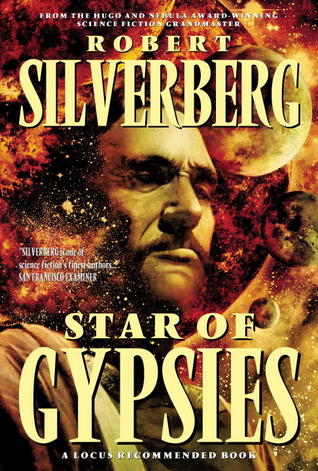
Star of Gypsies
- Автор: Силверберг Роберт
- Язык: английский
- Жанр: Научная фантастика

Электронная книга - «Star of Gypsies». Краткое содержание книги:
Since mud is something infrequently encountered in a desert, and this desert was even more bleak and parched than deserts normally are, you may be wondering why this creature is called a mudpuppy. Sandpuppy might be more accurate. There is a reason. The mudpuppy spends almost its entire existence burrowed deep down in the desert sand, far below the scorching heat of Duud Shabeel's remorseless sun. It lies asleep in its tunnel, scarcely even breathing. Once every five years-or ten, or twenty-rain comes to that desert. Sometimes it is the merest light shower, but more often, when it rains there at all, it rains a deluge. Trickles of water make their way between the grains of sand and awaken the mudpuppies. Hastily they begin to dig toward the surface. If they are lucky, they emerge while it is still raining. The torrential downpour turns the sand to mud and creates short-lived ponds and pools in the low-lying places. In a single frenzied night of mating the mudpuppies dance wildly around, choose their partners, and copulate desperately until dawn. The males die at the break of day; the females lay their eggs in the pools and ponds and then they die too. Forty-eight hours later the tadpoles begin to hatch.
The childhoods of these creatures last about two weeks. That is all they can possibly get, for after the rain comes the heat again, and the desert begins to dry. Within a couple of weeks the little ponds and pools have vanished. The tadpoles, if they have reached maturity before that happens, hastily begin burrowing into the sand, digging themselves down far below the surface. There they rest, slumbering, dormant, until the next time it rains, years hence, when it will be their turn to arise and dance and mate and die.
It rained while I was living in the desert of Duud Shabeel. I watched the mudpuppies emerge, I saw them do their dance. And I wondered: What is the virtue of such a life? What merit is there in sleeping under the sand for years and years in order to have a single night of joy? What purpose can there be in it? These poor creatures are victims of nature's blind impulse toward self-perpetuation. The only purpose they serve is to create the next generation, whose sole purpose it will be to create the next.
And then I thought, Is it not the same with us? Are not we just a more elaborate kind of mudpuppy, arising and going through our little mating dance and dying so that our places can be taken by those who follow after?
I confess that these thoughts threw me into the deepest despair I have experienced in my life, worse even than when I lay imprisoned with the overthrown Loiza la Vakako, worse than when I suffered in the passageways of Alta Hannalanna. For suddenly I saw life as purposeless, and that was terrifying to me. I saw us as mere prisoners throughout all our days, as the mudpuppies are in their burrows in the sand: hoaxed and deceived by nature, filled with philosophical nonsense designed to keep us working at our task of replacing old life with new. If I had been less sturdy and resilient of soul I think I might have wanted to kill myself, thinking these thoughts, alone in that melancholy desert.
And then I thought: What does it matter if we are nothing but mudpuppies? How does it change anything, knowing that? We still must rise in the morning and go through our days and do what is required of us. And if there is no point to it, why, then there is no point to it: but we must go on, and we must do the best job of it that we can. The mudpuppies understand that. They waste none of their strength in weeping and wailing and railing against their destiny. No, they wait and sleep, and then they arise and dance. Let it be the same with us. Let us live as though there is purpose, and go through each day joyously and with vigor, doing the task that is our task. For there is no alternative. This is the only road. Therefore it has to be the right road. Even if everything seems meaningless, nevertheless there must be some meaning beneath that meaninglessness; and even if we are no more able to see that meaning than are the mudpuppies of Duud Shabeel, yet it is better to go onward than not to go onward. So live. Seek. Learn. Grow.
I found great comfort flooding in upon me when I came to understand the truth of that conclusion. My despair lifted and I returned from the desert and went about my business on Duud Shabeel, and I have gone about my business, whatever it has happened to be, without doubts ever since. From that day onward I have known no despair. Anger, yes, and dismay, and anguish, from time to time; but never despair. For despair means the loss of hope, and I am no longer capable of achieving a loss of hope, now that I have absorbed and understood the lesson of the mudpuppies. The memory of their joyous dancing in the desert rain has carried me through many a black hour ever since.
I thought of these things again as I lay imprisoned in Shandor's oubliette. Waiting for the endless hours to pass, waiting for the moment when I could rise once more to the surface and begin my dance.
GHOSTING MY ONE AMUSEMENT, MYANODYNE THE SOLE consolation of the hapless prisoner in the clammy cell. Once again it became my joy and my escape, as it had been for me long ago on Alta Hannalanna. And on many another occasion after that.
It was a long time since I had done any serious ghosting. You pass through giddy phases, especially at the beginning, where you do it all the time. The whole vast range of the past lies open before you and you can't get enough of it. You go everywhere. Mars. Venus. Atlantis. New Jersey. It's like being a god. That freedom, that sense of omnipotence. But eventually you do get enough. Everyone who ghosts grows sated sooner or later, except maybe Polarca, who seems insatiable. Even I did. I wasn't bored with it. How can you get bored with infinity? But after you have been everywhere and a half, there are times when it seems as if you don't need to go anywhere else. Maybe gods come to feel the same way now and then. Do they get weary of godding, I wonder? Envy the lowly humans their tedious toil?
You may go without ghosting for years at a time, but you don't ever forget the knack of it. You know it's there, whenever you need or want it. And then you find yourself cast into somebody's dark oubliette and you give thanks to the Holy Spirit that you can do it. Off you go. Up and out, far and away.
I LIKED BEST OF ALL TO DO MY GHOSTING ON EARTH. BACK to my roots, back to the solid terra firma, land where my fathers died. The old Rom blood drew me like a magnet. Again, again, again Earth, any epoch, any of its myriad nations.
WHERE AM I NOW? A WALLED CITY, PROTECTED ON TWO sides by two great ramparts, on two sides by the sea. The sky is fair, the sun is strong. Who are these dour thick-bearded men in armor? Ah. They wear the emblem of the Cross. These must be Crusader knights. Within the city are Saracen defenders. And here, these darker men and women in tattered white robes and gowns, at the edge of the camp? I hear them chattering in Romany. Or something that sounds as if it might have been Romany once, long ago. They go among the warriors offiering services. This man is a blacksmith who carries his own forge on his back. Three stones for a hearth, a bellows that he works with his toes, charcoal for fuel. A file, a vice, a hammer. Sharpen your sword, good knight? Mend your armor? And this one here, the coppersmith. And the old woman who looks like our phuri dai, doing the dukkeripen, saying the future. You will be a great lord, immense estates will be yours, your sons will be dukes and your grandsons will be kings.
We help the good Christian warriors fight their war. We build a great four-story machine for them to invade the Saracen city. The first story is of wood, the second of lead, the third of iron, the fourth of bronze. But it catches fire and the defenders rejoice. So we build for them a stone-catapult that they call the Evil Neighbor, and a grappling ladder called the Cat. And two catapults that fling stones night and day against the besieged city.
I float over the wall and discover that there are Rom within. In this war we work for Christian Gaje and we work for Saracen GaJe. The work is what matters. The issues for which they fight are absurd to us. For the Saracens we mix pots of Greek fire-naphtha and other substances, a monstrous weapon that sticks to your skin and burns you alive-and they hurl them over the walls at the Crusaders. "Allah is Great," the defenders cry. They look at us expectantly and we cry it too, "Allah is Great." Why not? Allah is great.