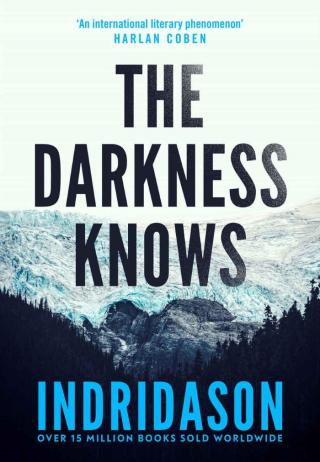
The Darkness Knows
- Автор: Indridason Arnaldur
- Серия: Detective Konrad #1
- Год: 2021
- Язык: английский
- Год: Harvill Secker/Penguin Random House UK
- ISBN: 978-1-78730-232-7
- Переводчик: Victoria Cribb
- Жанр: Криминальные детективы

Электронная книга - «The Darkness Knows». Краткое содержание книги:
The case: impossible to solve. Until now.
A frozen body is discovered in the icy depths of Langjökull glacier, apparently that of a businessman who disappeared thirty years before. At the time, an extensive search and police investigation yielded no results-one of the missing man’s business associates was briefly held in custody, but there wasn’t enough evidence to charge him.
Now the associate is arrested again and Konrád, the retired policeman who originally investigated the disappearance, is called back to reopen the case that has weighed on his mind for decades.
When a woman approaches him with new information that she obtained from her deceased brother, progress can finally be made in solving this long-cold case.
For many years before that, the custody facilities had been at the prison on Sídumúli in Reykjavík, conveniently close to the police station. That was where Hjaltalín had been detained during the original inquiry. But times had changed, Konrád thought, as he took the main road out of town across the seemingly endless expanse of moss-covered lava fields, passing the familiar landmarks: the green-roofed building of the Little Cafe, standing alone among the wastes, and the distinctive black-cinder slopes of Mount Vífilfell.
He had finally come round to the idea of visiting Hjaltalín in custody. Not because Hjaltalín had insisted and refused to speak to anyone else, but because Konrád had invested so much time and energy in the original investigation. He’d never really stopped looking for answers. All the hard graft that he and other members of CID had put into the inquiry had ultimately been wasted. The case had been a rarity in that it hadn’t been wrapped up in a matter of days, like most major crimes in Iceland. The investigation had quickly ended up all over the place, badly lacking direction; they’d never found a body, and although Hjaltalín had been the main focus, countless other people had been interviewed as potential suspects. Now, the discovery of Sigurvin’s body had cracked the case wide open again.
At some point Hjaltalín had got it into his head that Konrád was the only member of CID he could trust, and due to the way things worked out, Konrád had conducted most of his interviews. He assumed this was the main reason why Hjaltalín was demanding to talk to him now. The police had caved in to his wishes and, in the end, so had Konrád. But Konrád had no intention of doing anything else for the police. He had got too used to the comforts of retirement: the leisure time, the freedom to organise his own life, the lack of onerous duties and responsibilities. He had done his bit for society: it was someone else’s turn to take over. If his meeting with Hjaltalín provided the police with a lead, fine. Apart from that, Konrád was staying well out of it.
His son had called as soon as he heard the news. He knew all about his father’s biggest unsolved case and wanted to hear what Konrád was thinking now that Sigurvin had finally been found. Konrád told him he was glad that new information had come to light and that his thoughts were mainly of Sigurvin’s family and the distress they’d endured as a result of having to live all these years without closure.
Konrád’s recent insomnia hadn’t been helped by the fact that his brain was now working overtime on the old case, preoccupied with thoughts about how he had conducted the original investigation and whether there was some obvious angle he had neglected. It wasn’t the first time these questions had caused him sleepless nights.
The world had changed beyond recognition in the last thirty years. It seemed unbelievable now that beer had still been illegal in Iceland in 1985. There had been just one, state-run TV channel. And only a couple of aluminium smelters. Kárahnjúkar, the biggest hydroelectric dam in Europe, hadn’t even been conceived of. Reykjavík used to have regular snowfalls in winter. There had been no internet or mobile phones, and hardly any personal computers. The privatisation of the banks and the ensuing chaos; the arrogant, reckless stupidity of government and economic leaders; the financial collapse — they were all in the future. The new millennium had seemed as remote as science fiction.
One cold February afternoon in those far-off days, as the light was failing and a bitter wind was gusting through the streets, the police station on Hverfisgata received a phone call. The woman at the other end wanted to report the disappearance of a thirty-year-old man — her brother, Sigurvin. She had last spoken to him two days earlier on the phone, when they made an arrangement to meet up. When he failed to appear at the appointed time, she had tried to get hold of him. He wasn’t answering at home, so she called him at work, only to learn that he hadn’t been in for the last two days. After that she had gone round to his house and knocked on the door in vain, before finally calling out a locksmith, afraid that Sigurvin might be lying ill indoors, unable to get to the phone, or that he might have unplugged it for some reason. Once inside, she had gone from room to room, calling out his name, but he wasn’t there. As far as she was aware, he’d had no plans to travel abroad. He usually let her know if he was leaving the country and, anyway, she’d come across his passport in a drawer in the sitting room. He lived alone, was recently divorced and had one daughter, who lived with her mother.
The police took it for granted that the man would turn up, since he hadn’t been missing long, but they noted down his description and got a headshot from his sister, which they then circulated to all the newspapers and police stations in the country. The presence of his passport showed that he couldn’t have left Iceland by air, unless he had done so under an alias or somehow slipped through passport control undetected. When this possibility was put to his sister, she dismissed it as absurd: what possible reason could he have had to travel on a forged passport?
Before long, the volunteer search and rescue teams were called out and the standard missing-person response was put into action. All the beaches in the Greater Reykjavík area were combed. The press became interested in the case and carried detailed articles about the missing man. The public were urged to come forward with information if they knew anything about his movements, however insignificant it might seem, and in no time his jeep was discovered. It was parked at the foot of the hot-water tanks on Öskjuhlíd, the wooded hill close to the centre of Reykjavík. A special incident line was set up and tip-offs soon started flooding in, some more plausible than others, though the police did their best to follow them all up. One was an anonymous phone call from a woman who had delivered her message in a rush, then hung up immediately afterwards. She claimed that Sigurvin’s former business partner had been overheard threatening to kill him in the car park in front of the company offices.
It had fallen to Konrád to follow up this lead. He learnt that a man called Hjaltalín had been threatening Sigurvin for some time, claiming that he had been swindled out of millions of krónur. It transpired that the two men had owned three boats and a fishing business together. Sigurvin had been responsible for the day-to-day management; Hjaltalín had only been a sleeping partner. In fact, he liked to boast about being a total landlubber. His main concern was a couple of clothing shops in Reykjavík and an import business, along with shares in one or two other companies. The two men had met as students at the Commercial College. They had both been similarly bold and driven; young men on the make. Sigurvin had persuaded Hjaltalín to go shares on a boat with him and before long there had been two boats, then three, then it had developed into a whole fishing business. Eventually, at Sigurvin’s suggestion, Hjaltalín had agreed to sell his share to him and they had signed a contract to that effect. But it wasn’t long before Hjaltalín began to accuse Sigurvin of ripping him off. The company had been worth far more than his friend had led him to believe, he argued. And that wasn’t alclass="underline" the value was likely to increase dramatically if Sigurvin played his cards right, since the recently introduced quota system would restrict access to the fishing grounds, resulting in massive share rises for existing companies. Hjaltalín had started having misgivings when he learnt more about the new arrangement and consulted experts, who presented him with a very different picture of the company’s prospects from the one Sigurvin had sketched out for him. Aggrieved, Hjaltalín told his friend he had trusted him, but Sigurvin flatly denied cheating him. Business was business, he said, and Hjaltalín had signed the contract of his own free will. End of story.