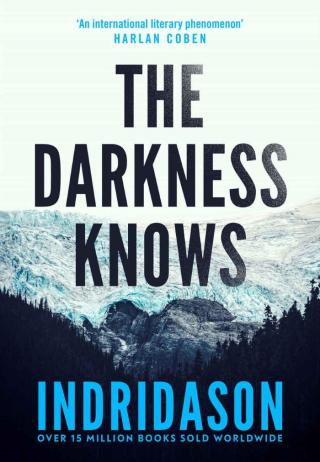
The Darkness Knows
- Автор: Indridason Arnaldur
- Серия: Detective Konrad #1
- Год: 2021
- Язык: английский
- Год: Harvill Secker/Penguin Random House UK
- ISBN: 978-1-78730-232-7
- Переводчик: Victoria Cribb
- Жанр: Криминальные детективы

Электронная книга - «The Darkness Knows». Краткое содержание книги:
The case: impossible to solve. Until now.
A frozen body is discovered in the icy depths of Langjökull glacier, apparently that of a businessman who disappeared thirty years before. At the time, an extensive search and police investigation yielded no results-one of the missing man’s business associates was briefly held in custody, but there wasn’t enough evidence to charge him.
Now the associate is arrested again and Konrád, the retired policeman who originally investigated the disappearance, is called back to reopen the case that has weighed on his mind for decades.
When a woman approaches him with new information that she obtained from her deceased brother, progress can finally be made in solving this long-cold case.
‘OK, bye.’
The discovery was all over the media but Konrád had got the inside story from Svanhildur. Ever since the body was recovered from the ice, four members of Forensics had been stationed on the glacier, conducting a search of the area. Police officers from the little west coast town of Borgarnes had been first on the scene after the German tour group had rung the emergency number. The local volunteer search and rescue team had also been called out, and this had alerted the press to the fact that something was up. The police officers from Borgarnes had made their way onto the ice, despite being inadequately equipped, and had confirmed that the body was that of a man, aged around thirty, who had evidently been there a long time. They had been ordered by their superior not to touch anything, and to keep the tourists well away. At this point, Forensics in Reykjavík had been notified. By then, the Borgarnes rescue team had reached the edge of the glacier in their specially equipped vehicles. They conveyed the Germans down to the hotel at Húsafell, along with their guide, a woman in her early sixties called Adalheidur, who had found the body. That evening, the group had travelled back to Reykjavík. Detectives from CID had questioned the woman closely and spoken to the Germans with her help. An older man, who informed them that he was a doctor, explained that he’d brushed some snow from the man’s face but that otherwise they’d been careful not to touch anything.
In order to minimise disturbance of the evidence, a block of ice weighing almost two hundred kilos had been carved out around the body, then freed and hoisted onto the rescue team’s ice truck. A forensic technician had accompanied the chunk of glacier to Reykjavík, keeping a close eye on anything it produced as it melted. Later that evening, most of the police and rescue team members had gone down to Húsafell where they had spent the night, leaving four officers behind on the glacier to prevent any unauthorised individuals from approaching the site.
One of the country’s top glaciologists, interviewed on the radio in connection with the discovery, was quick to point out that since 1985, when Sigurvin’s body had been hidden on the glacier, the ice cap had shrunk by more than seven cubic kilometres. It was now around six hundred metres thick, but experts calculated that during the next quarter of a century the glacier would shrink by almost 20 per cent as a result of global warming.
‘And some people are still sceptical about manmade climate change!’ Konrád had heard the glaciologist saying in a tone of exasperation on the radio that morning.
‘Would the body have been laid on top of the ice or buried somehow?’ the radio host had asked.
‘Hard to say. It’s possible he was dropped into a crevasse. He went missing in February, when freezing temperatures would have made it extremely difficult to dig into the ice. But he would have been covered with snow quickly enough. Another possibility is that a crevasse subsequently opened and swallowed him up, and he remained there until his recent reappearance.’
‘Did the ice just melt to reveal him, then?’
‘Of course, that will require further analysis, but it sounds plausible. It would be the simplest explanation for why he’s turned up now.’
Yet again Konrád’s mobile phone shattered the silence of his house in Árbær. This time it was Svanhildur, wanting to know what he was planning to do. She’d heard that Hjaltalín was asking to see him.
‘I don’t know,’ Konrád said. ‘Maybe it wouldn’t hurt to talk to him — to hear what he’s got to say.’
‘Oh, come on! You must be dying of curiosity. This is Sigurvin we’re talking about! Surely that must spark your interest?’
‘Hjaltalín wasn’t even thirty when we arrested him,’ Konrád remarked.
‘I remember it well.’
‘He must be pushing sixty now. I haven’t seen him for donkey’s years.’
‘Do you think he’ll have changed much?’
‘I think he’ll be the same idiot.’
‘You two weren’t exactly best mates.’
‘No,’ said Konrád. ‘Though he seemed to think we were. I don’t know what he wants to talk to me about. The fact is, I wouldn’t trust Hjaltalín as far as I could throw him. He wouldn’t be in custody now if they hadn’t thought he was trying to make a run for it. He was on the point of leaving the country when they arrested him. That was the day after Sigurvin was identified. He claimed it was a complete coincidence.’
‘Are you sleeping any better these days?’
‘Not much.’
‘You know you can always call me if there’s something bothering you,’ Svanhildur said. ‘If you want to chat.’
‘Yes, but I’m fine,’ Konrád said brusquely.
‘All right.’ Svanhildur was about to ring off, then added, as if she couldn’t help herself: ‘You never get in touch any more.’
‘No, I...’ Konrád didn’t know what to say.
‘Just call if...’
He didn’t respond and they ended the call. He took a sip of wine and lit another cigarillo. He and Erna had sometimes talked about downsizing and moving away from Árbær. Not to some block of flats for pensioners but to a cosy little place near the city centre. Though not in Thingholt or any of those old streets east of the lake, Erna had said, as there were too many party animals living there nowadays. To the west end, rather. Nothing had come of it, though. He remembered how often they had discussed the Sigurvin case at this kitchen table, and how she had always been there for him, whatever happened.
The table in the sitting room was covered with old papers of his father’s that Konrád had been looking through the evening Svanhildur had rung with the news about Sigurvin. They’d been in a cardboard box in the basement and he hadn’t given them so much as a glance in decades. It had been getting mixed up in an old case from the Second World War, involving fraudulent spiritualists, that had resurrected his long-buried interest in his father’s fate. He had been discovered one evening in 1963, lying fatally stabbed in front of the South Iceland Abattoir on Skúlagata. Despite an extensive investigation, the murder had never been solved. Konrád had banished the incident from his mind during all the long years he had worked as a detective. His father had been a troublesome, vindictive man, who had made enemies on every side. He had done stints behind bars for smuggling, theft and fraud. And that wasn’t the half of it. He had also conspired with at least one, if not more, fake mediums during the war. Konrád’s mother had eventually fled their home, taking Beta with her, but her husband had refused to let her take their son, who had remained behind, growing up with his father in the Shadow District.
Konrád leafed through the yellowing papers. His interest had been piqued by a handful of newspaper cuttings on spiritualism and the paranormal that his father had kept. Among them was an article about conmen, and an interview with an Icelandic psychic in a long-defunct weekly newspaper. Another cutting was from a publication by the Society for Psychical Research, discussing the afterlife and ‘the Ether World’. The articles dated from about two years before Konrád’s father had been stabbed outside the abattoir. They had led Konrád to wonder if, in the final months of his life, his father could have returned to his old bad habits of swindling money out of people through fake seances.
5
Konrád had not been happy when the custody facilities were moved to the Litla-Hraun prison ten years back. He was soon fed up with having to drive sixty kilometres over the Hellisheidi mountain road and down through the Threngsli pass, crossing the River Ölfusá where it flowed into the sea, then heading east along the coast towards the villages of Eyrarbakki and Stokkseyri. Some of his colleagues, on the other hand, found it a pleasant break from the city and the constant stress at the police station. Konrád had got his car stuck in a snowdrift on Hellisheidi twice in the same winter, but there were other times when he had been able to enjoy the journey, using it as a chance to relax and take a detour through the Sudurland towns of Hveragerdi and Selfoss, even stopping to buy himself an ice cream on the way.