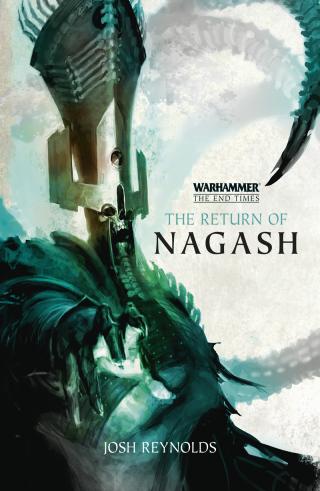
The End Times: The Return of Nagash
- Автор: Рейнольдс Джош
- Год: 2014
- Язык: английский
- Год: Black Library, Games Workshop Ltd.
- Жанр: Боевая фантастика

Электронная книга - «The End Times: The Return of Nagash». Краткое содержание книги:
Markos bit down on the reply that sprang unbidden to his lips. He turned away from Mannfred and settled down to wait, one hand resting on the pommel of his blade. His anger simmered, but he wrestled it down.
Striking now would be disastrous, whether he succeeded or not. They were miles beneath the surface, and dependent on Mannfred for guidance to find their way through the seemingly endless labyrinth of twisted and reeking warrens. He’d considered trying his luck when the skaven had attacked Forzini’s camp, but Elize’s words of caution had restrained him. Mannfred was wary, ready for treachery right now. But, when he’d achieved his goal, Markos would have his chance, or so Elize swore. With the Claw and the Fellblade in his possession, Mannfred would be distracted, drunk on victory and his own power. It was a window of opportunity, albeit a narrow one.
Strike swiftly, before he has the chance to acclimate himself to the power of the artefact, she’d said, and he had to admit that it wasn’t bad advice. Not that he trusted Elize farther than he could throw her. She was likely hoping that he and Mannfred would kill one another. So be it. He couldn’t find it in his heart to blame her. Elize had her own games, just as he did.
Mannfred had ruined them all by coming back. Arrogant, assured of his superiority, he had smashed their delicately woven webs to shreds and tangles, and demanded that they kowtow to him, as they once had. As if their ambitions meant nothing compared to his own.
Well, Markos intended to show him the error of his ways.
Mannfred was as mad as Konrad had been. Oh his madness took a different form, to be sure, but he was just as much a lunatic. His time in the mire had rotted his brains, and he endangered them all with his current obsession. Markos shivered slightly as he looked at the staff Mannfred clutched, and the withered thing that occupied its head. He could feel the malignancy of the Claw in his bones.
Markos was not one to lie to himself. He knew what he was, and what he had done in his centuries of bloodletting. But there were things in the world far worse than him, and the Claw was the tool of one of them. Mannfred was caught up in its whispers and promises. They could all hear the voices – the voice – of the artefacts that Mannfred had gathered. A wheedling, demanding susurrus that permeated Castle Sternieste and haunted them. Every vampire felt the call of Nagash in their blood, whether they admitted it or not.
Most, however, knew better than to give in to it.
He looked at Mannfred again, and blinked. For a moment, in the flickering of the great globes of warpfire that hung from the roof of the cavern, he thought he’d seen something looming over the other vampire. A dark shape, far darker than any shadow, and colder than the depths of a mountain lake.
Markos shuddered and looked away.
Heinrich Kemmler didn’t flinch as the knights struck the vast sea of the dead. He felt the reverberations of that impact in his bones, but he ignored it. He had more important matters clamouring for his attention. His magics were growing less precise, and less effective. At first, he’d thought the culprit was Arkhan. He wouldn’t have put it past the liche to strike while he was otherwise occupied, and try to wrest control of the dead from him.
Arkhan didn’t trust him, Kemmler knew. Nor did he blame the liche. Kemmler had no intention of allowing Nagash to return, whatever Arkhan’s desires. Nagash’s time had passed and good riddance to the creature. Hundreds of arch-necromancers had risen and fallen with the tide of years since the Undying King had been gutted on his own basalt throne, each of them worth more than any old dead thing.
The very thought of it incensed him. The drumbeat – the heartbeat of the Great Necromancer – in his head threatened to drown out all of his hard-won coherency. It had driven him mad, that sound. He knew that now. It had forged him, and fed his hungers. It had been the rhythm that had guided his steps, and set him on the path he had trod for centuries. It was the voice inside his head, whispering the secrets of power and the wielding of it; and then, when he had needed it most, it had taken all of it away. That was something Kemmler could not forgive.
Fresh rage flooded him, and he clawed at the barely visible skeins of magic that flowed about him, trying to find the source of the interference. He could feel the heat of Krell’s growing battle-lust, and he focused on it, using it as a touchstone. The wight had been his constant companion for more years than he cared to count, and he had woven innumerable spells with Krell at his side. The creature was at once a sump and a sponge for dark magic. Sometimes, he even thought that he could hear Krell speak. Or perhaps not Krell, but something that clung to his brutal husk like a shadow.
When Krell was near, the drumbeat was almost impossible to ignore. But that was not the only sound in his head. There were words as well, whispers and wheedling, plaintive murmurs, which rose and fell with the winds of magic. Kemmler had first heard those voices in the hour of Krell’s resurrection, when they had offered him aid if he would bend the wight to certain tasks. And he had, and the voices too had grown quiescent. But now, as the drumbeat grew louder, so too did they, as if the initiators of each were attempting to drown out the other.
Strange currents of power flowed through him now, beneath the old familiar shroud of deathly sorcery. Like an adder beneath the water, this new power warmed him to his joints, and buoyed him. It had healed his mind and memory and soul, though it had taken centuries to do so. Centuries to clear out the rot of Nagash, Kemmler knew.
Nagash had used him. It was Nagash who had used him to build an empire, and Nagash who had guided him to Krell, but not for Kemmler’s sake. That was what the whisperers had told him. And it was Nagash who wanted to use him now. It was Nagash who stalked him in the dark hollows of memory, hunting the tatters of his soul.
Fear, now, warred with rage. He flailed as a thread of magic slipped between his fingers. A nearby zombie flopped down, inert and inanimate. More followed suit, and Kemmler hissed in mounting frustration. Concentrate, he had to concentrate. Between the hammer of the drum and the mounting agitation of the whispers, he heard the telltale cackle of the skull atop his staff.
Kemmler turned, and his eyes narrowed. He caught a pale wisp of rising magics – not the ashy smoke of the wind of death, but the gossamer effluvium of the raw stuff of life – and saw a trio of women standing behind the embattled shieldwall of peasantry. His lips writhed back from his teeth in a snarl of disdain.
The women were marshalling the magics of life to counteract his sorceries of death. Behind them, moss and flowers crawled across the stones of the abbey walls, and thick vines and roots crawled across the battlefield about them. The impertinence of it assaulted his sensibilities, and he slammed the end of his staff down, planting it like a standard.
‘This is my ground, witches,’ he hissed. And it was, in every way that mattered. He had bought it in blood and time. Every time he had made war in this place, on the abbey, he had shed his life’s blood and soured the ground with the stuff of death. They could plant all of the trees and flowers they liked, remove all of the bodies, weave every protective enchantment known to elf or man, but the ground was still his and would be forever more.
As if they had heard his words, three pairs of eyes, violet and alien, met his own dark ones. He felt a jolt as three minds, trained to think inhuman thoughts and bent to inhuman goals, reached out to him. They were powerful, these witches. The cursed elves of Athel Loren had taken their natural gifts and forced them down unnatural paths, moulding them into weapons to be used against their own kind.