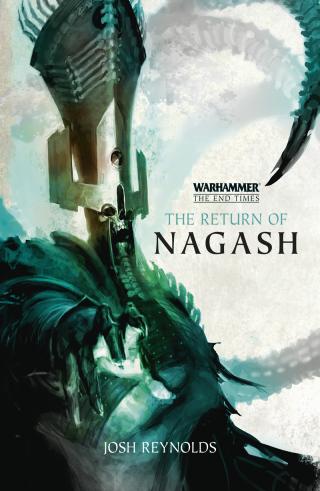
The End Times: The Return of Nagash
- Автор: Рейнольдс Джош
- Год: 2014
- Язык: английский
- Год: Black Library, Games Workshop Ltd.
- Жанр: Боевая фантастика

Электронная книга - «The End Times: The Return of Nagash». Краткое содержание книги:
‘This… is a glorious day,’ he murmured. He looked around at the knights who surrounded him. Anticipation was writ on every face, and their horses shifted impatiently, as eager as their riders to be at the charge. He knew that similar looks would be on the faces of the knights waiting for his signal on the opposite flank.
He rose up in his saddle and lifted his axe over his head. On the other side of the field, a horn crafted from the tusk of a great wyrm wailed. Theoderic knew that horn, and the man who wielded it – Montglaive of Treseaux, slayer of the wyrm Catharax, from whose cooling corpse he had hacked the tusk he had made into his horn. Montglaive commanded the right flank, as Theoderic commanded the left. As the horns on the right sounded, so too did the horns on the left, and Theoderic felt his soul stir.
He was not a man for speeches, inspiring or otherwise. It was not in him to rouse or incite, but he knew that something must be said. He felt the weight of the world’s attention on him. The air vibrated with some inescapable pulse, some fateful pull, which sharpened his attentions and tugged at his heart. He might die this day, but he would not be forgotten. He would not be remembered as a sozzle-wit or a failed knight, but as a hero. As a champion of the Lady, and of the realm. Songs would be sung, and toasts raised, and the name of Theoderic of Brionne would stand through the ages to come.
That was all he had ever wished.
‘This is a glorious day!’ he roared, spreading his arms. ‘We honoured few stand between holy ground and a black host, and the Lady stands with us! Our fair land writhes in pain, assaulted by daemon, outsider and ill-roused corpse. But we few stand here, to prove not simply our courage, or our honour, but that though all Bretonnia is besieged, hope has not yet forsaken the realm eternal! Hope, which echoes in the rattle of swords and the thunder of hooves! Ride, defenders of La Maisontaal! Ride, knights of Bretonnia! Ride and sweep the enemy before you – ride for the Lady and the world’s renewal!’
All around him, his knights gave a great shout, and then thrust back their spurs and joined the battle, Theoderic at their head. The ground shook as the pride of Bretonnia hurtled towards their enemy, lances lowered.
Theoderic bent forward over his charger’s neck. He carried no lance, but instead wielded his axe. The weapon was his only reminder of who he had been, before his disgrace. He had carried it in glory and in folly, and he would not be parted from it save in death. Its blade had been anointed in the holy font of La Maisontaal, and as it spun in his grip, it began to shine with a blessed light.
The darkness retreated before him, and he could see the dead where they stumbled, mindless and remorseless. To him, in that moment, they were a sign of all that had afflicted Bretonnia. He raised his axe, roared out an oath and struck out as his steed smashed into the flanks of the dead and pierced them like a spear. His axe licked out, shining like a beacon, and took the head from a zombie.
Then the rest of the knights struck home, and the twelfth and final battle for La Maisontaal Abbey began in earnest.
FOURTEEN
Markos von Carstein did not consider himself unduly ambitious. Indeed, he liked to think of himself as something of an idealist. Vlad had been an idealist, and Vlad was his model in most things. Vlad was a paragon, the vampiric ideal made flesh. The King of Blood, the Emperor of Bones, his ghost was tangible in every speck of Sylvanian soil.
Markos bent away from the thrusting spear, and flicked his wrist, bisecting the squealing ratman’s skull with his sword. He twisted in his saddle, chopping another in half, and swatted away a smoke-filled globe with the flat of his blade, sending it tumbling back towards the skaven who’d thrown it. It shattered and the skaven died, choking on its own blood.
It was Vlad who had elevated him from the common muck, and made him a Templar of the Drakenhof Order. It was Vlad who had nurtured his natural gifts for sorcery and strategy. It was Vlad who had given him purpose.
And it was Mannfred who had taken it all away.
Mannfred the liar. Mannfred the schemer. Mannfred the acolyte. Mannfred, who had come from somewhere else to join Vlad, who was no Sylvanian, who sometimes spoke in an accent that Markos had yet to recognise, despite his travels.
Vlad should never have trusted him. But that too was part of the ideal. Vlad had worn his honour like armour, and it had dragged him down in the end. Markos had learned from Vlad’s mistakes and when Mannfred had set his feet on the path of empire, Markos had absented himself. Mannfred was not Vlad, and he lacked Vlad’s patience, something that inevitably led to his downfall. His attempt at conquest had ended with him sinking into Hel Fenn, and the shattering of the Drakenhof Order. They had all gone their separate ways, eager to put their defeat behind them.
Markos had spent years building up his own network of spies and informers. He had schemed and plotted dynastic marriages and political alliances, all to ensure his ultimate success. Elize, he knew, had been doing much the same, as had Tomas and the others. The Game of Night had lasted for centuries, as the remaining von Carsteins wove plot and counter-plot against one another and the Lahmians.
And then Mannfred had ruined it all by coming back.
Markos growled and parried a rust-edged cleaver. He thrust down, pinning the skaven to the cavern floor. There were seemingly thousands of the beasts, and they just kept coming in wave after wave of squealing fodder. He jerked his blade up out of the dying skaven and looked around. The cavern resembled the bowels of some vast, nightmarish engine – immense cogs, corroded pistons and acid-pitted flywheels projected from the walls at all angles, and rose from deep grooves in the cavern floor. The mechanisms were still in motion, despite the battle, and as Markos watched, a skaven warrior got too close to one and was whisked into a clanking maw, to be pulverised instantly.
The cavern was so choked with machinery that it was impossible for the combatants to fight more than five or six abreast, and the skaven suffered for this inability to bring their numbers to bear. Horns wailed and bells clanged somewhere far back in one of the tunnels, and those skaven closest to the exits began to flee the cavern.
Markos wheeled his horse about and galloped back towards the knot of undead horsemen who surrounded the Drakenhof Templars and Mannfred. As he passed through the ranks of the former, he examined them enviously. The Doom Riders had been legendary even in Vlad’s time. Supposedly, they had first ridden forth from whatever barrow had held them at Nagash’s command, and after his defeat at Sigmar’s hand, they had ridden into the depths of the Drakwald, from whence they had haunted the surrounding lands for centuries until Vlad had sought them out and bent them to his will.
The undead horsemen wore corroded armour of a bygone age, and carried lances wreathed in cold flame. They watched him as he threaded through them, and his flesh felt as if it were covered in crawling spiders as they tracked his progress with hell-spark eyes. When he reached the others, Mannfred glanced at him. ‘Well?’
‘They’re falling back,’ Markos said. He leaned back in his saddle. ‘We’ll have the cavern cleared within the hour, unless they bring up reinforcements. Which they don’t seem inclined to do, if you want my opinion.’
‘I don’t,’ Mannfred said, turning away.