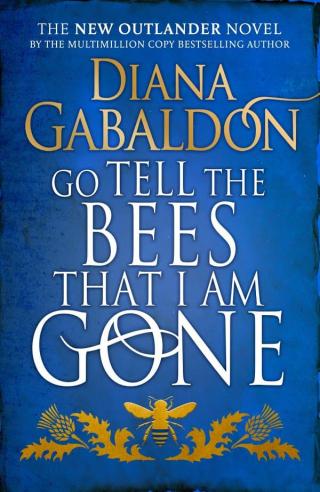
Go Tell the Bees That I Am Gone
- Автор: Гэблдон Диана
- Серия: Outlander #9
- Год: 2021
- Язык: английский
- Год: Delacorte Press
- ISBN: 978-1-473-51900-8
- Жанр: Исторические приключения

Электронная книга - «Go Tell the Bees That I Am Gone». Краткое содержание книги:
The past may seem the safest place to be . . . but it is the most dangerous time to be alive. . . .
Jamie Fraser and Claire Randall were torn apart by the Jacobite Rising in 1746, and it took them twenty years to find each other again. Now the American Revolution threatens to do the same. It is 1779 and Claire and Jamie are at last reunited with their daughter, Brianna, her husband, Roger, and their children on Fraser’s Ridge. Having the family together is a dream the Frasers had thought impossible. Yet even in the North Carolina backcountry, the effects of war are being felt. Tensions in the Colonies are great and local feelings run hot enough to boil Hell’s teakettle. Jamie knows loyalties among his tenants are split and it won’t be long until the war is on his doorstep. Brianna and Roger have their own worry: that the dangers that provoked their escape from the twentieth century might catch up to them. Sometimes they question whether risking the perils of the 1700s—among them disease, starvation, and an impending war—was indeed the safer choice for their family. Not so far away, young William Ransom is still coming to terms with the discovery of his true father’s identity—and thus his own—and Lord John Grey has reconciliations to make, and dangers to meet . . . on his son’s behalf, and his own. Meanwhile, the Revolutionary War creeps ever closer to Fraser’s Ridge. And with the family finally together, Jamie and Claire have more at stake than ever before.
A not-bad copy of Mr. Pope’s translation of The Odyssey—maybe he’d read a bit of that with Jem; he’d likely find the ships and monsters interesting, and it would be an excuse to cram a bit of Latin into the lad’s head while they were about it. Joseph Andrews … a waste of paper, that one; he’d maybe trade it to Hugh Grant, who liked silliness. Manon Lescaut, in French and a fine morocco binding. He frowned briefly at that one; he’d not opened it. John Grey had sent it to him, before …
He grunted irritably and, on impulse, took the book at the bottom of the stack—Mandy’s big bright-orange Green Eggs and Ham. The color, the title, and the comical beast on the cover made him smile, and a few minutes with Sam-I-Am eased his temper.
The thump of steps coming down the stairs made him sit up, but it was only Bluebell, who padded up to him, tail wagging gently, sniffed him in case he had any food about his person, gave that up, and went to stand by the back door in a meaningful manner.
“Aye, a nighean,” he said, opening the door for her. “Look out for painters.” She vanished into the night with a swipe of her tail, but he stood for a moment, looking out and listening to the dark.
It was quiet, save for the trees talking among themselves, and he stepped outside and stood looking up at the stars, letting go of the lingering annoyance roused by Manon Lescaut and letting their peace come into him. Took a deep breath of the fresh piney air and let it out slowly.
“Aye, I forgive ye, ye bloody wee bugger,” he said to John Grey, and felt the lightening of soul he’d been unconsciously seeking.
A rustling in the bushes by the privy heralded the dog’s return. He waited for her to finish her industrious sniffing and held the door open for her. She passed him with a brief wag of her tail and bounded softly up the stairs.
He felt more settled in himself, and walked a little way by starlight to the red cedar that grew near the well, to drink water and pluck a twig. He liked the smell of the berries—Claire told him they were used to flavor gin, which he didn’t care for, but the scent was fine.
Inside again, the door bolted and the fire poked up, he went back to the books, the cedar twig making a small fresh smell for him that went well with the wine. He took up one of the small thick books about Hobbits that Bree had brought for him, but even with his spectacles, the print was dense enough to make him feel tired looking at it, and he put it down again, eyes seeking something else in the pile.
Not Manon, not yet. His forgiveness was sincere, but distinctly grudging, and he kent well enough it would need to be repeated a few times before he spoke to John Grey again.
Nay doubt it was the thought of reluctant forgiveness that made him pick up the book Brianna had brought for herself—Frank Randall’s book. The Soul of a Rebel.
“Mmphm,” he said, and drew it out of the stack, turning it over in his hands. It felt strange; a good weight and size, sound binding, but the paper cover was printed with a very peculiar tartan background in pink and green, on which there was a square of pale green with a decent wee painting of the basket hilt of a Scottish broadsword and a bit of the blade. Below the square, the subtitle, The Scottish Roots of the American Revolution. What made it feel odd, though, was the fact that it was wrapped in a transparent sheet of something that wasn’t paper, slick under his touch. Plastic, Brianna had told him when he asked. He kent the word, all right, but not with this meaning. He turned the book over to look at the photograph—he was becoming halfway accustomed to photographs, but it still took him back a bit to see the man looking out at him like that.
He pressed his thumb firmly over Frank Randall’s nose, then lifted it. He tilted the book from side to side, letting light from the fire play over the plastic covering. He’d made a very faint smudge, not visible if you were looking straight at it.
Suddenly ashamed of this childishness, he erased the mark with his shirtsleeve and set the book on his knee. The photograph looked calmly up at him through dark-rimmed spectacles.
It wasn’t only the writer that disturbed him. Hearing bits of what was to come from Claire and Bree and Roger Mac frequently alarmed him, but their physical presence was reassuring; whatever horrible events were to happen, many folk had survived them. Still, he kent well enough that while none of his family would ever lie to him, they did often temper what they said to him. Frank Randall was another thing: an historian, whose account of what was going to happen in the next few years would be …
Well, he didn’t ken exactly what it might be. Frightening, perhaps. Upsetting, maybe. Maybe reassuring … in spots.
Frank Randall wasn’t smiling, but he looked pleasant enough. Lines in his face that cut deep. Well, the man had been through a war.
“To say nothing of bein’ married to Claire,” he said aloud, and was surprised at the sound of his voice. He picked up his wineglass and took a mouthful, holding it for a moment, but then swallowed and turned the book over.
“Well, I dinna ken if I forgive ye or not, Englishman,” he murmured, opening the cover and taking a cleansing breath of cedar. “Or you me, but let’s see what ye have to say to me, then.”
HE WOKE THE next morning to an empty bed, sighed, stretched, and rolled out of it. He’d thought he’d dream about the events described in Randall’s book, but he hadn’t. He’d dreamed, rather pleasantly, about Achilles’s ships, and would have liked to tell Claire about it. He shook off the remnants of sleep and went to wash, making a mental note of some of the things he’d dreamed so as not to forget them. With luck, she’d be home before supper.
“Mr. Fraser?” A delicate rap on the door, Frances’s voice. “Your daughter says breakfast is ready.”
“Aye?” He wasn’t smelling anything of a savory nature, but “ready” was a relative term. “I’m coming, lass. Taing.”
“Tang?” she said, sounding startled. He smiled, pulled a clean shirt over his head, and opened the door. She was standing there like a field daisy, delicate but upright on her stem, and he bowed to her.
“Taing,” he said, pronouncing it as carefully as he could. “It means ‘thanks’ in the Gaelic.”
“Are you sure?” she said, frowning slightly.
“I am,” he assured her. “Moran taing means ‘thank you very much,’ should ye want something stronger.”
A faint flush rose in her cheeks.
“I’m sorry—I didn’t really mean are you th—sure. Of course you are. It’s only that Germain told me ‘thank you’ is ‘tabag leet.’ Is that wrong? He might have been practicing on me, but I didn’t think so.”
“Tapadh leat,” he said, restraining the urge to laugh. “No, that’s right; it’s only that moran taing is … casual, ye might say. The other’s when ye want to be formal. If someone’s saved your life or paid your debts, say, ye’d say, ‘Tapadh leat,’ where if they passed ye the bread at table, ye’d say, ‘Taing,’ aye?”
“Aye,” she said automatically, and flushed deeper when he smiled. She smiled back, though, and he followed her down the stairs, thinking how oddly engaging she was; she was reticent, but not shy at all. He supposed one couldn’t be shy, if raised with the expectation of becoming a whore.