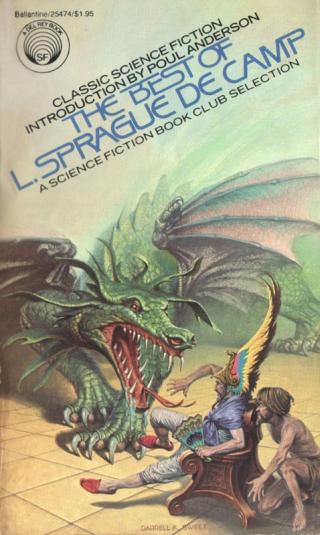
The Best of L. Sprague de Camp
- Автор: Де Камп Лайон Спрэг
- Год: 1978
- Язык: английский
- Год: Del Rey / Ballantine
- ISBN: 0-345-25474-0
- Жанр: Научная фантастика

Электронная книга - «The Best of L. Sprague de Camp». Краткое содержание книги:
Falck laughed. "Oh, that. Jerry Bundy's on Sunday, so I'll tell him to monitor you and be ready to take over."
Ross said: "You should call yourselves the John Alden Company." Falck smiled. "Bring on your Priscilla, and we'll bundle her for you."
They parted, and Ross plunged back into the swarming garment district. He killed time, watching sweating shipping clerks push hand trucks loaded with dresses, until his controller returned to his booth and came on the hypospace. Then Ross sent in the signal.
Marcus Ballin (Outstanding Knitwear: sweaters, T-shirts, bathing suits) was a medium-sized man with sparse gray hair and somewhat the air of one of the more amiable Roman emperors. Ovid Ross soon learned that his trepidations about having the man insult him or clam up had been needless. Marcus Ballin loved to talk, he was a fascinating talker, and best of all he loved talking about himself.
Over the background noise of the knitting machines in the suite of lofts that comprised his empire, Ballin, with eloquent gestures of his cigar, poured into Falck-Ross's ears the story of his many activities. He told of his travels, his fun with his airplane and his violin, his charitable and settlement work, until Ross, a prisoner for the nonce in his own skull, wondered how this man of parts found time to be also one of the most successful garment manufacturers in New York.
Falck-Ross said: "But, sir, how about that special show?"
"Oh, that." Ballin chuckled. "Just a little stunt to help my fall line. I'm putting on a show for the buyers with a contest."
"A contest?"
"Absolutely. To choose the most beautiful bust in America."
"What? But Mr. Ballin, won't the cops interfere?"
Ballin laughed. "I wasn't intending to parade the girls in the nude. Nobody in the garment trade would encourage nudism; he'd be ostracized. They'll all be wearing Outstanding sweaters."
"But how can you be sure some of 'em aren't—ah—boosting their chances by artificial means?"
"Not this time. These sweaters will be so thin the judges can tell."
"Who are the judges?"
"Well, I'm one, and I got the sculptor Joseph Aldi for the second. The third I haven't picked out. I called that stuffed-shirt publisher of yours, but he turned me down. Let me see ..."
"Mr. Ballin," Ross to his horror heard himself say, "I'm sure I should make a good judge."
Ovid Ross was horrified for three reasons: first, to judge so intimate a matter in public would embarrass him to death; second, he thought it would impair his standing with Claire La Motte if she found out; finally, he would never, never come right out and ask anybody for anything in that crass way. He struggled to get his hand on the switch, but Gilbert Falck kept the bit in his teeth.
"Yeah?" said Ballin. "That's an idea."
"I've got good eyesight," continued Falck, ignoring the mental squirmings of Ross, "and no private axes to grind ..."
Falck continued his line of sales chatter until Ballin said: "Okay, you're in, Mr. Ross."
"When is it to be?"
"Next Thursday. I've already got over thirty entries, but next year if I repeat it there ought to be a lot more. We'd have to set up some sort of preliminary screening."
Falck wound up the interview and took Ross's body out of the Outstanding Knitwear offices. Ross heard his body say:
"Well, Ovid old boy, there's an opportunity most men would fight tooth and nail for. Anything to say before I sign off? Write it on your pad."
As Falck released control, Ross wrote a couple of dirty words on the pad, adding: "You got me into this; you'll have to see me through."
Falck, taking over again, laughed. "Rather! I have every intention of doing so, laddie."
Back at the Gazette, Addison Sharpe whistled when he heard Ross's story. He said:
"I don't know how the boss will like your getting in on this fool stunt. He turned Ballin down in no uncertain terms."
"I'd think it would be good publicity for the paper," said Ross. "Well, Mr. Hoolihan has funny ideas; quite a Puritan. You wait while I speak to him."
Ross sat down and wrote notes on his interview until Sharpe said:
"This way, Ovid."
The managing editor led him into Hoolihan's office, where the advertising manager was already seated. Hoolihan barked:
"Ross, call up Ballin and tell him it's no go! At once! I won't have my clean sheet mixed up in his burlesque act!"
"But, Mr. Hoolihan!" wailed the advertising manager. "Mr. Ballin has just taken a whole page for the October issue, and if you insult him he'll cancel it! And you know what our advertising account looks like right now."
"Oh?" said Hoolihan. "I don't let advertisers dictate my editorial policies!"
"But that's not all. Mike Ballin, his brother-or rather one of his brothers—is the bigshot at the Pegasus Cutting Machine Company, another advertiser."
"Hm. That's another story."
As the great man pondered his problems, the advertising manager added slyly: "Besides, if you don't let Ross judge, Ballin will simply get somebody from The Clothing Retailer or Women's Wear or one of the other sheets, and they'll get whatever benefit—"
"I see," interrupted Hoolihan. "Ross! You go through with this act as planned, but heaven help you if you bring us any unfavorable notoriety! Keep yourself in the background. Play it close to your chest. No stunts! Get me? All right, back to work!"
"Yes, Mr. Hoolihan," said Ovid Ross.
"Yes, Mr. Hoolihan," said Addison Sharpe.
"Yes, Mr. Hoolihan," said the advertising manager.
Ovid Ross spent most of Saturday shining up his small middle-aged convertible and touching up the nicks in the paint. He had to journey up to the Bronx to get to it, because automobile storage fees had become prohibitively high in Manhattan.
Sunday morning, the sky was so overcast that Ross had doubts about his party. The paper, however, said fair, warm, and humid. By the time he went all the way up again by subway, got the car, and drove back to Manhattan to pick up Falck and his girl, the sun was burning its way through the overcast.
Falck directed Ross to drive around to a brownstone front house in the west seventies to get the girl, whom he introduced as a Miss Dorothea Dunkelberg. She was a plump girl, very young-looking, and pretty in a round-faced bovine way. She was the kind whom their elders describe as "sweet" for want of any more positive attribute.
They spun through a hot, humid forenoon up the Westchester parkways to the Peshkov estate near White Plains. As they turned in the driveway between the stone posts, Falck said:
"These Russkys rather did all right by themselves, didn't they?"
"Yeah," said Ross. "When they liquidated all the Commies in the revolution of '79, Peshkov was Commissar of the Treasury or something and got away with a couple of trunkloads of foreign securities."
"And he's been allowed to keep them?"
"The new Russian Commonwealth has been trying to get hold of that dough ever since, but Peshkov keeps it hidden away or tied up in legal knots."
"And your Miss La Motte tutors his kids?"
"That's right. She doesn't like 'em much, but it's money."
"Why, what sort of folks are they?"
"Well, to give you an idea, Peshkov's idea of a jolly evening is to sit all alone in his living room with a pistol on the table beside him, drinking vodka and staring into space. Claire tells me he's been getting moodier and moodier ever since those anti-Communist Russians tried to assassinate him last year."
A tremendous barking broke out. Around the corner of the house streaked a half-dozen Russian wolfhounds with long snaky heads thrust forward and long legs pumping like steel springs. The dogs rushed to where the automobile was slowly crunching up the winding gravel driveway and began racing around it like Indians circling a prairie schooner.