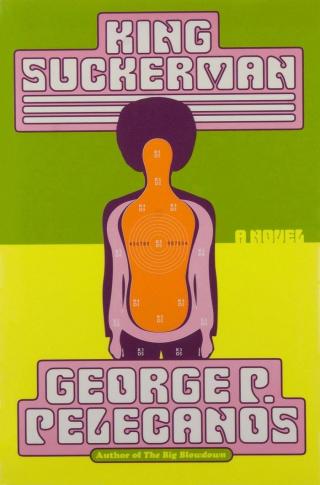
King Suckerman
- Автор: Пелеканос Джордж
- Серия: D.C. Quartet #2
- Год: 1997
- Язык: английский
- Год: Little, Brown and Company
- ISBN: 978-0-316-69590-9
- Жанр: Триллеры

Электронная книга - «King Suckerman». Краткое содержание книги:
“I love you, Elaine,” said Clay. “You know I do. And I want all the things you want, for the both of us. That’s what I’ve been workin’ so hard for, and that’s what I’m gonna keep workin’ for, hear? Now, whatever you decide to do, that’s up to you. But I’ve got to go now.”
“Marcus—”
“Don’t say nothin’, baby. I’ve got to go.”
He left the house, closed the door behind him. At the bottom of the steps he turned and looked at the light in the second-story window. He went to the Riviera, opened the door, and dropped the chain cutters behind the front seat.
Clay turned the ignition key, pulled out of his space. He drove down to Newton, hung a right. Coming out of the turn, he saw a white man with shoulder-length black hair and a black handlebar mustache, leaning against a small car. Clay slowed the Riviera to a stop, put his head out the window.
“Hey,” said Clay.
“Hey.”
“Come to say good-bye?”
“Comin’ with you.”
“Decided to step up, huh?”
“That’s right. Cooper made a play on my mother. And there’s no way, Marcus...”
“What?”
“There’s no way I’m lettin’ you go up against him alone.”
Clay eyes softened. There was pride there, and admiration, too. It had been a long time since Karras had seen Clay look at him like that.
“Well,” said Clay, “get in.”
“We takin’ your ride?”
Clay nodded. “We’re gonna take a real car tonight. Besides, tall as you’re lookin’ right now, you’d have trouble squeezing into that toy of yours.”
Karras walked around to the passenger door, dropped into the shotgun bucket. He looked across the seat at Clay.
“What now?” said Karras.
“Gonna even up the odds.”
“We got a few more comin’ with us?”
“Don’t need a few more,” said Clay. “Just Al.”
Marcus Clay pulled back on the shift, put the Riviera in gear.
Twenty-Six
Wilton Cooper carried the suitcase holding the money and the drugs. Bobby Roy Clagget followed him down the stairs, a duffel bag in one hand, the other hand holding the banister for support. Clagget wore the coffee-stained pleated white baggies with a clear blue plastic belt cinched tightly at the waist, his blood-smudged baby blue rayon shirt patterned in navy blue seashells, and multicolored stacks with four-inch heels. Cooper, who felt that a man on his way to a gun party needed to be styling, had gone dark and classic: a maroon polo shirt tucked into reverse-pleated black slacks with canvas jazz oxfords on his feet.
They reached the bottom of the stairs and stood in the foyer of the house. Open doors gave to a cheaply furnished living room, where the Thomas brothers sat with their cousin Doretha and her two kids. Cooper and Clagget entered the room. Doretha brought the children into her arms at the sight of them, sat straight in her chair, managed to force a trembling smile.
“Ronald?” said Cooper.
“Yeah, Coop?”
“You and your brother get your shit together. We checkin’ out.”
Ronald and Russell rose from their seats simultaneously. Russell stabbed his Kool out in an ashtray and picked up a gym bag with an Adidas logo printed on its side.
Cooper withdrew a roll of green from the pocket of his slacks, counted out three hundred-dollar bills in an elaborate manner. “Here you go, baby.” He dropped the bills on a particle-board lamp stand next to her seat.
“Thank you kindly,” said Doretha, a thin, spidery woman with glaucomic eyes.
“’Preciate your hospitality. Hope we didn’t put you out.”
“Oh, no,” said Doretha. “No trouble at all.”
“We’ll be leavin’ town tonight,” said Cooper. “Don’t expect we’ll be seein’ you again. But just so we don’t misunderstand each other—”
“I don’t know you no way,” said Doretha, nodding her head, not looking into Cooper’s eyes. “I never laid eyes on you in my life.”
Cooper smiled, gave Doretha a little bow. “Was a pleasure makin’ your acquaintance.”
Ronald said, “See you around, Dodo. Say hello to Uncle Lee for us, hear?”
Russell nodded to Doretha and the children. All the men left the room and exited the back door of the house.
Doretha held her younger daughter, who had begun to cry, tightly against her chest.
“Let it out,” said Doretha, patting the girl’s back.
At the end of the alley, two boys watched while another boy lit an M-80 and rolled it under an overturned trash can. The boys ran away, the trash can lifting from the force of the explosion. In a nearby yard a family of four held Roman candles and marched in a wide circle. A string of firecrackers went off two blocks away; over the sound, Cooper and his men heard a drunken man screaming at a woman and the woman’s pathetic, sobbing reply.
“Ain’t nothin’ but a house party tonight,” said Russell.
“There it is,” said Ronald.
Cooper jerked his head toward the car. “Get it uncovered,” he said.
Ronald rolled the canvas tarp back off the Daytona. He and Russell folded the tarp and dropped it over the fence into Doretha’s yard.
Cooper placed the suitcase in the Charger’s trunk, retrieved Clagget’s hunting vest, shut the lid. He tossed the vest to Clagget and the keys to Ronald.
“Want me for the wheel man?” said Ronald.
Cooper nodded. “Y’all sit up front. Me and B. R. gonna chill in the back.”
They got into the car. Clagget set the duffel bag between him and Cooper. He unzipped the bag, reached in, passed Ronald his short-barreled .357 and Russell his revolver. Ronald checked the load, wrist-snapped the cylinder back in place. Russell opened the Adidas gym bag, pulled out the Baggie of cocaine. He dipped his pinky nail into the blow, did two jolts, fed Ronald the same way.
“Bad freeze,” said Russell.
“Who you tellin’?” said Ronald, and the two of them touched skin. Cooper strapped both holsters under his arms, checked his .45s, fitted them, drew them quickly, fitted them again. Clagget thumbed shells into the sawed-off, slipped four more through the loops of his vest.
“Kick it over, Mandingo,” said Cooper.
Ronald brought the car alive.
They drove down the alley, the sputter of the dual exhaust cutting the air. Russell reached into the sun visor, pulled free a fresh pack of cigarettes. He packed the smokes against his palm, then tore a hole in the bottom of the deck.
“Gimme one of them double-O’s,” said Ronald.
Russell Thomas withdrew two Kools. He lit Ronald’s, lit one for himself.
Marcus Clay took Irving Street and then Michigan Avenue across town. The traffic thinned considerably as they headed east, though in all the neighborhoods through which they passed people had gathered on porches and others stood in groups, drinking beer, smoking cigarettes, leaning against cars in the street. Around Brookland, Clay slapped in a cassette that kicked off with “Little Child, Running Wild,” his favorite Mayfield jam. By the time the song ended, they had parked in front of an open garage in a small commercial strip at the edge of the residential district near the north-south railroad line. Clay and Karras got out of the Riviera and walked across the street.
Al Adamson was under the hood of a canary yellow, suicide-door Continental, one droplight illuminating his cluttered double-bay garage. He stood up straight, cleaning his hands on a rag, and walked toward them.
Adamson wore a black fishnet T-shirt tucked into black plain-front flares. The flares ended an inch shy of his oilskin work shoes, revealing black thick-and-thin socks. Adamson’s arm muscles rippled as he wiped his hands clean; his deep brown smoothly shaved dome shone in the light.