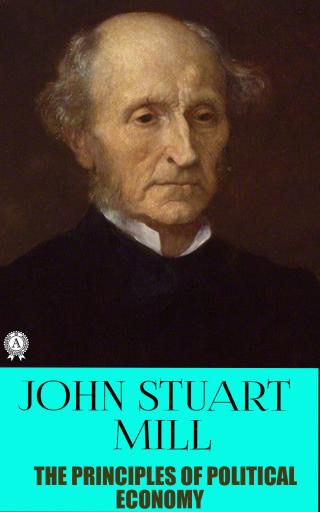
Principles Of Political Economy
- Автор: Mill John Stuart
- Год: 2022
- Язык: английский
- Год: Strelbytskyy Multimedia Publishing
- Жанр: Политика

Электронная книга - «Principles Of Political Economy». Краткое содержание книги:
Beside discussing descriptive issues such as which nations tended to benefit more in a system of trade based on comparative advantage (Mill's answer: those with more elastic demands for other countries' goods), the work also discussed normative issues such as ideal systems of political economy, critiquing proposed systems such as communism and socialism.
Along with A System of Logic, Principles of Political Economy established Mill's reputation as a leading public intellectual. Mill's sympathetic attitude in this work and in other essays toward contemporary socialism, particularly Fourierism, earned him esteem from the working class as one of their intellectual champions.
The dependence of wages on the number of the competitors for employment is so far from hard of comprehension, or unintelligible to the laboring-classes, that by great bodies of them it is already recognized and habitually acted on. It is familiar to all trades-unions: every successful combination to keep up wages owes its success to contrivances for restricting the number of competitors; all skilled trades are anxious to keep down their own numbers, and many impose, or endeavor to impose, as a condition upon employers, that they shall not take more than a prescribed number of apprentices. There is, of course, a great difference between limiting their numbers by excluding other people, and doing the same thing by a restraint imposed on themselves; but the one as much as the other shows a clear perception of the relation between their numbers and their remuneration. The principle is understood in its application to any one employment, but not to the general mass of employment. For this there are several reasons: first, the operation of causes is more easily and distinctly seen in the more circumscribed field; secondly, skilled artisans are a more intelligent class than ordinary manual laborers; and the habit of concert, and of passing in review their general condition as a trade, keeps up a better understanding of their collective interests; thirdly and lastly, they are the most provident, because they are the best off, and have the most to preserve.
§ 5. Twofold means of Elevating the Habits of the Laboring-People; by Education, and by Foreign and Home Colonization.
For the purpose, therefore, of altering the habits of the laboring people, there is need of a twofold action, directed simultaneously upon their intelligence and their poverty. An effective national education of the children of the laboring-class is the first thing needful; and, coincidently with this, a system of measures which shall (as the Revolution did in France) extinguish extreme poverty for one whole generation. Without entering into disputable points, it may be asserted without scruple that the aim of all intellectual training for the mass of the people should be to cultivate common sense; to qualify them for forming a sound practical judgment of the circumstances by which they are surrounded. (But) education is not compatible with extreme poverty. It is impossible effectually to teach an indigent population. Toward effecting this object there are two resources available, without wrong to any one, without any of the liabilities of mischief attendant on voluntary or legal charity, and not only without weakening, but on the contrary strengthening, every incentive to industry, and every motive to forethought.
The first is a great national measure of colonization. I mean, a grant of public money, sufficient to remove at once, and establish in the colonies, a considerable fraction of the youthful agricultural population. It has been shown by others that colonization on an adequate scale might be so conducted as to cost the country nothing, or nothing that would not be certainly repaid; and that the funds required, even by way of advance, would not be drawn from the capital employed in maintaining labor, but from that surplus which can not find employment at such profit as constitutes an adequate remuneration for the abstinence of the possessor, and which is therefore sent abroad for investment, or wasted at home in reckless speculations.
The second resource would be to devote all common land, hereafter brought into cultivation, to raising a class of small proprietors. What I would propose is, that common land should be divided into sections of five acres or thereabout, to be conferred in absolute property on individuals of the laboring-class who would reclaim and bring them into cultivation by their own labor.
This suggestion works to the same purpose as the proposal that our Government should retain its public lands and aid in the formation of a great number of small farmers, rather than, by huge grants, to foster large holdings in the Western States and Territories.[174]
The preference should be given to such laborers, and there are many of them, as had saved enough to maintain them until their first crop was got in, or whose character was such as to induce some responsible person to advance to them the requisite amount on their personal security. The tools, the manure, and in some cases the subsistence also, might be supplied by the parish, or by the state; interest for the advance, at the rate yielded by the public funds, being laid on as a perpetual quitrent, with power to the peasant to redeem it at any time for a moderate number of years' purchase. These little landed estates might, if it were thought necessary, be indivisible by law; though, if the plan worked in the manner designed, I should not apprehend any objectionable degree of subdivision. In case of intestacy, and in default of amicable arrangement among the heirs, they might be bought by government at their value, and re-granted to some other laborer who could give security for the price. The desire to possess one of these small properties would probably become, as on the Continent, an inducement to prudence and economy pervading the whole laboring population; and that great desideratum among a people of hired laborers would be provided, an intermediate class between them and their employers; affording them the double advantage of an object for their hopes, and, as there would be good reason to anticipate, an example for their imitation.
It would, however, be of little avail that either or both of these measures of relief should be adopted, unless on such a scale as would enable the whole body of hired laborers remaining on the soil to obtain not merely employment, but a large addition to the present wages—such an addition as would enable them to live and bring up their children in a degree of comfort and independence to which they have hitherto been strangers.
Chapter IV. Of The Differences Of Wages In Different Employments.
§ 1. Differences of Wages Arising from Different Degrees of Attractiveness in Different Employments.
In treating of wages, we have hitherto confined ourselves to the causes which operate on them generally, and en masse; the laws which govern the remuneration of ordinary or average labor, without reference to the existence of different kinds of work which are habitually paid at different rates, depending in some degree on different laws. We will now take into consideration these differences, and examine in what manner they affect or are affected by the conclusions already established.
The differences, says (Adam Smith), arise partly “from certain circumstances in the employments themselves, which either really, or at least in the imaginations of men, make up for a small pecuniary gain in some, and counterbalance a great one in others.” These circumstances he considers to be: “First, the agreeableness or disagreeableness of the employments themselves; secondly, the easiness and cheapness, or the difficulty and expense of learning them; thirdly, the constancy or inconstancy of employment in them; fourthly, the small or great trust which must be reposed in those who exercise them; and, fifthly, the probability or improbability of success in them.”
(1.) “The wages of labor vary with the ease or hardship, the cleanliness or dirtiness, the honorableness or dishonorableness of the employment. A journeyman blacksmith, though an artificer, seldom earns so much in twelve hours as a collier, who is only a laborer, does in eight. His work is not quite so dirty, is less dangerous, and is carried on in daylight and above ground. Honor makes a great part of the reward of all honorable professions. In point of pecuniary gain, all things considered,” their recompense is, in his opinion, below the average. “Disgrace has the contrary effect. The trade of a butcher is a brutal and an odious business; but it is in most places more profitable than the greater part of common trades. The most detestable of all employments, that of the public executioner, is, in proportion to the quantity of work done, better paid than any common trade whatever.”
174
For further discussion of the advantages of small holdings, see Book IV, Chap. V, § 2.