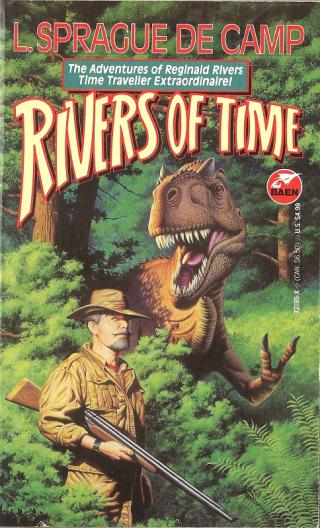
Rivers of Time
- Автор: Де Камп Лайон Спрэг
- Год: 1993
- Язык: английский
- Год: Baen Books
- ISBN: 9781555940232
- Жанр: Научная фантастика

Электронная книга - «Rivers of Time». Краткое содержание книги:
Includes:
• Faunas (1968)
• A Gun for Dinosaur (1956)
• The Cayuse
• Crocamander Quest
• Miocene Romance
• The Synthetic Barbarian
• The Satanic Illusion
• The Big Splash
• The Mislaid Mastodon
• The Honeymoon Dragon
Then Brenda smiled sweetly in a way that warned me she was going to slip in the stiletto. She said:
"I assure you, Mister Prendergast, that Sir Reginald can do all the things he did as a young man—perhaps better if not quite so often. Come on, Reg!"
Away she went, skidding down the slope in her new boots.
Ordinarily I should have been a bit more cautious in my approach; but I couldn't let my life's partner show me up. So I slung my rifle over my back to leave both hands free; and down I went, skidding and stumbling. I took one small tumble, but I grabbed a branch and stopped my fall before it did any harm. I called out to Brenda:
"Watch where you put your feet! Snakes!"
Australia has today a fine assortment of venomous serpents, and we may assume that they slithered around quite as frequently in the Pleistocene. But Brenda bounded on ahead of me as if she were still a schoolgirl. After so many years of dealing with wildlife, I have no irrational horror of snakes, as many have. But I don't take chances with organisms that can kill me with one little bite.
"Slow up!" I called. "You'll scare the critters away from the water hole with a noisy approach." Actually, most of the animals we see in prehistoric times show little or no instinctive fear of human beings, because they have never been hunted by man.
As we neared the bottom of the slope, we began pushing through the bush toward the billabong. Soon we had a good view of the diprotodons, relatives of the present-day wombat but vastly larger. In size this pair resembled a grizzly bear or even a rhinoceros. Otherwise they were rather nondescript creatures, with thick plantigrade limbs and big, bulbous heads with little round ears, and all clad in the same dark-brown fur.
The diprotodons had finished drinking and were just turning away from the pool, when Brenda exclaimed "Hey!" She had her little camera up. "Wait!"
The diprotodons paused at her shout, swiveling those huge heads around. Brenda burst out from cover, ran forward a few steps, dropped to one knee, and focused the camera.
The diprotodons turned away again and lumbered off. Brenda ran a few steps after them, trying for another shot. In so doing, she bumped into—literally bumped into—another patron of the water hole, who had just come out of the bush on its way to the billabong.
The newcomer was a fawn-colored giant kangaroo, so large that it made the biggest present-day kangaroos look like joeys. It had been poling its way forward at the slow-moving gait that modern roos employ in grazing, using its forelimbs as crutches to swing its huge hindlimbs forward as a pair. When Brenda brushed against it, the animal reared back and straightened up, raising its head a good three meters above ground. It towered over Brenda, who is a good-sized girl.
I must confess that I had been so busy watching Brenda and the animals that I had forgotten to unsling my rifle, still strapped across my back. I squirmed out of that sling faster than ever before and started to bring the rifle to bear.
At the same time, the giant roo took a swipe with one of its forefeet at this strange little creature that had barged into it. Brenda gave a yelp of pain and swung her camera on its cord so that it banged the roo on its nose. The roo jerked away in a startled manner and cut loose with a huge bound, over some low bush. By the time I had the beast in my sights, it had taken off on a second bound and quickly disappeared.
The whole confrontation lasted only a few seconds. I could, I suppose, have shot the roo before it passed out of sight. But the brute evidently had no intention of bothering us further, and my main concern was for Brenda. I hurried up to find her nursing a single long scratch on her forearm, with little drops of blood forming along it.
I had a bottle of disinfectant in the pocket of my safari vest, and in a few seconds I was swabbing the scratch. It was not serious—the roo's claws had barely penetrated the skin—but we don't take chances with strange infections.
I was bandaging the injured arm when I saw Brenda's eyes, looking past me, widen with apprehension. I spun round as something huge came pouring down the slope after us. A large hole yawned in the side of the slope, and we had passed that gap without noticing it in our carefree descent. The new arrival had popped out of this cave and was headed toward us with evidently unfriendly intent.
This formidable creature stood at the apex of the Australian Pleistocene food chain: not a marsupial or even a mammal, but a reptile, Megalania. It was a monitor lizard, related to the Komodo dragon but ranging up to fifteen meters in length. It thus surpassed the biggest crocodiles, the salties; to find a crocodile of such size you would have to go back to the Cretaceous. Megalania had larger and stouter limbs, enabling it to get around faster on land than any croc; and crocs can trot along faster than you might think when you see one snoozing after a meal.
One argument among paleontologists has to do with the way the limbs of quadrupeds are joined to the body. In salamanders, the legs protrude sideways and have only limited mobility. In the more primitive reptiles, the shoulder and hip joints still cause the upper part of the limb, the thigh and the upper arm, to project horizontally from the body; but the forearm and lower leg are set vertically, enabling the animal to move in a livelier way.
The final step towards full quadrupedal locomotion is the modification of the hip and shoulder joints to bring the upper limb bones to vertical, as it is in mammals. A completely vertical limb, acting as a column, can obviously support the weight of the body with less muscular effort than a limb that is bent into a right angle.
Back in the Permian, some lines of reptiles made this transition. These included the dinosaurs, the crocodiles, and those that evolved into mammals. But the ancestors of the lizards did not. Well, at the K-T boundary between Cretaceous and Paleocene, all the dinosaurs went poof, along with several other orders of reptiles. But the lizards survived, despite this awkward limb arrangement of the upper joints. The dragon that charged Brenda and me was just an oversized lizard, with the primitive hip and shoulder joints. But that fact did not stop it from being a bloody effective predator, about the nearest thing to the conventional dragon that I had ever seen—
Oh, sorry, Mr. Saito. I sometimes get to lecturing on the wonders of prehistoric life and forget the story I'm telling.
Believe it or not, in setting up this jaunt into the Aussie Pleistocene, I had completely forgotten about Megalania. I had read about the animal, of course; but in planning this mini-safari I must have thought only of the larger marsupial carnivores that we might meet. During the Cenozoic, South America had a marsupial sabertooth, Thylacosmilus, just as big and bloodthirsty as the more familiar sabertooth cats from other continents.
So here came this super-lizard, scrambling down the slope with its big yellow eyes locked on ours. It was mostly slate gray, like the Komodo dragon; but with faint grayish-green stripes on its flanks instead of those red markings on that model Megalania in the Australian Museum in Sydney.
I brought the animal's head into my sights, aimed between the eyes, and pulled the trigger. The gun went—click!
I worked the bolt and tried again: another click. The Megalania approached within a dozen meters, looking a hell of a lot more dragonny than any Komodo monitor. It was quite as intimidating as any theropod dinosaur I had ever faced, although in a fight between a Megalania and a Tyrannosaurus or an Epanterias I'd bet on the dinosaur. Being a biped, the theropod could simply bend down and grab the lizard by its spine, either the neck or the back.