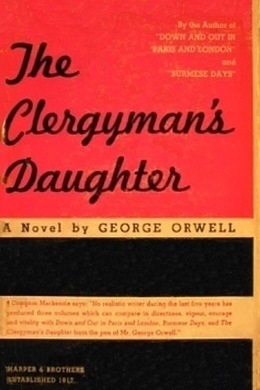
A Clergyman's Daughter
- Автор: Оруэлл Джордж
- Год: 2014
- Язык: английский
- Год: epubBooks Classics
- Жанр: Классическая проза

Электронная книга - «A Clergyman's Daughter». Краткое содержание книги:
She turned on Dorothy, and, in front of the parents, gave her a venomous 'talking to' which lasted upwards of ten minutes. The burden of it all was that Dorothy had brought these dirty books into the house behind her back; that it was monstrous treachery and ingratitude; and that if anything like it happened again, out Dorothy would go with a week's wages in her pocket. She rubbed it in and in and in. Phrases like 'girl that I've taken into my house', 'eating my bread', and even 'living on my charity', recurred over and over again. The parents sat round watching, and in their crass faces—faces not harsh or evil, only blunted by ignorance and mean virtues—you could see a solemn approval, a solemn pleasure in the spectacle of sin rebuked. Dorothy understood this; she understood that it was necessary that Mrs Creevy should give her her 'talking to' in front of the parents, so that they might feel that they were getting their money's worth and be satisfied. But still, as the stream of mean, cruel reprimand went on and on, such anger rose in her heart that she could with pleasure have stood up and struck Mrs Creevy across the face. Again and again she thought, 'I won't stand it, I won't stand it any longer! I'll tell her what I think of her and then walk straight out of the house!' But she did nothing of the kind. She saw with dreadful clarity the helplessness of her position. Whatever happened, whatever insults it meant swallowing, she had got to keep her job. So she sat still, with pink humiliated face, amid the circle of parents, and presently her anger turned to misery, and she realized that she was going to begin crying if she did not struggle to prevent it. But she realized, too, that if she began crying it would be the last straw and the parents would demand her dismissal. To stop herself, she dug her nails so hard into the palms that afterwards she found that she had drawn a few drops of blood.
Presently the 'talking to' wore itself out in assurances from Mrs Creevy that this should never happen again and that the offending Shakespeares should be burnt immediately. The parents were now satisfied. Dorothy had had her lesson and would doubtless profit by it; they did not bear her any malice and were not conscious of having humiliated her. They said good–bye to Mrs Creevy, said good–bye rather more coldly to Dorothy, and departed. Dorothy also rose to go, but Mrs Creevy signed to her to stay where she was.
'Just you wait a minute,' she said ominously as the parents left the room. 'I haven't finished yet, not by a long way I haven't.'
Dorothy sat down again. She felt very weak at the knees, and nearer to tears than ever. Mrs Creevy, having shown the parents out by the front door, came back with a bowl of water and threw it over the fire—for where was the sense of burning good coals after the parents had gone? Dorothy supposed that the 'talking to' was going to begin afresh. However, Mrs Creevy's wrath seemed to have cooled—at any rate, she had laid aside the air of outraged virtue that it had been necessary to put on in front of the parents.
'I just want to have a bit of a talk with you, Miss Millborough,' she said. 'It's about time we got it settled once and for all how this school's going to be run and how it's not going to be run.'
'Yes,' said Dorothy.
'Well, I'll be straight with you. When you came here I could see with half an eye that you didn't know the first thing about school– teaching; but I wouldn't have minded that if you'd just had a bit of common sense like any other girl would have had. Only it seems you hadn't. I let you have your own way for a week or two, and the first thing you do is to go and get all the parents' backs up. Well, I'm not going to have THAT over again. From now on I'm going to have things done MY way, not YOUR way. Do you understand that?'
'Yes,' said Dorothy again.
'You're not to think as I can't do without you, mind,' proceeded Mrs Creevy. 'I can pick up teachers at two a penny any day of the week, M.A.s and B.A.s and all. Only the M.A.s and B.A.s mostly take to drink, or else they—well, no matter what—and I will say for you you don't seem to be given to the drink or anything of that kind. I dare say you and me can get on all right if you'll drop these new–fangled ideas of yours and understand what's meant by practical school–teaching. So just you listen to me.'
Dorothy listened. With admirable clarity, and with a cynicism that was all the more disgusting because it was utterly unconscious, Mrs Creevy explained the technique of the dirty swindle that she called practical school–teaching.
'What you've got to get hold of once and for all,' she began, 'is that there's only one thing that matters in a school, and that's the fees. As for all this stuff about "developing the children's minds", as you call it, it's neither here nor there. It's the fees I'm after, not DEVELOPING THE CHILDREN'S MINDS. After all, it's no more than common sense. It's not to be supposed as anyone'd go to all the trouble of keeping school and having the house turned upside down by a pack of brats, if it wasn't that there's a bit of money to be made out of it. The fees come first, and everything else comes afterwards. Didn't I tell you that the very first day you came here?'
'Yes,' admitted Dorothy humbly.
'Well, then, it's the parents that pay the fees, and it's the parents you've got to think about. Do what the parents want— that's our rule here. I dare say all this messing about with plasticine and paper–scraps that you go in for doesn't do the children any particular harm; but the parents don't want it, and there's an end of it. Well, there's just two subjects that they DO want their children taught, and that's handwriting and arithmetic. Especially handwriting. That's something they CAN see the sense of. And so handwriting's the thing you've got to keep on and on at. Plenty of nice neat copies that the girls can take home, and that the parents'll show off to the neighbours and give us a bit of a free advert. I want you to give the children two hours a day just at handwriting and nothing else.'
'Two hours a day just at handwriting,' repeated Dorothy obediently.
'Yes. And plenty of arithmetic as well. The parents are very keen on arithmetic: especially money–sums. Keep your eye on the parents all the time. If you meet one of them in the street, get hold of them and start talking to them about their own girl. Make out that she's the best girl in the class and that if she stays just three terms longer she'll be working wonders. You see what I mean? Don't go and tell them there's no room for improvement; because if you tell them THAT, they generally take their girls away. Just three terms longer—that's the thing to tell them. And when you make out the end of term reports, just you bring them to me and let me have a good look at them. I like to do the marking myself.'
Mrs Creevy's eye met Dorothy's. She had perhaps been about to say that she always arranged the marks so that every girl came out somewhere near the top of the class; but she refrained. Dorothy could not answer for a moment. Outwardly she was subdued, and very pale, but in her heart were anger and deadly repulsion against which she had to struggle before she could speak. She had no thought, however, of contradicting Mrs Creevy. The 'talking to' had quite broken her spirit. She mastered her voice, and said:
'I'm to teach nothing but handwriting and arithmetic—is that it?'
'Well, I didn't say that exactly. There's plenty of other subjects that look well on the prospectus. French, for instance—French looks VERY well on the prospectus. But it's not a subject you want to waste much time over. Don't go filling them up with a lot of grammar and syntax and verbs and all that. That kind of stuff doesn't get them anywhere so far as I can see. Give them a bit of "Parley vous Francey", and "Passey moi le beurre", and so forth; that's a lot more use than grammar. And then there's Latin—I always put Latin on the prospectus. But I don't suppose you're very great on Latin, are you?'