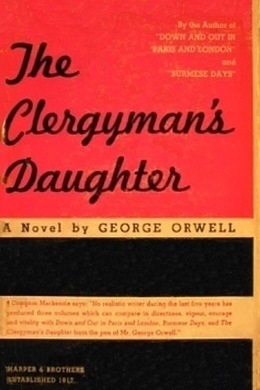
A Clergyman's Daughter
- Автор: Оруэлл Джордж
- Год: 2014
- Язык: английский
- Год: epubBooks Classics
- Жанр: Классическая проза

Электронная книга - «A Clergyman's Daughter». Краткое содержание книги:
Almost at the beginning there was a skirmish over the Scripture lessons—twice a week the children used to read a couple of chapters from the Bible. Old Testament and New Testament alternately—several of the parents writing to say, would Miss Millborough please NOT answer the children when they asked questions about the Virgin Mary; texts about the Virgin Mary were to be passed over in silence, or, if possible, missed out altogether. But it was Shakespeare, that immoral writer, who brought things to a head. The girls had worked their way through Macbeth, pining to know how the witches' prophecy was to be fulfilled. They reached the closing scenes. Birnam Wood had come to Dunsinane—that part was settled, anyway; now what about the man who was not of woman born? They came to the fatal passage:
MACBETH: Thou losest labour; As easy may'st thou the intrenchant air With thy keen sword impress, as make me bleed: Let fall thy blade on vulnerable crests, I bear a charmed life, which must not yield To one of woman born.
MACDUFF: Despair thy charm, And let the Angel whom thou still hast served Tell thee, Macduff was from his mother's womb Untimely ripp'd.
The girls looked puzzled. There was a momentary silence, and then a chorus of voices round the room:
'Please, Miss, what does that mean?'
Dorothy explained. She explained haltingly and incompletely, with a sudden horrid misgiving—a premonition that this was going to lead to trouble—but still, she did explain. And after that, of course, the fun began.
About half the children in the class went home and asked their parents the meaning of the word 'womb'. There was a sudden commotion, a flying to and fro of messages, an electric thrill of horror through fifteen decent Nonconformist homes. That night the parents must have held some kind of conclave, for the following evening, about the time when school ended, a deputation called upon Mrs Creevy. Dorothy heard them arriving by ones and twos, and guessed what was going to happen. As soon as she had dismissed the children, she heard Mrs Creevy call sharply down the stairs:
'Come up here a minute, Miss Millborough!'
Dorothy went up, trying to control the trembling of her knees. In the gaunt drawing–room Mrs Creevy was standing grimly beside the piano, and six parents were sitting round on horsehair chairs like a circle of inquisitors. There was the Mr Geo. Briggs who had written the letter about Mabel's arithmetic—he was an alert– looking greengrocer with a dried–up, shrewish wife—and there was a large, buffalo–like man with drooping moustaches and a colourless, peculiarly FLAT wife who looked as though she had been flattened out by the pressure of some heavy object—her husband, perhaps. The names of these two Dorothy did not catch. There was also Mrs Williams, the mother of the congenital idiot, a small, dark, very obtuse woman who always agreed with the last speaker, and there was a Mr Poynder, a commercial traveller. He was a youngish to middle– aged man with a grey face, mobile lips, and a bald scalp across which some strips of rather nasty–looking damp hair were carefully plastered. In honour of the parents' visit, a fire composed of three large coals was sulking in the grate.
'Sit down there, Miss Millborough,' said Mrs Creevy, pointing to a hard chair which stood like a stool of repentance in the middle of the ring of parents.
Dorothy sat down.
'And now,' said Mrs Creevy, 'just you listen to what Mr Poynder's got to say to you.'
Mr Poynder had a great deal to say. The other parents had evidently chosen him as their spokesman, and he talked till flecks of yellowish foam appeared at the corners of his mouth. And what was remarkable, he managed to do it all—so nice was his regard for the decencies—without ever once repeating the word that had caused all the trouble.
'I feel that I'm voicing the opinion of all of us,' he said with his facile bagman's eloquence, 'in saying that if Miss Millborough knew that this play—Macduff, or whatever its name is—contained such words as—well, such words as we're speaking about, she never ought to have given it to the children to read at all. To my mind it's a disgrace that schoolbooks can be printed with such words in them. I'm sure if any of us had ever known that Shakespeare was that kind of stuff, we'd have put our foot down at the start. It surprises me, I must say. Only the other morning I was reading a piece in my News Chronicle about Shakespeare being the father of English Literature; well, if that's Literature, let's have a bit LESS Literature, say I! I think everyone'll agree with me there. And on the other hand, if Miss Millborough didn't know that the word—well, the word I'm referring to—was coming, she just ought to have gone straight on and taken no notice when it did come. There wasn't the slightest need to go explaining it to them. Just tell them to keep quiet and not get asking questions—that's the proper way with children.'
'But the children wouldn't have understood the play if I hadn't explained!' protested Dorothy for the third or fourth time.
'Of course they wouldn't! You don't seem to get my point, Miss Millborough! We don't want them to understand. Do you think we want them to go picking up dirty ideas out of books? Quite enough of that already with all these dirty films and these twopenny girls' papers that they get hold of—all these filthy, dirty love– stories with pictures of—well, I won't go into it. We don't send our children to school to have ideas put into their heads. I'm speaking for all the parents in saying this. We're all of decent God–fearing folk—some of us are Baptists and some of us are Methodists, and there's even one or two Church of England among us; but we can sink our differences when it comes to a case like this— and we try to bring our children up decent and save them from knowing anything about the Facts of Life. If I had my way, no child—at any rate, no girl—would know anything about the Facts of Life till she was twenty–one.'
There was a general nod from the parents, and the buffalo–like man added, 'Yer, yer! I'm with you there, Mr Poynder. Yer, yer!' deep down in his inside.
After dealing with the subject of Shakespeare, Mr Poynder added some remarks about Dorothy's new–fangled methods of teaching, which gave Mr Geo. Briggs the opportunity to rap out from time to time, 'That's it! Practical work—that's what we want—practical work! Not all this messy stuff like po'try and making maps and sticking scraps of paper and such like. Give 'em a good bit of figuring and handwriting and bother the rest. Practical work! You've said it!'
This went on for about twenty minutes. At first Dorothy attempted to argue, but she saw Mrs Creevy angrily shaking her head at her over the buffalo–like man's shoulder, which she rightly took as a signal to be quiet. By the time the parents had finished they had reduced Dorothy very nearly to tears, and after this they made ready to go. But Mrs Creevy stopped them.
'JUST a minute, ladies and gentlemen,' she said. 'Now that you've all had your say—and I'm sure I'm most glad to give you the opportunity—I'd just like to say a little something on my own account. Just to make things clear, in case any of you might think I was to blame for this nasty business that's happened. And YOU stay here too, Miss Millborough!' she added.