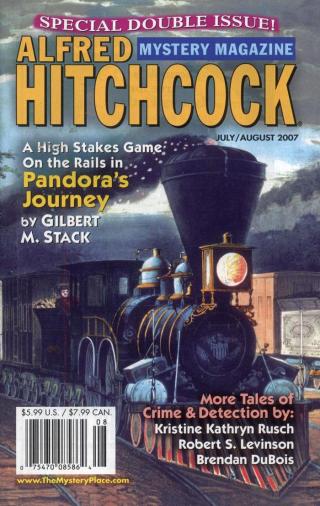
Alfred Hitchcock’s Mystery Magazine. Vol. 52, No. 7 & 8, July/August 2007
- Автор: Baldwin Barry, Campbell Melodie
- Год: 2007
- Язык: английский
- Год: Dell Magazines
- ISBN: ISSN:0002-5224
- Жанр: Другие детективы

Электронная книга - «Alfred Hitchcock’s Mystery Magazine. Vol. 52, No. 7 & 8, July/August 2007». Краткое содержание книги:
“Neither have I,” Robideau reminded him again. “I’m retired, remember?”
“Yeah. We all are. We’re just a bunch of old retired guys sticking our noses in where we ain’t wanted. Ain’t needed, for that matter.”
Robideau wondered what Pete thought he was retired from, since the man hadn’t, as far as the chief knew, worked a pensionable day in his life. He said, “Well, the fact of the matter is there’s a problem. It may be that Bullet should be left alone, but something has got to be done about that place of his. For his own good.”
Pete leered. Hard-bitten silver bristles stood out defiantly on his chin. “When the authorities tell you something’s for your own good, look out for squalls.”
“I’m not ‘the authorities.’”
“No, Butts is. And you’re workin’ for him.”
“I’m not working for him, I’m representing him.” Robideau glanced around at the smirking faces and sighed. “Look, if none of you are willing to help, if you don’t think you can get Bullet — I mean Bulwer — to see reason, then fine. I’ll try him again myself. I only wanted to get past his suspicious nature, that’s all. It’ll be a shame to see the Palace expropriated.”
He got to his feet.
Pete Melynchuk grinned up at him. “Now you’ve went an’ got your Jockeys twisted. When do you want to go and see the guy?”
“Now the way I’d handle it if it was me,” Pete advised, “I’d first of all visit Oddlot Jenkins.”
Oddlot. A village character who tooled around in an old van. In the old days he had been the Palace projectionist and at the same time general dogsbody for Prancing Al Evans up at the funeral home. He still worked for Al Evans. Took care of the incinerator. Kept the hearse polished up.
Oddlot was almost as reclusive as Bulwer, but Pete had more than a nodding acquaintance with him.
“He’s about the only guy Bullet Onager talks to,” Pete Melynchuk explained as they got into Robideau’s car. “They’ve kept in touch, I guess, since the Palace Roxy closed.”
Oddlot lived in a tidy little minihome, old and cramped but neat as a pin. A sort of cabana jutted over the entrance, and the wheels were hidden behind plywood panels, primly painted with images of tall green grass and daisies. A decorative plastic bumblebee hovered on a stick outside the door. An old Dodge van stood in the drive.
Robideau, his eyes fixed on the place, didn’t notice Oddlot standing behind them until the man spoke out.
“Something I can do for you?”
The men turned. Oddlot was eyeing them suspiciously. He was one of those thin, wiry men and looked as if trouble couldn’t lay a glove on him. He had a hoe in his hand, and his face was reflected in the darkened side windows of the van.
“Oddie!” Pete boomed. “You trying to scare us to death?” He indicated Robideau. “This here’s—”
“I know who he is,” Oddlot answered. “Everybody knows Chief Robideau.” His voice softened. “Too bad you retired. Look at what we got for a police chief now.”
“Listen,” Pete said, “here’s the thing. We’re tryin’ to help out a friend of yours. Bullet Onager.”
Oddlot’s eyes narrowed. He leaned the hoe against the side of the house. He turned back to his visitors with a mixture of suspicion and inquisitive concern on his face. Robideau set out the problem.
“So you see,” Robideau concluded, “if he won’t listen to reason, the town’s going to take action.”
Oddlot deliberated, one hand plucking at his chin. “That wouldn’t be right. He’s a quiet old guy. And it’s terrible what happened to him. The Palace was his whole life, and when he had to close, it busted him up inside. It’s why he lives that way. Hangs onto stuff. He don’t want to lose nothing ever again. It’s sad.”
Robideau agreed. It was kind of sad. A man loses a business he loves because the community stops supporting it; then that same community comes hounding him years later, threatening to knock the place down. Things weren’t supposed to work that way.
“I went to see him,” Robideau said, “to warn him, but he wouldn’t open his door to me. So we thought, you being a friend of his, maybe you could get him to hear what I have to say. We only want what’s best for him.”
Oddlot studied Robideau’s face. He took the hoe in his hand again, leaned on it, and stared at the ground. Then he straightened.
“I suppose I could see what I can do.”
The sky was heavy again with the threat of yet more rain. Mountainous flat-bottomed thunderheads loomed above the lake, and far to the south, out over the marshes, little smoke-white rags of cloud darted swiftly before the wind.
At Onager’s house, they pulled over and stopped. Oddlot, who had arrived there ahead of them, got out of his van.
“Jeez,” Pete Melynchuk breathed, with a sour glance at the house, “would you look at the place!”
“Should we go in with you?” Robideau asked Oddlot, who had sauntered back to stand at the side of the car.
“Nope,” Oddlot said, “I’ll go in alone. I’ll explain things to him and see what he says. If I give you the signal, you can come on in. Otherwise...”
They watched his thin, wiry figure proceed up the walk, negotiate the obstacle course on the porch, and bang on the door. The door opened instantly for him, and he disappeared inside.
Then they waited.
“You ever see a place to beat it?” Pete said, staring sideways out the car window. “Place like that’ll be alive with squirmin’ vermin. Mice, rats, and roaches. Chuck Lang is right. Knock the movie house down, and knock this dump down too.”
Oddlot Jenkins appeared and raised his hand.
“That’s our cue,” Robideau said.
“Ain’t we lucky!”
“I want you to take this,” Robideau handed Pete his little digital camera, “and see if you can get a few snapshots inside the place. They might come in handy. And try not to be too obvious.”
“James Bond, that’s me,” Pete said. He held the camera out with one hand and took an experimental shot through the windshield.
If the front porch was bad, the interior was far worse. And the smell! The smell of decay, the smell of mildew, the smell of cats allowed to run wild. “I’ll just wait here,” Pete said, wrinkling his face and halting in the sty of a kitchen.
Robideau followed Oddlot into a large sitting room, twenty feet on a side. It was piled waist high — in some places shoulder high — with the debris and detritus of life. Looking at the jumble, the muddle, the overwhelming hodgepodge of litter and refuse, it was incomprehensible to Robideau that anyone could amass such a collection of junk. Bulwer Onager sat in a thronelike chair. Once a fine piece of furniture, now the stuffing bulged out where the cats had worried it, and the cushion behind his head was dark with hair oil and perspiration.
He was a big man, round shouldered and bottom heavy. He had flaccid jowls and a dewlapped neck. A tangled gray fringe tumbled over his ears. He looked beaten, worn out, and haunted by his personal demons. He wore slippers, droopy gray sweatpants, and a wrinkled, food-stained T-shirt with the word WIMPY silk-screened across it in large disintegrating letters.
“Now just listen to what the man has to say,” Oddlot advised him.
There was no place to sit. They stood like petitioners before the king. Robideau cleared his throat and laid it all out. While he spoke, the old man watched him like a creature cornered in its nest, head canted, eyes fixed. When Robideau had finished speaking, the big man still stared, but his head had sunk visibly lower on his chest.
“So what do you think?” Robideau asked him. “Can you clean up the Palace a little? Have that sagging marquee taken down, with all its broken bulbs? Slap a little paint on the place?”