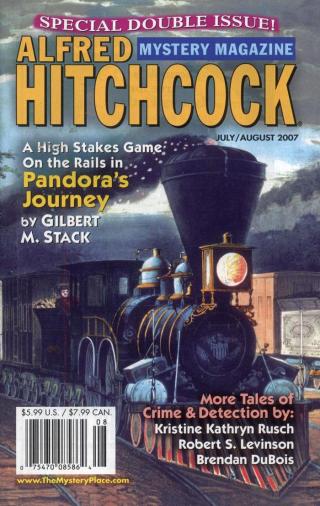
Alfred Hitchcock’s Mystery Magazine. Vol. 52, No. 7 & 8, July/August 2007
- Автор: Baldwin Barry, Campbell Melodie
- Год: 2007
- Язык: английский
- Год: Dell Magazines
- ISBN: ISSN:0002-5224
- Жанр: Другие детективы

Электронная книга - «Alfred Hitchcock’s Mystery Magazine. Vol. 52, No. 7 & 8, July/August 2007». Краткое содержание книги:
“Like Bulwer Onager.”
“Exactly. If I could phone the guy, drive over and talk to him — hell, if he was a halfway normal human being! — things would be different. But Bullet is Bullet. There’s nothing normal about him. Besides...”
“Besides, I know him and you don’t.”
“Well, that’s a fact, now, isn’t it? I’ve only lived here three, four years. You — hell! You been here all your life. You had my job for twenty years. You grew up here. I bet you were throwing spitballs from the balcony when he was still showing cliffhangers in that dump of a theater of his.”
Robideau smiled. Butts was right. Except for the part about the spitballs.
“It wasn’t always a dump, you know.”
“Fine. And I wasn’t always a potbellied old man. Time flies when you’re having fun.”
“So what do you want from me exactly?”
“I want you to go to him, talk sense to him, and deliver a message from the town council. Tell him he’s got to clean up the Palace Roxy before the town expropriates and knocks it down. Tell him there are rats in it. Tell him anything you want. Tell him he’s single-handedly threatening the Toyota — Koyota—”
“Kyoto?”
“That’s it.” He threw his hands up. “Those dumb pollution accords. And tell him to clean up his house, too, while he’s at it. From what I hear it’s even worse than his theater.”
“He might not listen.”
“I couldn’t care less. Just so long as he’s notified. Person-to-person, the town manager tells me. That’s the rule. No messages left on answering machines, no letters through the mail slot. He has to be given fair warning, and then I can send in the front-end loaders.”
Chief Butts suddenly stopped talking. He seemed to have run out of arguments. He sat behind his desk like a giant rat himself, neckless, shoulderless, looking a tiny bit vulnerable under the glare of the fluorescent light.
“Okay,” Robideau said. “I’ll give it a shot. But the minute the kid turns up, I’m off the case, all right?”
Butts looked alarmed.
“You think it’ll take that long?”
First, Robideau decided, he would find out the latest on Bulwer Onager. He didn’t want to confront an irascible man without learning everything there was to know about him. Leaving the Safety building, and aiming a wink and a grin at his old receptionist Claudia Webb on his way out, he jaywalked across Burton Street to the offices of the Netley Leader, climbed a flight of stairs, and knocked at a door with a sign on it that said: THIS MAN BITES DOGS!
“Come in,” muttered an amiable voice, “if you can stand it.”
When Robideau leaned into the room, the long, lined face of Editor Delyle Allwood lit up. A tall man with wispy white hair, Allwood leaped to his feet and came around his desk with a grin. He gripped Robideau’s hand and forearm, saying in his faintly British tones, “Chief Robideau! Retired Chief Robideau! I knew you had to be alive. I’ve been watching the obits and haven’t spotted your beaming face there yet.” He ushered his visitor to a chair. “What’s your poison? Coffee that’ll remove your stomach lining? Or would you prefer a spot of the other?”
He fluttered his eyebrows.
“Oh, the other,” Robideau said, “by all means.”
“Exactly right. Or no point being retired.”
Allwood opened a sideboard liquor cabinet that was almost entirely filled with office clutter: loose papers, old camera cases, a broken light bar, and a horde of other junk. He rummaged out a couple of mismatched crystal glasses and sloshed a generous portion of Crown Royal into each of them. Passing one to Robideau, he said, “Here’s to homicide,” and downed his in one gulp.
“Woof!” He thumped his chest. “Excellent blood thinner. Better than aspirin.” He dropped into his chair. “Now, what brings you this vast distance? This must be — what? — at least a good block and a half from your house.”
“Sorry I haven’t dropped by sooner.”
“I’m a newspaperman. I’m used to rejection.”
“I was just visiting Chief Butts.”
Allwood’s nose wrinkled. “I thought I detected an air of unpleasantness.”
“He wants a favor. Wants me to speak to Bulwer Onager.”
“Ah, now there’s a mission almost impossible. Bulwer doesn’t take kindly to being spoken to these days. I know. I’ve tried.”
“Yes, well, I’m going to give it a shot. But before I do, I want to know a little more about him. And since you never forget a fact—”
“I see. You want to paw through my files.” Allwood touched his brow. “The ones up here.”
Robideau nodded. Took a small sip of whiskey.
“Well,” said Allwood, “I’ll give you the thumbnail sketch.” He tilted his chair back, pulled out a desk drawer, and draped his long legs over it. “Bulwer is one of those odd individuals who has lived his life more or less in reverse. Where most people start with little or nothing and slowly progress to affluence and influence, he has marched steadily in the opposite direction. His father once owned half the town, as you well know, including the movie house — the Palace Roxy. Of all the Onager interests, only the Palace interested Bulwer, so the old man signed it over to him. A comfortable berth for a year or two, but shortly after that two significant events occurred. In April of ’53, television came to town, and in the fall of that year the old man died, relaxing his grip on the levers of power. Bulwer and his mother faltered. Couldn’t cope. Squabbled. Made a belated effort to shore things up by hiring a boardroom full of MBAs. But too late. By the end of the Fifties it was sell-off time.”
“I didn’t know the Onagers squabbled,” Robideau said.
“Squabbling was their lingua franca. In seven years all they managed to agree on was changing the Onager logo from a bold "O" against a starkly delineated siege engine, to a gentle lower case "onager" superimposed upon a soft black stripe. This was early days. And it was prescient.”
“Was it?”
“You do know what onager means?”
“No.”
“Ah, well. You must do more crossword puzzles. Anyway, after the first Onager establishment fell — Onager Flowers and Gifts — the rest toppled like dominoes. Only the Palace remained upright, but of course it was wholly owned by Bulwer. When his mother passed on, she left him to fight a brave but lonely battle against Jack Benny, Lucille Ball, and Wayne and Shuster of the tiny screen. The experience rattled him. Shook him. He couldn’t walk down a street without compulsively counting the insidious TV antennas sprouting from the rooftops like alien life-forms.”
Robideau mused. “I remember Dragnet...”
“You would. In the middle Sixties Bulwer gambled everything on a second screening of one of the blockbuster Hitchcock films — I forget which. It had been his biggest draw, you see. He figured if that smash hit didn’t pull in the crowds again, nothing would. And the idea worked. To a point. For the first time in years, the Palace had a full house and a line-up. Bulwer even ran out of popcorn and had to rush across to the Family Fare for more kernels to feed into the machine.
“But it wasn’t sustainable. He was soon back to empty seats. His accountant — you remember Heddy Halderson? Hot Heddy, as the fishwives called her? — advised him to start showing blue movies. Bulwer was scandalized. Refused to do it. And very soon after that, the Palace closed.”
“Any brothers or sisters?”
“None.”
“And he disliked his mother?”
“Quite the opposite. Sure, they bickered, but that was surface tension.”
Robideau sat back. “I remember going to shows at the Palace back in the Sixties.”
“Yes, he had a couple of reprieves. Thiessen Electric stopped selling TVs locally after old man Thiessen slipped on an icy patch out front of his store one night, fell down and obligingly killed himself. And then Ronnie Ralston, who rigged TV antennas, met that girl at the Netley and ran away with her.”