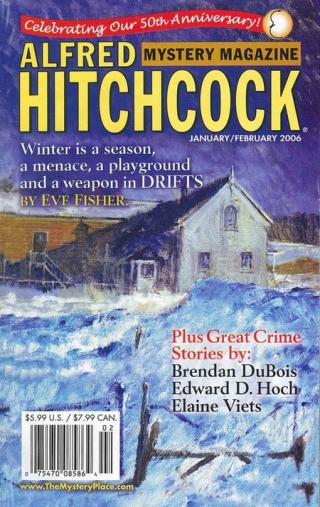
Alfred Hitchcock’s Mystery Magazine. Vol. 51, No. 1 & 2, January/February 2006
- Автор: Бетанкур Джон Грегори, Jr. William J. Carroll,
- Год: 2006
- Язык: английский
- Год: Dell Magazines/Crosstown Publications
- Жанр: Другие детективы

Электронная книга - «Alfred Hitchcock’s Mystery Magazine. Vol. 51, No. 1 & 2, January/February 2006». Краткое содержание книги:
“Might as well finish it,” he said happily.
“Would you mind telling me something—” Nic began hoarsely.
“Certainly,” Cedric said, “but first, let’s take care of this.” He put the glass down and took a checkbook and a pen from his pocket. “Three thousand minus eighteen fifty is eleven fifty. Half of that—” He scribbled, tore out the check, and put it on the table. “—is five seventy five. The bonus I promised. Thank you.”
Cedric Cranston drank again and just to keep him company, Nic took another sip.
“What do you think of it?” Cedric asked with a grin.
Nic sipped again. “Well...”
“Go ahead. Tell me.”
Nic considered.
“You could buy just as good a wine as this at Safeway for ten dollars,” Nic said. His voice was hollow.
“Maybe somebody did,” Cedric said.
“What do you mean by that?” Nic asked, going quickly from puzzled to irritated.
Cedric sat looking at the bottle he had bought, seemingly wrapped in thought.
“Is this a hobby of yours?” Nic asked.
“Buying wines like this? No way. I usually drink Gallo.” He finished the wine. “I have to tell you something. That was my uncle who owned Graystone Manor — and the wine collection.”
“Your uncle?”
“Yes — and I am his sole heir.”
“His heir?” Nic said faintly. “But in that case, you’ll be getting his whole wine cellar, won’t you?”
Cedric nodded. “That’s right.”
“Then the cellar is really yours, isn’t it?”
“I guess it is.”
“So you didn’t have to pay eighteen hundred and fifty dollars for this one bottle!”
Nic was beginning to feel like Dr. Watson, desperately trying to follow the explanations of the Great Detective as to how he made his deduction, which was about to be revealed as so simple that the good doctor would not be able to understand how he had not found it obvious.
“Let’s see what’s in the minibar,” said Cedric, getting to his feet. “They might have some better stuff in there.”
“Extraordinary!” Roger chuckled. “I really handed you a live one this time, didn’t I, Nic!”
They sat in Roger’s office, where Nic had just recounted the story of his visit to the auction at Graystone Manor.
“So,” Roger went on, “presuming you found a drinkable vintage in the minibar — why did Cranston pay eighteen fifty for one bottle of what was his own property?”
“We emptied the minibar of Champagne,” Nic said, “in the course of getting the whole story out of him — it was Mumm’s, you will be glad to hear. It was like this...
“Uncle Harold was a self-made man, very proud of his achievement in making millions in the scrap and recycling business.
“He liked to play the country squire, but he was always uneasy about his position as a nouveau-riche among the old moneyed families—”
“—and San Francisco has plenty of those,” said Roger.
“It certainly does,” Nic agreed. “In order to establish himself among that hierarchy, Uncle Harold first began by buying Graystone Manor and throwing big dinner parties. He accumulated a very reputable cellar, but here a strong rivalry emerged. Many of his neighbors were wine connoisseurs and had cellars that would rate with any in the country—”
“Bless their vinous hearts,” Roger said piously. “I trust they were among our clients.”
“I intend to follow up on that,” Nic said and Roger nodded approvingly. “Anyway, fierce argument arose on one occasion over the merit of a particular wine and Uncle Harold decided to play a trick at his next dinner party.
“He bought a bottle of Leoville-Barton Bordeaux ’59 and a bottle of supermarket Bordeaux and switched the labels—”
“Pardon another interruption, Nic, but how did Cranston know this?”
“He paid a surprise visit and walked in on his uncle making the switch.”
“In flagrante delicto!” Roger cried.
“Exactly. His uncle, of course, swore Cedric to secrecy—”
“But what happened with—?”
Nic cut in on the question. “What happened was that his uncle died the day before the dinner. The family lawyer told Cedric he would inherit the property and everything in it. Cedric had no desire to live in the manor, all he wanted to do was sell it. The will called for auctioning off the entire wine collection as it was so valuable but, of course, Cedric was worried that someone might discover the phony Leoville. If they did, it would throw suspicion on the entire cellar.”
“It certainly would,” agreed Roger.
“So being a conscientious sort of fellow, Cedric decided to get rid of the evidence. It seems he was really fond of his uncle and didn’t like the thought that people might unmask him as a wine faker. They might not believe he would stop at one bottle and think he did it often. So Cedric decided to get rid of the evidence, but under the terms of the will, the lawyer had already notified Farringdon’s, who had sealed up the whole cellar.”
“Normal practice,” nodded Roger.
“So when Cedric learned that it was to be an item by item sale, he hatched this plan. Having us buy it for him kept his name out of it.”
Roger slapped the desk in amusement. “Great story, Nic!”
“It’s not all,” said Nic and his tone caught Roger’s attention.
“Go on,” Roger urged.
“I went back there yesterday. I concocted a story for the man from Farringdon’s who was arranging disposal of the unsold items — I, er, allowed him to think we might be interested in some of them.”
Roger smiled slightly. “Well, we might.”
“It gave me access to the place, although there were few people around. Anyway, I got the opportunity to slip into the warehouse building I mentioned — the one that we passed on the way in.”
Roger was fully focused now. “Go on.”
“It was a small but efficient scrap and recycling operation. Equipment on a minuscule scale but all fairly new. Paper, cans, bottles, other miscellaneous stuff.”
“No workers? They’d been let go?”
“Hadn’t been any. Uncle Harold did it all himself. I was able to go through the place very thoroughly and I found what I was looking for—”
“I’m getting the inkling of where you’re going with this,” Roger murmured, “but keep going, Nic.”
“I found enough to convince me that the faked bottle of Leoville-Barton Bordeaux ’59 wasn’t a one-off, get-the-better-of-his-wine-drinking-friends stunt at all. He could select the paper he wanted, he had a very expensive color printer so he could make labels, he had his pick of bottles, and I even found, hidden away, a barrel load of corks. Of course, he could still have been interested in making pilot runs of recycling methods and processing ordinary scrap — but that made a convenient cover for his secret hobby—”
“Uncle was running a small business in phony wines.”
Roger completed Nic’s exposition. “And you think Nephew Cedric didn’t know about it?”
“It’s possible he knew, but more likely, he had a sneaking suspicion that he didn’t want to share with anyone. He seems to have had a genuine liking for his uncle and wouldn’t want to see him exposed.”
“And after all,” said Roger, “what’s another few dozen bottles of faked wine among all the thousands out there already, most of them engineered by experts, making our lives difficult?”
Nic nodded, but his smile was wry. “Or could it have been a few hundred bottles? And which wines?”