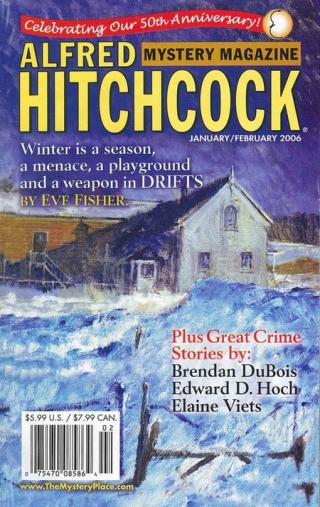
Alfred Hitchcock’s Mystery Magazine. Vol. 51, No. 1 & 2, January/February 2006
- Автор: Бетанкур Джон Грегори, Jr. William J. Carroll,
- Год: 2006
- Язык: английский
- Год: Dell Magazines/Crosstown Publications
- Жанр: Другие детективы

Электронная книга - «Alfred Hitchcock’s Mystery Magazine. Vol. 51, No. 1 & 2, January/February 2006». Краткое содержание книги:
“You’ve been there before? This Graystone Manor?”
“Oh yes.”
“So Graystone Manor is where the auction is being held?”
“That’s right. It’s a beautiful building. You’ll love it.”
What he would really love, Nic thought, is to know what this is all about. He was trying to formulate another question or two that might bring some elucidation when the taxi swung off Highway 1. They had gone only a few hundred yards along a narrow but well-kept street before they were driving past a long stone wall. Cedric leaned forward to the driver, who was holding up the sheet of paper with the instructions on it. They exchanged a brief question and answer, then the driver slowed and they stopped at an impressive pair of wrought-iron gates set in massive stone pillars. Silently, they swung open.
They drove on a road that wound upward between expanses of dazzling green lawn with stands of leafy oaks.
They passed a clearing with a large brick building that looked old but had modern overhead shutters. Nic craned his neck to see it better.
“My uncle’s hobby,” Cedric said. “He made his money in the scrap business and even after he retired, he couldn’t give it up altogether.”
One shutter was open and Nic could see neat stacks of paper and beverage cans and bottles inside the warehouse. “He was very environmentally conscious too,” Cedric explained. “Really enthusiastic about developing better recycling methods.”
Nic was wondering if they had enough gas when they emerged onto a straight stretch of road that revealed a magnificent towered and turreted mansion of gray stone.
Cedric was regarding it without emotion. “You can see why they call it Graystone Manor,” he said as he paid the driver.
A man in a smart dark blue uniform with red cuffs and collar and brass buttons was at the wide stone steps that led up to two enormous oak doors. He must have memorized names, for as soon as Cedric gave his, the man lifted the wrought-iron arm and opened the one door to let them in. Another servant, similarly attired, stood in the center of a large hall with would-be baronial trappings — a suit of armor, shields and banners, arrays of edged weapons and tapestries on the walls. Two large doors led into what was obviously the ballroom, now converted into an auction hall. A magnificent chandelier threw off crystal flashes while bulbous orange lamps on the walls reflected from the polished wood panels.
A large podium was front and center, with a smaller one at the side of it. At least a hundred chairs were arrayed in rows and half of them were filled already. Most were men in business suits. Nic even recognized a few faces. A table at the back had two young women with phones and laptop computers set up. Nic reviewed the catalog. The Leoville-Barton Bordeaux 1959 was Lot 449, just below the halfway mark in the program. The auctioneer came on to the front podium and Nic recognized him as one of Farringdon’s most experienced auctioneers. Then a young woman seated herself at the smaller podium next to it ready to note the bids. By now, more than two thirds of the seats were filled.
It was a good turnout, but then San Francisco is a wine-drinking and a wine-buying town. California, New York, and Illinois are the only states in the Union that permit wine auctions, and California leads by a wide margin in volume of business transacted this way.
The auctioneer opened the bidding on a case of Domaine Roumier Clos 1978. It is a rich and long-lived wine from a renowned producer in a vintage not commonly seen, he commented. No particular enthusiasm manifested itself despite the recommendation, and bidding was low in the estimated range of nine hundred to twelve hundred dollars. It crept past the one thousand mark, but even laudatory comments by the auctioneer did not bring it higher and it went for eleven hundred dollars.
Cedric followed the action — if it could be called that — with glistening eyes and parted lips. He whispered an occasional question and Nic answered. They had chosen seats near one end of a row toward the back so no one was in the surrounding seats. Farther along the row sat an elderly man with an old-fashioned wing collar. His finger was following his well-thumbed copy of Broadbent’s New Great Vintage Wine Book, a valued reference and a reliable guide.
A 1958 Bouchard Pere et Fils Beaune went next. Bidding was brief and low and it sold for four hundred dollars. A favorite drinking wine of Nic’s came next — a case of Deinhard Bernkasteler Doktor Auslese 1976. It went past its reserve and a determined man in a summer suit sitting near the front bought it for five hundred and fifty.
So far, Nic noted, several of the wines were eminently drinkable and some went as collector items. He commented on this to Cedric, who nodded without surprise. Some excellent clarets followed, a 1929 Latour and a 1945 Margaux among them. The phones were busy and several bids came in from last-minute absentees. Other bids had come in by fax, and the auctioneer kept referring to them. Finally, it came to their turn and Nic heard Cedric take a deep breath.
“And now,” said the auctioneer, “we come to Lot 449, a Leoville-Barton Bordeaux 1959. This wine is one of the finest in the commune, and it has the reputation of being one of the best clarets offered. It is always in great demand and I know...” He went on with his buildup then — and Nic could hear Cedric holding his breath — lifted his gavel.
A write-in bid started off at eight hundred — clearly from an optimist. The price went speedily up to a thousand, twelve hundred, then fifty at a time until it reached fifteen hundred dollars.
Cedric was getting nervous. “When are you going to jump in?” he hissed. Nic waved him down — using his other hand, not the one with the program. At seventeen hundred, the pace slowed and it was then that Nic flicked the program to offer seventeen fifty. Cedric, watching him anxiously, nodded relieved approval. A couple of phone bidders backed out, a merchant Nic knew from Seattle shook his head, which left only a bald-headed man near the front as a competitive bidder.
He went to eighteen hundred dollars and Nic promptly raised it to eighteen fifty, then it was his turn to hold his breath. The auctioneer gave the bald man the allotted time, doubled it without response. Then the gavel came down.
“Cedric,” Nic said, “you’ve just bought a bottle of wine.”
They were back in the Huntington Hotel by one thirty. In Cedric’s room, Nic carefully placed the wooden case containing their trophy onto a table, opened the lid, and removed the bottle. They both looked at it. Nic had seen dozens of valuable bottles of wine but never failed to get a thrill.
Cedric sat for some moments, regarding it as reverently as if it were the Holy Chalice used at the Last Supper. At last, he got up and went to a side table, returning with two wine glasses and a corkscrew. He cut the foil around the neck of the bottle. His cutting was a little ragged; it was clearly not something he did often. Nic watched in horrified amazement.
Cedric inserted the corkscrew and began turning.
“What are you doing?” Nic asked, but Cedric ignored the question.
He extracted the cork, being as careful as his evident lack of practice would allow, and laid it on the table. He sniffed the bottle, nodded, and poured two glasses of wine. It was rich, ruby red, pulsing with promise.
He handed a glass to Nic. “Cheers,” he said, taking a large swallow.
“Do you realize what you’ve just done?” Nic prided himself on his self-control, but this was beyond the limit of duty for a wine merchant, and his voice was not only shaky but almost a squeak.
“Cheers,” Cedric said again, taking another big swallow.
Nic sighed. He sniffed the wine then sniffed again. He twirled the glass to see how the wine would cling to the sides. He took a tiny sip, frowned, swirled, and took another. When he put it down, Cedric promptly poured more wine into both glasses. Nic watched as Cedric emptied his glass in one big draught and poured again.