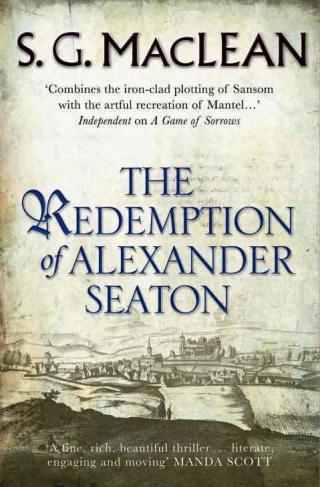
The Redemption of Alexander Seaton
- Автор: Маклин Шона Дж.
- Серия: Alexander Seaton #1
- Год: 2009
- Язык: английский
- Год: Quercus
- ISBN: 1847247911
- Жанр: Исторические детективы

Электронная книга - «The Redemption of Alexander Seaton». Краткое содержание книги:
Is the young man merely drunk or does his tottering walk suggest something more sinister?
When he collapses, vomiting, over the two whores who find him on that dark wet night, they guess rightly that he’s been murdered by poisoning.
So begins this gripping tale set in the town of Banff, Scotland in the 1620s. The body of the victim, the provost’s nephew and apothecary’s apprentice, is found in Alexander Seaton’s school house. Seaton is a school master by default, and a persona non-grata in the town – a disgraced would-be minister whose love affair with a local aristocrat’s daughter left him disgraced and deprived of his vocation. He has few friends, so when one of them is accused of the murder, he sets out to solve the crime, embarking on a journey that will uncover witchcraft, cruelty, prejudice and the darkness in men’s souls.
It is also a personal quest that leads Alexander to the rediscovery of his faith in God as well as his belief in himself.
Among her many strengths, Shona MacLean is brilliant at evoking period and place. You feel you are in those cold, dark, northern rooms, eavesdropping on her characters. You are totally involved in the rich, convincing world she has re-created.
I swallowed. ‘He was brought there.’
He was watching me closely now. ‘By whom?’
I had no reason that I knew to distrust the laird of Straloch, but neither was I content to tell him all I knew. ‘For their own protection, I cannot tell you.’
‘The killer?’
I shook my head. ‘No, I am certain of that. Those who found him saw the state he was in and sought to help him. They had seen me entering the schoolhouse shortly before, and thought I would not yet have been abed, or at least asleep. They left him there. I knew nothing of it till morning. He was dead then.’
‘Why did they not call for you?’
‘They did not wish to be discovered themselves.’ I had given away too much already. Mary Dawson was out of the country, and safe now, but her sister Janet might not yet have gained a sanctuary. The laird, sensing my reluctance, did not press me further. He changed his line of questioning a little.
‘They tell me he was murdered on the night of the great storm. We were battered here for many hours, and lost some trees in the park there. On such a night there cannot have been many abroad. These Samaritans of yours, they saw no one else?’
Since he would not leave it I would lie. ‘No.’
‘And there is nothing, in your past or his, nothing in these maps, that links you in some way to Patrick Davidson or his fate?’
The sensation of fear began to creep through me, and I could feel a coldness under my skin. ‘I know of nothing.’
Straloch was grave. ‘But he was laid in your schoolroom to die. And yet it is your friend, the music schoolmaster, who lies in the tolbooth of Banff, while you walk free.’ He looked at me in silence for a moment before proceeding. ‘I fear there is some great game of evil afoot in Banff, a game that will not end at the one death. You must take great care, Mr Seaton, great care.’ We had neither of us finished our wine. I sat and sipped the warm red liquid while the laird’s words resonated in my head.
I drained my cup and stood up. ‘I must go to my bed now, I think.’
Straloch came towards me and offered me his hand. ‘I myself have an early start. I ride out tomorrow at seven. I am bound for Edinburgh. I doubt if we will meet again before I leave. As you can see, I am much surrounded by young men and in their company often, but it is not so often that I find one whose conversation is of interest to me. I hope we may meet again some day.’ We shook hands and I gave him the letter from Jamesone that I had almost forgotten, and made for the door. I had my hand on the handle when he suddenly called me. ‘The map!’ How quickly it had been forgotten in the talk of its maker’s murder. ‘I will write a line for you to take back to the provost tomorrow. I can be of little help to allay his fears. It is the finest piece of cartography I have seen, and would serve any army well, if the others you spoke of are of anything like the quality. But I tell you again, I know of no intended invasion, and if there be any, the hand of the Marquis of Huntly is not in it.’
I believed him; whether or not Baillie Buchan, the Reverend Guild and the rest would was another question. Assuring the laird I could find my way myself to my bedchamber, I took the candle he offered me and made my way back along through the west wing to the great central stairway. The sound of a raucous ballad and much laughter filled the whole ground floor of the house. How many times I had been party to such evenings, such gatherings of friends and kin, the storytelling, the music, the catches and rounds, that went on into the small hours of the night. I longed to go in, just to listen, to be one of them again, for a moment. The ballad came to an end as I stood at the foot of the stairs. And then, when the laughter and cheering had died down, a woman’s voice, clear and alone, rose in a lament. All around was silence. Isabella Irvine. I ascended the stairs.
I had reached my small chamber at the very top of the house before I remembered the boots that a servant had taken in the afternoon to dry for me. Wearily I turned and began to make my way down again. I used my knowledge of such houses to guess where the kitchens might be. I turned to the right at the foot of the stairs and knew that something had gone wrong. I looked around the great entrance hall of the house and saw nothing or no one to give cause for alarm, and yet something was not as it should be. I stood still and listened. I heard nothing. And that was it: where before there had been music, and voices singing, and laughter, now no sound came from the dining hall. Yet, I had heard no one come up the stairs after me. I followed the corridor past the dining hall towards the kitchens, and was met by the steward coming the other way. He was carrying my clothing and riding boots. I thanked him and took them from him. As I did so, a bell was rung in the dining hall and he hastened to answer it. As he stood in the open doorway I could see beyond him into the room. Straloch stood with his back to the fireplace, talking in a low but authoritative voice to his older sons and two or three of the young men who had been at table earlier. Of the women I saw nothing. The steward closed the door behind him, and in the darkening silence of the house I climbed the stairway once again and made for my bed.
Sleep was not long in coming, but it was not sound. At the top of the house though I was, I was conscious of much movement and low voices on the floors beneath me. Once, someone with a candle paused outside my door. The flicker of light seeped beneath the doorway for a moment and then withdrew. The footsteps were light and soon I could not hear them at all. And then somewhere, deep into the long night, I was brought to full wakefulness by the sounds of horses gathering in the yard below. Conscious of the patrol that had earlier passed my door, I crept from my bed and peered through a gap in the window shutters. Gradually, I prised them further open. In the light of a full moon I could see, far below me, five men on horseback: the young men to whom Straloch had been talking in the dining hall. He was not there now, but I could see Isabella Irvine, her nightclothes a startling, ghost-like white in the moonlight, bidding her cousins and their kinsmen farewell. Quietly, they set off away from the house, only picking up speed once they were far enough away not to disturb those sleeping within. Isabella watched after them until they disappeared from sight, before turning back to the house. As she did so she looked up, directly, at my window. I could not tell whether she saw me or not. I returned to my bed, the window shutters still open, and watched the night sky until the first shafts of sunlight appeared from the east.
The laird had also departed by the time I appeared in the dining hall for my breakfast. The room was a noisy babble of the younger children of the house and their nurses. Bowls of porridge with warmed milk and scones spread with sweet confits were played with, spilt, dropped for the hounds or left, all to the indignation of the nurses. I took a good meal, as I had no plan to tarry long at any of my staging posts on the road home. Just after the chapel clock struck eight, I rose from the table and returned to my room to gather my few belongings. As I descended the stairs, relief that I would soon be leaving the strange house of night-time partings turned to apprehension: Isabella Irvine stood at the bottom, watching and clearly waiting for me. I held her gaze until, at the last step, she looked away.
‘Good morning,’ I said.
She did not respond to the civility and for a moment seemed at a loss for how to proceed at all. In the end she held out a small package and a sealed letter. ‘My uncle asked that I should give you these. The letter is to be delivered to your provost; the packet is for yourself.’ I took them from her and thanked her. She merely nodded briskly and turned to walk away.
‘Wait,’ I said, touching her arm with my hand. She looked down upon it as if it were an object infected. I let it drop. ‘Please spare me a moment.’