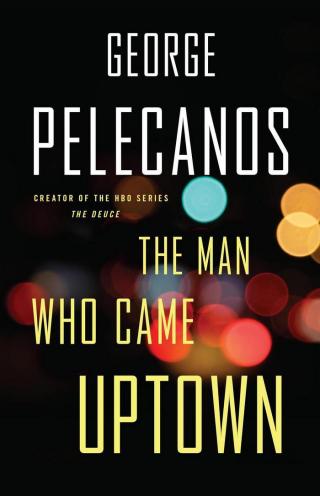
The Man Who Came Uptown
- Автор: Пелеканос Джордж
- Год: 2018
- Язык: английский
- Год: Mulholland Books / Little, Brown and Company
- ISBN: 978-0-316-47982-0
- Жанр: Криминальные детективы

Электронная книга - «The Man Who Came Uptown». Краткое содержание книги:
“I’m sorry about Phil,” said Berhanu. “I liked him.”
“So did I,” said Ward.
The question for Ward was, what would he do now? Homicide detectives had already shown up at his house and spoken to him. He imagined that Sydney had given him up as a business associate. Ward, despite his past as a D.C. cop, had told them he had no knowledge of the event. His involvement in the home invasion would have incriminated him, of course, but there was something else. In the image he had of himself, he saw retaliation, some payback for the murder of his friend.
Soon after his meeting with Berhanu, Sydney called Ward on his cell and asked if he could meet her at a spot in her neighborhood.
They sat at a booth at Slim’s, a diner on Georgia and Upshur. Both of them were drinking coffee. Sydney’s cheeks were drawn. She appeared to have lost weight. Her body odor was strong. He wondered when she had showered last.
“I have something for you,” she said, and she reached into her bag. She found an envelope and dropped it on the table between them. Thaddeus was written across the face of the envelope in Phil Ornazian’s scrawl. Ward took it and slipped it into the inside pocket of his jacket.
“Aren’t you going to count it?” said Sydney. “There’s ten thousand dollars in there.”
“I don’t need to count it.”
“Was it worth it?”
“Of course not,” he said. “Look, I’m sorry.”
“I don’t want your apology. I only came here to give you your money. Do you know why? Because Phil would have wanted me to. In his own way, he was an honorable man.”
“I’ll gladly give you this money back. It’s the least I can do.”
“No need. Phil took care of everything. He had a half-million-dollar life insurance policy. On top of that, unbeknownst to me, he had taken out mortgage insurance so that in the event of his death, our house would be paid for. If you don’t account for the fact that I no longer have a husband and my sons will grow up without a father, everything’s just fine.”
“I’m sorry,” said Ward, again, because he could think of nothing else to say.
“I blame myself, not you. I knew that the two of you were into something wrong. I told Phil that I didn’t like it. That I was afraid for him. I told him gently. But I should have threatened to leave him if he continued on with whatever he was doing. I should have screamed it into his face.”
“I’m going to find the ones—”
“No!” she said, loud enough to turn heads in the diner. “No. Just stop it, Thaddeus. This has to stop.” She gathered herself. “Answer me one question: Are my children safe? Are the people who did this going to do violence to me and my family?”
“This wasn’t about retrieving what we took from them. It was about revenge. I’ve thought hard about this. They’re not going to do anything to an innocent woman and her children. It’s too high-profile. It will bring all kinds of heat down on them.” He held her gaze while she stared back at him, quiet anger radiating off her. “The answer is, you and the kids are safe.”
She stood up abruptly and left him there. He watched her through the window as she walked east on Upshur. Their waitress came and asked him if everything was all right. He told her he was fine.
Stop.
Sydney was right. They had played a bold game and paid a price. The only thing left was more bloodshed. More loss. And anyway, he was damn near seventy years old. It was time to get off the stage.
Ward was done.
Twenty-Seven
Late in the spring, Michael Hudson convinced his mother that their dog Brandy’s time had come. Brandy had long been unable to climb stairs, and now she dragged her rear feet when she went to the front door to bark at the mailman, Gerard, or when she tried to walk to her dish come feeding time. Michael sat his mother down and gently explained to her that it was selfish and cruel to prolong the life of an animal that was suffering. She agreed to have Brandy euthanized.
Brandy was on her bed by the couch with her favorite ball and rubber bone next to her as their vet injected a solution into her paw. Doretha Hudson talked to her and rubbed behind her ear in that spot that made her sigh as the pentobarbital took effect, rendering her unconscious and shutting down her heart and brain. She was looking up at Michael, seated beside her on the floor, as the light left her eyes.
The very next day Michael and his mother went to the shelter on Blair Road and Oglethorpe Street, as they had done when he was in high school, and found a dog. It was not a puppy but an adult terrier mix. Not big or strong, and not all that attractive, but with lively eyes. As they approached him, he came up off his bed, put his feet up on the door of his space, and licked Doretha’s outstretched hand. His tail wagged furiously.
“That’s the one,” said Doretha.
“Kinda funny lookin,” said Michael. “There’s plenty of cute puppies here we could get.”
“Everybody wants a puppy. This dog here won’t get adopted unless we take him home. I like him.”
“What about that name?” said Michael. The card on the door said the dog’s name was Honeyboy.
“I’m going to call him O’Jay.”
“You gonna name him after a murderer? For real?”
“Not for O. J. Simpson, silly. Brandy was named for that beautiful O’Jays song about a man who’s missing his dog. So I’m just making a connection.” Doretha smiled. “Let’s go talk to that nice Spanish girl and do the paperwork.”
There was a dark-haired young lady named Rosa who worked at the shelter and who had been very helpful when they arrived.
“She’s Guatemalan,” said Michael.
“So? The point is, Michael, let’s take O’Jay home.”
“Whatever you want, Mama.” He meant it too.
Michael had begun to spend the money a little at a time. He used it to get a new pair of Timbs, and a Helly Hansen jacket from a shop at Gallery Place, but he was not much of a clotheshorse, and he needed little for himself. He found a bookcase with glass doors at an antique spot on North Capitol Street, splurged on that and a cab ride home, and put it up in his room. He bought more books.
Mostly, he used the money on others. He bought one of those comfortable outdoor chairs, the weather-resistant kind people put on decks, for Woods, the veteran amputee who was usually out back in the alley. He didn’t like seeing Woods sitting on an overturned crate. And he bought Alisha, Carla Thomas’s daughter, a set of children’s books recommended by the lady at the store on Upshur Street. It wasn’t going anywhere with Carla, but they were friends, and he liked her little girl.
One night he took his mother out to dinner at the Prime Rib on K Street because she had always wanted to go. He asked for a table near the piano where they could hear the man in his tuxedo play and sing standards and watch the bar, where nice-looking people drank and socialized. His mother had the signature dish that gave the establishment its name, and he had a New York strip, medium rare. The atmosphere and service were impeccable, which Michael, now in the restaurant business, could appreciate. His mother was in her glory.
The money would soon be gone. It wasn’t much to begin with, not by modern standards. Not enough to have risked death, of that he was certain. Michael thought of this every time he walked to work and passed the intersection of Park and Sherman, where Phil Ornazian had been murdered in his car.
With everything that had happened, there was a lesson to be learned, and Michael had taken it to heart. He was alive, and he was straight.
His job at the District Line was secure. It was not a challenging position, but it was work, and he was accepted and had found a second family there. Despite Angelos Valis’s frequent reminders that Michael would receive a raise only when the minimum wage went up, he was in fact given a raise, unceremoniously. The increase simply showed up one Friday in his paycheck. Also, he had health insurance. It looked like he had a home here for as long as he wanted it. All was fine, for now.