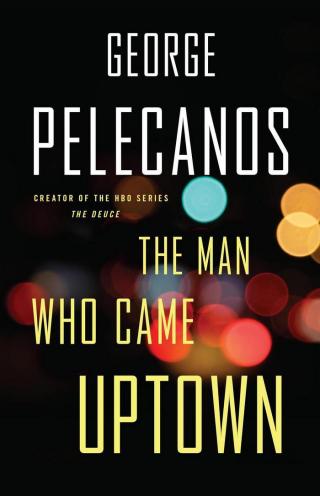
The Man Who Came Uptown
- Автор: Пелеканос Джордж
- Год: 2018
- Язык: английский
- Год: Mulholland Books / Little, Brown and Company
- ISBN: 978-0-316-47982-0
- Жанр: Криминальные детективы

Электронная книга - «The Man Who Came Uptown». Краткое содержание книги:
Ornazian hit Thaddeus Ward up on his office phone.
“Ward Bonds,” said the man himself.
“Like the character actor?”
“What do you want, Phil? I got no time for your nonsense.”
“I found Terry Kelly. One of the guys who stole the Tiffany bracelet.”
“And?”
“He came home to roost. I’m outside his father’s house. I’m going to tail him and see where he goes.”
“Don’t get burned.”
“Thanks, Dad. Actually, I don’t have to hug him too close. He’s driving a car so bright, I can see it from miles away. It’s real subtle, like napalm dropping on a forest.”
“Was the Vietnam reference for me?”
“I forgot to mention the Zippo lighter.”
“You need a ride-along?”
“Sure. There’s plenty of time for you to get out here. Terry’s doing his laundry.”
Ornazian gave Ward the address.
Three hours later, they were following the Charger out of the Washington metropolitan area and onto 270 North. They drove for over an hour, past Frederick, on to Route 15, then turned left off the highway to a two-lane that ran through a sparsely populated town called Hillville at the foot of the Catoctin Mountains. There, Terry Kelly went up a winding grade and turned into a gravel driveway that led to a house set back in a stand of pines.
Twenty-Two
The following morning, Terry Kelly woke up to the sounds of his phone alarm and the hard-core thrash of a band called Storm. His housemates had downloaded the tune off a Maryland-based website that sold CDs, clothing, and other items that promoted white supremacy. If Terry had had any historical perspective, he might have noted that the music sounded very similar to that of first-wave D.C. punk groups like Minor Threat, albeit with racist lyrics. But he had no historical perspective. He merely had a headache.
The night before, Terry and his housemates, Richard Rupert and Tommy Getz, had drunk a case of beer and a bottle of Jack and smoked plentiful amounts of weed.
Richard put the music on first thing every morning. He said it got him motivated for his day. Terry sometimes wished that Richard would give it a rest. The music had sounded great last night, when they were torched and dancing with their shirts off, but the barking vocals and speedy guitars were grating at seven thirty a.m. Terry was a believer, but if pressed he would admit that white-nationalist rock lyrics were pretty much the same from song to song. Some young guy lamenting about old days he’d never actually experienced when jobs were plentiful for white people, before “others” arrived, fucked up the neighborhood with graffiti, gangs, and cheap labor, and ruined everything.
Terry sat up on the edge of the bed and rubbed his temples. Unlike the guy shouting those lines, he had to go to work. So did his friends. The three of them had jobs in towns outside of Frederick. Terry was a stocker in a small grocery store in Walkersville. Richard and Tommy were in an auto-body shop in Monrovia.
They had met when all of them worked as body men in a garage in Gaithersburg, a Maryland suburb north of D.C. Terry supplied them with marijuana that he was moving in quantity with some guys he had befriended out of the Cherry Hill Road area in eastern Montgomery County. Richard and Tommy were polite with Terry but kept their distance. Later, when Terry got busted and told them about his situation, he found out why. They couldn’t abide white people who hung out with blacks. They told him that his troubles were because of the blacks. Blacks had no honor. They were inferior to whites in every way. Come court time, they would turn on Terry. Blacks and whites didn’t belong together. Terry needed to choose a side.
After he flipped on his former friends and drew probation rather than time, Terry got some threatening texts and phone messages and began to see that Richard and Tommy were right. He’d been misguided. A white man could only trust whites.
Terry shaved off his beard, which he used to get shaped up at one of the many black barbershops in Silver Spring. He began to hang tight with Richard and Tommy. They took him along to white-nationalist meetings outside Baltimore and to larger events, picnics, rallies, and concerts, up in Harrisburg, Pennsylvania, where the Keystone State Skinheads got their start. Gradually, Terry began to see the truth. White genocide was real. He told himself that he didn’t hate black people, but he and his friends had to do something to protect the true American way of life that had been under siege for far too long.
When Richard got caught stealing tools from the shop in Gaithersburg and was fired, Terry and Tommy quit in an act of solidarity, and the three of them decided to rent a place up in Frederick County, where they could be among their own kind. Richard and Tommy got body work and Terry snagged a job in a local grocery chain. They rented a house together in Hillville, a secluded mountain community off Route 15 that was heavily populated by whites. There they worked day jobs as a cover for their more lucrative activities, which included all varieties of theft, dealing marijuana to coworkers, and selling cut-down Lean to gullible white kids they trolled on Facebook and Instagram. They called them Eight Milers: whites who wanted to be black. Like white people who adopted black kids, they were race traitors, and they deserved to get fucked.
Terry dressed, left his small bedroom, and walked out into the kitchen/living area. It had a table, where they ate, and a TV that got its signal from a dish mounted on the roof. Richard and Tommy were at the table in their work clothes, finishing their cereal, about to head out to the shop. Like Terry, they were tall, six foot plus. Richard had the fancy haircut, shaved on the sides and full on top. His unbuttoned shirt revealed his ink, the usual lightning bolts and number symbols. Tommy kept his hair shorn to the scalp. Both of them were strong.
Terry had some cereal too, and then the three of them left the house. Richard secured the front and rear doors with a barrel lock and a dead bolt. All the windows were fixed with high-impact plastic burglar bars. Richard and Tommy had their guns and other valuables in a large framed-out box under a floor cutout in Richard’s bedroom. Terry kept a pistol under the front seat of his car. He was aware of the risk of having an unlicensed gun, but the threat of the Cherry Hill Road boys was still in his head.
They walked to their vehicles: Terry’s Charger, Richard’s lifted Cherokee, and Tommy’s Silverado, parked in the gravel drive amid tall pines. They punched each other’s fists by way of good-bye. Terry felt a swell of pride. He was one of them. He had always felt apart, in his private school, on the baseball team, and, looking back on it, whenever he was riding with those gator-baits who he thought were his friends. For the first time in his life, with Richard and Tommy, he felt like he was a part of something. He belonged.
They drove down the winding grade to the town: a sparsely populated strip of houses, a gas station, a church, and a failed general store. They followed Hillville Road to Route 15 and headed off to their daily jobs.