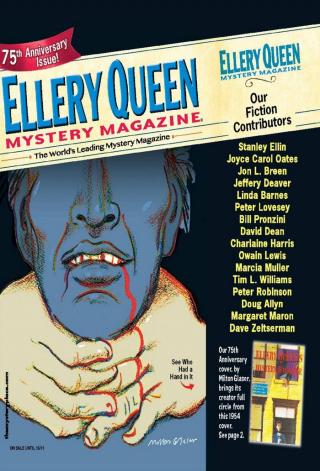
Ellery Queen’s Mystery Magazine. Vol. 148, Nos. 3 & 4. Whole Nos. 900 & 901, September/October 2016
- Автор: Дивер Джеффри, Эллин Стенли
- Год: 2016
- Язык: английский
- Год: Penny Publications
- ISBN: 0013-6328
- Жанр: Другие детективы

Электронная книга - «Ellery Queen’s Mystery Magazine. Vol. 148, Nos. 3 & 4. Whole Nos. 900 & 901, September/October 2016». Краткое содержание книги:
But I wasn’t alone now.
Someone was stalking me. Keeping to the shadows.
At first I thought it was battlefield jitters. I’ve been through a few tough scrapes. But it wasn’t paranoia. Someone was definitely dogging my trail, ghosting through the cover off to my right, using the terrain and the mist to mask his movements. And he was good.
If I hadn’t grown up in these woods, I might’ve missed him. As it was, I was only catching an occasional glimpse, a shadow, a flicker of a silhouette gliding silently through the trees. Just enough to know he was real. And that he was armed. Carrying a rifle.
I stopped. On instinct. Didn’t even realize why for a moment. Then, twenty yards ahead, a dark form took shape as a dog stepped into the road. A big dog. Black. Labrador, maybe? With his hackles raised. Showing his teeth in a silent snarl.
In the gathering dusk, I couldn’t see him clearly. But he looked so damned familiar... that I knelt.
“Ringo?” I called.
The dog stopped snarling. Cocking his head, he eyed me curiously, listening.
“Ringo! Here boy! Come on.”
And he bounded toward me, barking a hello, with his tail wagging.
And for one surreal moment I thought I might be dead. That I’d been killed in the Sandbox, and somehow my ghost had traveled through time and space, back to this road.
Because I knew this dog couldn’t be my Ringo—
My Ringo had been savaged by a rogue bear when I was ten. I’d put him down myself, and buried him, long before this dog was born.
So he couldn’t be my dog. And the boy with the rifle who’d stepped into the open behind me wasn’t some ghost from my past either.
He had red hair, jug ears, and freckles. His flannel shirt was patched and faded, and his Carhartt coveralls were two sizes too big. Hand-me-downs. It’s tough being a little brother.
His rifle was no toy, though. It was practically an antique. A ’98 Springfield 30–40 Krag, with a box magazine. Teddy Roosevelt’s Rough Riders carried Krags up San Juan Hill. But this kid wasn’t out here playing cowboys and Indians. He was a wood-smoke kid, hunting meat for the table.
“This is all private land hereabouts, mister. What are you doing here?”
“Passing through,” I said. “I used to live here.”
“No way. I don’t know you.”
“It was years ago,” I said. “You weren’t around yet.”
“I’m older than I look. Who are you?”
“My name’s Jax LaDart. My folks owned a cottage up around the next bend. I was born there. Grew up there.”
“Nobody lives up this road. It’s a dead end.”
“The house burned awhile back. I was away at the time. Just wondered if anything was left.”
“There’s a chimney’s still standing,” he admitted reluctantly. “And part of the porch.”
“Do you mind if I take a look?”
“Ain’t my land, I just kinda keep an eye on things. Nobody comes around here much. C’mon, Ringo.”
The dog loped after him as he turned away.
I swallowed. Hard.
“Hey kid,” I called after him. “How’d your dog get that name?”
“It’s carved in a tree,” he said. “By your old house.”
Of course it was. I’d carved it there myself. When I buried the first Ringo. All those years ago. And it was still there, in the yard of the burned cabin, guarding a few scorched timbers, a chimney leaning like the Tower of Pisa over the porch floor.
I’d planned to check out the ruins, then hike back to my rented Jeep and find a motel in town. But the sun was sinking now and after dreaming of this place all those years? I was reluctant to leave it so soon.
I made a rough camp instead. Spread some cedar boughs on the porch, built a small fire, and settled in for the night.
The floorboards were uneven, but I’ve slept in trucks and tanks and on rocky hillsides. Soldiers can sleep anywhere. Just not for long.
I woke with the rise of the moon, then lay there half awake, watching my fire dwindle down to glowing embers, listening to the wind singing in the pines.
Eventually I drifted off, and slept like the dead. Until just before dawn, when my favorite dream came to me again.
And I found myself walking down that dead-end road. Again. And the first Ringo stepped out of the shadows. And woofed a hello.
And I was almost home.
The first glow of dawn snapped me awake instantly, on full alert. I stayed silent and solid as a rock, taking in my surroundings. Sniffing the air for danger. There was none, of course. No Taliban in these hills, no tribal jihadis hunting me. The clearing around the charred ruins was on high ground with a clear view for miles in all directions. I was safe as a church up here.
I scanned the terrain anyway, out of pure habit. I’d been living at orange alert for so long that hyper caution seemed normal to me.
The forest began seventy yards below the clearing, scrub brush that blended into clumps of tag alders, then willowy poplars, then pines and hardwoods. Beyond that, the treetops rolled away from the hill like a vast green sea, stretching to the edge of the world, where the silvery line of Lake Michigan defined the horizon like a freshwater necklace.
Magnificent. Even better than my dream, actually. But seeing it again nudged my memory. Bringing back old feelings I’d forgotten.
Funny, as a teenager I’d grown to hate this place. The solitude. The eternal dusk of the deep woods.
But mostly the poverty.
I’d grown up wood-smoke poor. Dad was a logger, Ma worked in town. And they were happy here, I guess, though back then I couldn’t imagine why.
Then I hit the smart-ass time of my life. I looked around, and all I saw were rusty pickup trucks, loggers sweating in the deep woods for minimum wage, poaching game off state land to feed their families.
Losers. Like my father. No ambition, no gumption. Or so it seemed to me, with the vast experience of my eighteen summers.
I didn’t understand that there’s more than one American Dream. That the tapestry of life in the back country had nothing to do with numbers in a checkbook or the latest gee-whiz computer game.
Folks could walk free in these forests, harvest wild raspberries in the spring, take salmon and turkeys and white-tails in their seasons. Or whenever they damn well pleased, really.
If the Internet crashed and took civilization down with it, they’d scarcely notice, or care all that much. But at eighteen, I knew so much better.
I knew that the Secret of Life was money. Rack up enough long green, and you can buy anything or anybody. The world’s for sale. Buy as much as you want.
And because I’d grown up in wood-smoke country, I had marketable skills. I could hunt, shoot, track, and run like a spooked buck. I’d been working construction since I was twelve, already had my journeyman’s card.
And the U.S. Army was hiring, and paying a lot more than minimum wage. So my best friend and I signed on with the army, and then the Company after that, rebuilding Afghanistan. And there was plenty to rebuild, since the locals seem dead set on blowing everything up. Including us. Still, I took to the work. And I was good at it. At first...
I shook off the dark memories before they could settle in and take hold. Rummaging through my pockets, I found half an energy bar stashed, then strolled the yard, munching, loosening up.
And noticed something I’d missed at first light.
A paper sign, stapled to a pine tree.
PRIVATE!
NO TRESPASSING!
SAV–LAND MANAGEMENT
Forty yards further on, there was a second sign. And a long line of them stretching into the distance.