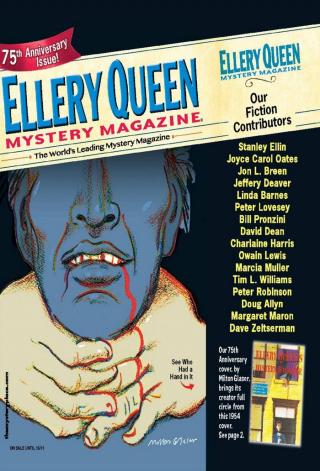
Ellery Queen’s Mystery Magazine. Vol. 148, Nos. 3 & 4. Whole Nos. 900 & 901, September/October 2016
- Автор: Дивер Джеффри, Эллин Стенли
- Год: 2016
- Язык: английский
- Год: Penny Publications
- ISBN: 0013-6328
- Жанр: Другие детективы

Электронная книга - «Ellery Queen’s Mystery Magazine. Vol. 148, Nos. 3 & 4. Whole Nos. 900 & 901, September/October 2016». Краткое содержание книги:
Cruickshank shot Banks a glance full of hatred.
“Yes, they’re all turning on you, those friends of yours,” he said. “There’s about as much honour among murderers as there is among thieves. And it’s not only George Harris. What about Ned Howard? Ned’s the local removal man, and after Platt’s murder you got him to ‘move house’ for the dead man. Ned’s one of your cronies, in on the whole deal, so he makes it look good and somehow gets rid of the stuff, furniture, papers, and all. Yes, we’ve talked to Mr. Howard, Oliver, and he’s come clean too, as soon as we found no record of the move on his books. So Tony Platt is dead, and a year later, poor Becky Harris is still so traumatised by what happened that she commits suicide.
“Perhaps she found out what you’d done to Tony? Perhaps he wasn’t the one who raped her? Maybe she made up the story? Maybe they were both willing but Platt just didn’t know his own strength and got carried away? We may never know. But everything’s hunky-dory in the village for a while, then your local PCSO, perhaps with delusions of becoming a great detective, gets suspicious about the suicide and Platt’s disappearance, partly because someone came looking for Tony. There’s a bit of a time gap here. This happened only seven months ago. But Nick Vauxhall and his wife knew Becky Harris, and they knew Max Belling. Nick also knew Tony Platt, whom he was told had left town. Also, George Harris told us that about a week ago this person came back to the Hope and Anchor looking for Platt again. He was quite persistent, and when you told him Tony had moved away years ago, he seemed doubtful, the same as before, according to George. Anyway, in the end he went away. We’re trying to trace him, by the way, and I’m sure we’ll succeed. I’ll bet you never imagined Tony Platt might have had any old friends who’d miss him, did you? Who knows whether this mystery man knows anything, but it’s another link in the chain.
“Anyway, that’s what got Max Belling so nervous, isn’t it, Oliver? Doreen Harris told us that Max had been against the whole thing from the start, remember. He’d been for calling the police after Becky’s rape. He took a lot of persuading that you’d be better off taking the law into your own hands, and I’ll bet he was livid when he found out you’d killed Platt rather than simply booting him out of Fortford. Max was a decent man, moral even, I’m told. He made a big mistake in allowing himself to be complicit with the rest of you, and it gnawed away at his conscience. Anyway, it’s my guess he was about to become a whistle-blower. Things were falling apart. After eighteen months of relative security, you had to run a PCSO off the road for asking questions where they weren’t wanted, and now one of your very own was turning against you. It was time for a stern warning. Time to send a message. And I believe it was you who sent that message, Oliver. In the first place, you’re a doctor. You have the skills and the tools necessary to do what was done, and the stomach to do them. You’d also know that potassium chloride can bring on a heart attack and is practically undetectable in the system afterwards. But Max Belling had a healthy heart, and our pathologist’s better than you think.
“The village stocks. That was a masterstroke. Let everyone see what happens to dissenters. Because the whole village either knew or suspected what had gone on, and people were either afraid of you or beholden to you. And what a clever idea it was to come after me and tell me about Max Belling’s financial dealings, something to send us off down the wrong path, perhaps never to return from it. One thing you forgot, or failed to consider, was that Doreen Harris was probably the one person who knew most of the story who hadn’t seen the warning placed on the village green. She was a loose end you’d overlooked, and that’s what makes me so sure we’ll find others. Mandy Vauxhall was at a distance too. You’re not quite as brilliant as you think you are.”
Cruickshank said nothing, just sat there smirking with his arms folded. Banks put his papers back in the buff folder, stuck it under his arm, nodded to Annie, and they got up and left the room. Cruickshank’s lawyer would arrive in due course, but so would the forensic results from the doctor’s car and surgery, and from Tony Platt’s preserved body, along with statements from George Harris and Ned Howard and all the others who were finally turning against Cruickshank.
As he and Annie headed over to the Queen’s Arms for a well-deserved pint of Black Sheep, Banks had no doubt whatsoever that they would get the proof they needed within days and that the good doctor would get far more than a slap on the wrist or a suspended sentence.
Coup De Grâce
by Doug Allyn
Say certain authors’ names and people think of EQMM. Doug Allyn is such a writer. He has won our annual Readers Award eleven times in the thirty-one years since its inception, and his stories are highly anticipated by our subscribers. He’s also a two-time Edgar winner in the short-story category, and has nearly a record number of Edgar nominations. There’s been a darkening in Doug Allyn’s stories recently, but they’re as strong — or stronger — than ever.
I’ve walked this old dirt road ten thousand times in dreams. Walked it in Texas during basic training, then later in Afghanistan, standing guard over construction sites, bunkers, bridges, helipads. I whiled away the endless hours imagining the long walk home, down this dead-end road.
Over and over again.
Sometimes I’d vary the season in my mind. I’d be walking in the fall with the leaves going golden. Or in spring, in April, after a morning rain, with the mist rising from the forest floor like the souls of woodland spirits.
But I liked my winter dreams the best. New-fallen snow, cold and clean and glistening, totally unlike the rocky barrens of Helmand or Herat or wherever our construction battalion was blasting a landing zone out of a mountain or beefing up a redoubt.
From a guard post in the ’Stan, you can see a thousand meters in any direction. Not a single tree in view. A few clumps of scrub brush here and there. But nothing green. Nothing that even looks alive.
But in my mind? I’d be walking down this dead-end road, through a midwinter forest at dusk, shadows stretching out and away, pine trunks dark and stark against the snowdrifts, a study in chalk and charcoal.
Wending my way home as the twilight blue faded to purple, wondering what Ma would have simmering on the stove.
Knowing that I would never arrive. Ever again.
My folks are gone now. And our old cottage too. I got a postcard awhile back from a high-school buddy saying vandals had torched the place. Burned it to the damn ground.
It shouldn’t have mattered much. The cabin had been abandoned for years. After the logging accident that killed my father, we moved to town. Ma said she needed to be closer to her job, but in truth, I don’t think she could bear living in the place where we’d all been so happy. My father’s death changed everything. Her life most of all.
And now that I was finally making the long walk home, on a midsummer evening, after so many years away, I realized my favorite dream was... well. Only a dream.
Oh, the woods were lovely, dark and deep as a poem, but the old road wasn’t my imaginary memory lane. It was a woodland path through a northern Michigan forest, stalked by its own predators and prey.
The raw stench of a dead skunk hovered in the mist, a fresh kill. I’d definitely never dreamed up dead skunks in Afghanistan. And in my guard-duty reveries? I’d always walked the old road alone.