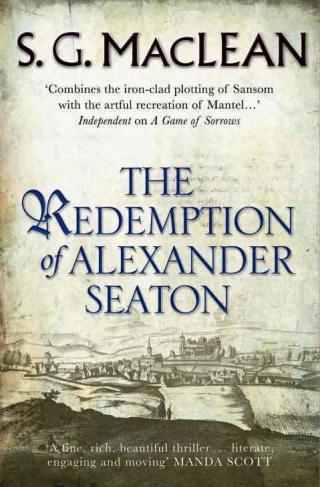
The Redemption of Alexander Seaton
- Автор: Маклин Шона Дж.
- Серия: Alexander Seaton #1
- Год: 2009
- Язык: английский
- Год: Quercus
- ISBN: 1847247911
- Жанр: Исторические детективы

Электронная книга - «The Redemption of Alexander Seaton». Краткое содержание книги:
Is the young man merely drunk or does his tottering walk suggest something more sinister?
When he collapses, vomiting, over the two whores who find him on that dark wet night, they guess rightly that he’s been murdered by poisoning.
So begins this gripping tale set in the town of Banff, Scotland in the 1620s. The body of the victim, the provost’s nephew and apothecary’s apprentice, is found in Alexander Seaton’s school house. Seaton is a school master by default, and a persona non-grata in the town – a disgraced would-be minister whose love affair with a local aristocrat’s daughter left him disgraced and deprived of his vocation. He has few friends, so when one of them is accused of the murder, he sets out to solve the crime, embarking on a journey that will uncover witchcraft, cruelty, prejudice and the darkness in men’s souls.
It is also a personal quest that leads Alexander to the rediscovery of his faith in God as well as his belief in himself.
Among her many strengths, Shona MacLean is brilliant at evoking period and place. You feel you are in those cold, dark, northern rooms, eavesdropping on her characters. You are totally involved in the rich, convincing world she has re-created.
My last night with William and Elizabeth was an evening of quiet contentment. Elizabeth had, to our great relief, at length agreed to my suggestion for easing her present and coming burdens. She asked many questions, and I felt that only the whole truth, as far as I knew it, would be worth telling to her, so I did. Anger and compassion vied within her as I told her Sarah Forbes’s tale, and at the end of it it was all that William and I could do to prevent her from setting out there and then to put the matter to rights.
‘Alexander will see to it all on Monday,’ William assured her. ‘All will be well; only have patience.’
I had much to prepare for the following day’s journey, and was glad, for once, of an excuse to retire early. As I lay in my bed in William’s house, my candle snuffed out and the shutters still open, I looked up at the northern stars, at the majesty of the works of God. They challenged me, as Matthew and Dr Forbes had challenged me, to leave off from my self-imposed indulgence of penitence and sloth, and to set forth once again with purpose on this earthly life. My last thought, before I was finally conquered by sleep, was that I was looking forward to the day to come.
TEN
Straloch
I left Aberdeen the next day in the early afternoon. The service in the West Kirk of St Nicholas had lasted from ten until noon, and I had shared a hasty meal of broth and bread with William and Elizabeth before taking my leave of them. When I rode out from Aberdeen that afternoon it was with a new determination to be whatever it might be given to me to be. The need to free Charles from his prison was as strong as it had been from the first, not just for his sake now, though, but for my own, for I felt that I had been chosen for the task. I felt no great sorrow at leaving Aberdeen, as I had feared only two days previously that I might, and no sense of dread at the prospect of making my way back to Banff. I had not failed myself, not shamed myself or my burgh since leaving, and I had come to understand, in my few days with old friends and new acquaintances, that it was not universally expected of me that I should hang my head in shame and achieve nothing.
As I crossed the Don at the Brig o’ Balgownie, and left the two towns behind me once more, my hand went to the saddlebag and I checked the clasp once again, fearful that it might have been interfered with. My commission from Banff, the precious map, with its accompanying letter from the provost, were still there, still sealed, but now they were accompanied by not one but two other, sealed documents, whose contents remained a tantalising secret to me. There was the letter, written before my eyes, by the artist George Jamesone to the provost of Banff, and there was another, by the same hand, which had arrived by a servant at William’s door late last night, addressed to Robert Gordon of Straloch himself. Jamesone’s servant had relayed that his master very kindly asked that I might deliver this letter into the laird of Straloch’s own hand. As I had assured William, I had told the artist nothing of my business at Straloch, other than that I would bed there on my homeward journey. William was uneasy that I had said anything at all. I could scarcely refuse, but I did not like the commission.
Not only letters, but voices too, accompanied me as I left the two towns behind and took the road north-west. Voices of encouragement, voices of warning, voices of fear. As the horse, not yet wearying under its extra burden of newly bought books, trampled out the road and the spires and coastline of Aberdeen faded further into the distance until at last they disappeared, so too did the encouraging voices of Matthew Lumsden, Dr Dun and Dr Forbes recede. Their place was taken by the ever more insistent voice of caution of my friend William Cargill, and the determined terror of the departing Mary Dawson. ‘Why you, Alexander? Why your schoolroom? Why you with this commission? Have a care, Alexander.’ The horse’s hooves beat out the rhythm of William’s warnings and every so often they found a reply on the wind from Mary Dawson, ‘I will never see Banff again.’
The sky was darkening as I approached Straloch in the late afternoon, and the storm broke just as I turned into the broad sweep of the drive. Thunder and lightning ripped from overhead and I forced the horse into a gallop for the last few hundred yards. Nevertheless, I was drenched, a poor specimen of a visitor, by the time we reached the courtyard at the front of the house. A servant answered my banging on the door and called for a stable boy to take my horse. He heard my hurried commission in the front hall and then, evidently deciding I might be who I said I was, allowed me into the body of the house. A young woman emerged into the light from the darkness of the east wing, watching for the visitor to arrive. She came forward, her flowing silk skirts rustling almost in time with the rain which poured down from the gutters outside. Her hair was dark, and she did not wear it up, but long and loose, brushed back from her face to show cheekbones that looked to be the work of some master sculptor and not formed by God. Her eyes were grey crystal. She was too young to be Straloch’s wife, but a little too old, I thought, to be one of his daughters.
‘It is a messenger from Banff,’ said the servant, ‘for the master. He says he has a letter from the provost.’ The man’s bearing implied that he was not entirely convinced that what I said was the truth, but the young woman seemed satisfied and dismissed him.
‘I am sorry, sir,’ she said. ‘The laird is not in the house at this minute. He is still out, hunting. He should return within the hour, or sooner, if this storm does not pass. The mistress is resting, but will be up for dinner. Can I be of any help?’
I looked at her, unsure as to how to proceed. She had a bright and open manner, and her face spoke of intellect, yet the provost’s dire warnings were ringing in my ears, and I knew I must wait on an answer from Straloch himself. ‘I’m sorry, I am not …’
She made a gesture of awkwardness. ‘Oh, I am sorry. I have not said who I am. My name is Isabella Irvine; my aunt is the lady of this house.’ She waited.
‘I am Alexander Seaton,’ I said. ‘I have come to see the laird of Straloch on the business of the burgh of Banff. I am sorry, but I am under authority to place my commission only into the hands of Robert Gordon himself.’ Although her feet had not taken a step, she looked as if her whole body had shrunk backwards, and not at my rebuttal of her offer of help, but at the mention of my name. She recovered herself quickly enough, but that she had been shaken, and that her manner towards me was now somewhat changed, was unmistakable.
She indicated a large, high-backed chair beside the fire. ‘If you wish to wait until the laird returns, you may sit there. I will have some refreshment sent.’ Then, with little more conversation or ceremony, she excused herself and departed up the stairs and out of my sight. I took the chair with gladness and, since it appeared no one would be around to see it, I removed my boots and let my feet dry by the fire. A servant brought ale and warm bannocks. As I took my rest and my refreshment, I tried to think what might have occasioned the change in Isabella Irvine’s manner towards me. Could it really be that the mention of my very name, bad as it was in Banff but surely not notorious here, was enough to put fear or contempt into young women in lairdly houses all over the north? I did not think so. And yet it was my name that had marked the change in her, as if borne in on a cold wind from the North. I pondered it, as the rain beating down outside contended with the roar of the fire within: I knew the name Isabella Irvine, but I could not think how or from where.