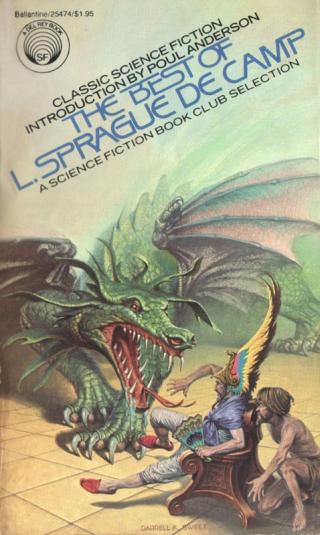
The Best of L. Sprague de Camp
- Автор: Де Камп Лайон Спрэг
- Год: 1978
- Язык: английский
- Год: Del Rey / Ballantine
- ISBN: 0-345-25474-0
- Жанр: Научная фантастика

Электронная книга - «The Best of L. Sprague de Camp». Краткое содержание книги:
"Now, if you guys have got any guts, you'll do like me and go out there and get back to work. The sawdust can't hurt you. I'm going out if I have to load the damn cars myself. Who's with me? Time and a half as long as that cloud's around."
Nobody said anything for a minute. Then Edward Gallivan mumbled something and put on a pair of goggles. Most of the others did likewise. They were, after all, a strong, tough lot, and the sight of their fat and aging boss preparing to face the cloud alone may have shamed them.
So, masked and goggled, they went back down the tramways, clutching at the piles for support as the whirlwind buffeted them and the sawdust stung every exposed inch of skin. Pringle grinned behind his handkerchief as he watched them get slowly on with their work, while Aceria's top shrieked about their ears. So, the wood spook still thought she could lick him? If this was her last stunt, he'd won, by jeepers. Or at least it was still a draw.
But it was not Aceria's last stunt. The cloud rose up and up until it looked no bigger than a marble. Everybody thought it was leaving for good, although they continued to glance up nervously at it.
Then it started down again. As it came near, they saw that it was a lot smaller and more opaque than when it had gone up. As it approached, it resolved itself into something that might be imagined by a paleontologist with the d.t.'s. It looked somewhat like a pterodactyl, somewhat like an octopus, and somewhat like Fafner in "Siegfried."
It had huge batlike wings and six long tentacular limbs with hands on their ends.
The shouts that had sounded on previous occasions about the yard were but as the chirp of canaries compared with the yells that now arose. As the thing glided over the yard, workers, foreman, inspectors, everybody went away. They went in straight radial lines, like droplets of mercury when a gob falls on a table top, only much faster. They jumped fences and waded neck-deep across the Moose River. Those inside the mill looked out to see what was up. They saw, and they went, too.
Pringle danced on the tramway. "Come back!" he screamed. "It can't hurt you. It's only sawdust! Look!" The monster was bobbing up and down in front of him, moving its horrid yellow jaws. He strode up to it and punched it. His fist went right through the sawdust, which swirled out in little puffs around his wrist. The hole made by his fist closed up as soon as he drew his arm back. For it was, as he surmised, merely the same cloud of animated sawdust, somewhat condensed and molded into this horrifying form.
"Look here! It's not a real thing at all! Come on back!" He passed his hand right through one of its groping limbs, which joined together again immediately.
But there was nobody to appreciate this display of nerve. Across the river, Pringle could see the rear elevation of a couple of small figures in drab work clothes, getting smaller every minute. As he watched, they disappeared into the forest. The form floated low over the site of the sawdust pile and collapsed. The pile was back where it had been, and Pringle was alone.
The thing that perhaps annoyed Pringle the most was that this time the engineer had run off without shutting down the engines, so that all the saws were whirling merrily in the empty mill. Pringle had to go down and turn the valve himself.
It was almost dark when Pringle and Larochelle appeared at the sawmill. They looked odd. Pringle was wearing, among other things, a catcher's mask and chest protector. Larochelle wore an old football helmet, several sweaters, and a lumber yard worker's heavy leather apron. Pringle carried a flashlight; Larochelle, a five-gallon can of kerosene and a gasoline blowtorch.
"What are you going to do, Mr. Pringle?" asked Aceria. She was sitting on No. 1040. Larochelle had gone off to start the water pump and uncoil the fire hose.
"Going to have a little fire."
"You are going to bum my home?"
"Maybe."-
"Won't you burn up the whole yard?"
"Not if we can help it. We're going to wet down the neighboring piles first. It's taking a chance, but what the hell?"
"Why are you so determined to destroy my home?"
"Because, damn it," Pringle's voice rose, "I've had all I can stand of this business! It's cost me a hundred times the value of those boards. But I won't give in to you, see? You won't let me load the boards. Okay, they're no good to me. So I might as well burn 'em up and end this nonsense for good. And you can't stop me. Your boards are tied down so you can't crawl inside 'em and animate 'em. Joe and I are protected, so it won't do you any good to get rough with us. And your sawdust monsters won't have a chance against this blowtorch."
Aceria was silent for a while. The only sounds were the hum of insects, the slap of Pringle's hand as he hit a punkie on his cheek, the whir of an automobile on the state highway, and Joe Larochelle's distant footsteps.
Then she said: "I do not think you will burn my home, Mr. Pringle."
"Who's going to stop me?"
"I am. You were very clever and very brave about facing my magics, no? And now you say, 'Ho-ho, I have beaten all Aceria's tricks'."
"Yep." Pringle had been making a heap of edgings and bark, well away from the pile. A loud swish in the dark showed that Joe had begun his wetting down. "Now, Joe," Pringle called, "you catch the other end of this rope. We want to tighten up on the pile as soon as we pull a couple of boards out, so the rest can't get loose."
"Okay, Mr. Pringle. Here goes." There were sounds in the semidark as the two men moved around the pile, making sure that their enterprise would suffer neither from spreading of the flames nor unwonted activity on the part of the boards.
"Very clever," continued Aceria, "but I should have remembered sooner that it is not always the most complicated magic that is the most effective."
"Uh," said Pringle. He splashed kerosene over his pile of kindling and lighted it. It flared up at once into a big, cheerful flame. "No wind," said Pringle, "so I guess she's safe enough. All right, Joe, let's haul the first board out."
Aceria seemed not to mind being ignored so pointedly. As Pringle and Larochelle laid hands on the board, she said:
"You were only so-so afraid of the boards when I went into them and made them alive, no? And you stood up to my monster. But there is something you are more afraid of than the boards or the monsters."
Pringle just grinned. "Is there? All right, Joe, heave! Don't pay any attention if I seem to be talking to myself."
"Yes. Union organizers," said Aceria.
"Huh?" Pringle stopped pulling on the board.
"Yes. You would like it, no, if I organized your men."
Pringle's mouth dropped open.
"I could do it. I have been listening to them talk, and I know something about unions. And you know me. I appear, I disappear. You could not keep me away, like you do those men from the A.F.L. and the C.I.O. Oh, I would have a nice revenge for the burning of my home."
For the space of thirty seconds there was no sound but the breathing of the two men and the crackle of the flames. When Pringle made a noise, it was a ghastly strangling sound, like the death rattle of a man dying of thirst in the desert.
"You—" he said. And again, "You—"
"You sick, Mr. Pringle?" asked Larochelle.
"No," said Pringle, "I'm dying."
"Well?" spoke Aceria.
Pringle sat down heavily in the muck, took off his wire mask, and buried his face in his hands. "Go away, Joe," he said, and would listen to no remonstrances from the alarmed Larochelle.
Pringle said: "You win. What do you want me to do with the damn boards? We can't just leave 'em sit here until they rot."
"I would like them put in some nice dry place. I do not mind having them sold, if they are kept together until I can find another tree of the right kind."
"Let's see," said Pringle. "Earl Delacroix needs a new dance floor in his joint. But Earl's so tight he'll wait till somebody falls through the old one. Maybe if I offered him the boards at half price—or even a quarter—"