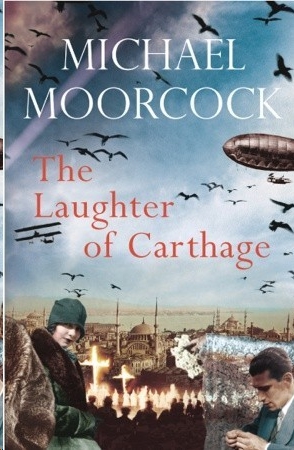
The Laughter of Carthage
- Автор: Муркок Майкл
- Серия: Between The Wars #2
- Язык: английский
- Жанр: Научная фантастика

Электронная книга - «The Laughter of Carthage». Краткое содержание книги:
Engineer, braggart, addict, Pyat is a magnificent invention, a genius of innocent vituperation: his finest achievement (and that of the author) is that his own warped and deluded vision is powerful enough to redefine reality.
I saw her in La Rotonde, sitting on a bar-stool, swinging her little legs and sipping lemonade, for all the world like a lively schoolgirl on holiday at Arcadia. She wore an old-fashioned pinafore and skirts and her golden hair fell in ringlets around her wide, fair face. Her blue eyes were large and unutterably innocent, merrily curious, and she was Esmé Loukianoff, my angel come back to life: in every perfect detail the same girl who had been my constant childhood companion. It was Esmé, the true Esmé, returned to me. I was a boy again, crying out my delighted surprise in that seedy café, making heads turn, not caring. ‘Esmé! Melushka! My darling!’
The stupid Syrian got in the way. Perhaps he did it deliberately, the shrunken devil. Drinks flew, glass smashed. I went down. I had not seen him there. I straightened up and began to rise to my feet. She was leaving with an American sailor, a thickset redheaded brute with tattooed arms, all in white. She could not hear me. ‘Esmé!’
They were in the street before I had reached the lobby.
‘Esmé! Esmé!’
I did not bother to collect my coat. It was cold. The day was grey and threatened rain. All the electric lights were coming on. There was mist in the streets, rising from the harbour. They stood in the little green shelter by the tram-stop apparently reading advertisements pasted over the inside. They were laughing. They were gesticulating to one another. The sailor was obviously drunk. My stomach turned over. There was a piece of metal in it. ‘Esmé!’ (He saved my life, she said. It was not much of a rape.)
I reached them as the tram sighed and squealed to a stop. Esmé, my darling, my sweet virgin, smiling at the sailor. I could read his depraved mind. I knew his filthy plans. I was disgusted. ‘Esmé!’ I recovered myself. I was panting. There was sweat on my face. People were staring. ‘Excuse me, young lady, I believe we’re acquainted.’ I caught my breath, trying to smile, to bow. I was shaking. She frowned. ‘From Kiev,’ I said, still forcing a grin, trying to seem casual. ‘Do you remember Kiev, Esmé?’
She had amnesia, I thought. Neither she nor the sailor understood my Russian. The tram drew up with a groan beside the stop. My English would not come to me. I was ten years old again. ‘Esmé!’ They made to board. Its destination was Galata Bridge. I followed them on. I rubbed at my head, trying to recall just a few ordinary English words. The sailor was shorter than me, but more muscular. He had huge forearms, like Popeye. He glared into my face. ‘Piss off, buddy.’
I was desperate, panting at him like a placatory dog. The English returned. ‘You don’t understand, sir. I know this girl. She’s from my home-town in Ukraine. An old family friend.’
He laughed sharply. ‘Sure. And she’s my sister. OK?’
I was shocked. Moja siostra! Moja rozy! Slōnce juz gaslo! Po dwadziescia! Cieniu! O Jezu Chryste! My sister and my rose. My darling! Twenty lice-ridden soldiers stood outside your hut making coarse jokes among themselves then went in one by one to relieve their animal lusts upon your body. ‘She is the daughter of my mother’s—’ I failed. ‘My mother’s I reached for her. ‘Esmé! It is I, Maxim from Kiev!’
She shrank back. (I have a boy. He wants to marry me.) The sailor must have hit me. My face was against rattling boards, there were people treading on my arms and back. The side of my head was numb. Brown hands tried to grab me. I wriggled free. hated the stink of those Turks. ‘Esmé!’ The tram had reached Galata Bridge and I could see nothing. My eye hurt. It was growing dark. The conductor yelled to me, driving me off his tram, pointing to his own skull and making ludicrous faces. He thought I was crazy.
I found myself on the pavement, near where I had first come ashore. The water was grey, a repeated, unrhythmical slap against the pontoons. Ships cried out. A million people swarmed across the bridge and then vanished. The mist grew thicker. There was a rushing noise. The bridge was suddenly deserted, empty. I moved down the steps and made to cross, thinking my Esmé had gone that way. A Turkish policeman at the barrier put his long rod against my chest. He shook his head and wagged his finger. I pressed on, trying to brush him aside. He became firmer, pointing to a sign in Arabic and beginning to hector me in the way only Turks can. There were Roman letters below the sign but I could not read them. Behind me was a ululation of street-sellers, the sound of motor-horns, of reined-in, impatient hooves. I looked back the way I had come. She was not visible in any direction. I screamed at the policeman. I offered him money. I pleaded with him to let me pass. He shrugged and pointed, relaxing as I understood what he was showing me. I could not cross now. The middle section of the bridge was parting to admit the big ships into the Horn. There was a line of them, flying a dozen different national flags: battle-cruisers, tramp-steamers, oil-tankers, grain-carriers; and flitting around them, like parasites around the whales, were the little red- and yellow-sailed caiques. The policeman refused to understand my French. ‘Ma soeur! Ma soeur!’ He poked me with the tip of his stick, shaking his head again, with more impatience. ‘Sorella! Sorella!’ I shouted. ‘Schwester. Shvester! Shvester! Hermana!’ I racked my brains. I was angry with myself for learning too little Turkish. By now I should have known more. I was paying the price of laziness. ‘Kiz kardesh!’ He shrugged and relaxed. The steamers were moving through the gap, confident and graceful, into Galata Harbour. Why should an American sailor take her to Stamboul? Or had they gone off in another direction altogether? I was quivering with frustration as I sat against the barrier while a great crowd of Turks, Albanians, Arabs, Persians, Montenegrins, Greeks and Jews began to form behind me.
It had grown dark by the time I was allowed to pay the toll and cross. I walked all the way to the other side, the boards bouncing under my feet, up the tree-lined streets where Moslems kneeled and made noises in the backs of their throats, into a sudden silence. Men were on their faces, sprawled in front of the Blue Mosque. The sky had lost almost all its colour and the outline of the mosque was massive ebony. It frightened me, that citadel of heresy and superstition. I passed hastily between the faithful, crossing a square to Hagia Sophia, almost a twin to that other monstrous building, but still a Christian church in her vast tranquillity. Down steps, along alleys, through the reeking fish-market, past the main entrance to the Grand Bazaar, up streets filled with the glare and flicker of lamps and candles and tiny braziers, where coppersmiths and armourers still worked, between rows of dimly lit tobacconists where the shags and flakes were heaped in piles, each pile topped by a lemon. I went by restaurants, peering in every one but seeing no white women or even American sailors; mosques and fountains, black and white arches, tiny streets with walls covered in vines, columns, pilasters, corridors, and eager voices shouting, little hands plucking. ‘Capitano! Caballero! Kyrie! Eccellenza!’ Rugs and silks and cushions. Horses, camels and hawks. White-robed Arabians; dervishes in conical hats and hair-coats; Hebrews in yellow cloaks; Albanians with pistols in their belts; Tatars in sheepskins; negresses in Cairo motley; bearded Circassians in black and silver; Syrians in Byzantine dolmans, their style unaltered for two thousand years. I stumbled without bearings through this confusion of centuries, hunting for that tiny fragment of my own past which had so briefly been within my grasp. I sat on worn marble and wept for my stolen optimism, my sister, my bride. We were to marry. My mother wanted it so badly. I had walked too far. There was no evidence even that they had crossed the bridge. I suppose I assumed she was leaving the vice of Pera for the virtue of Stamboul; but there was no virtue in Stamboul, merely an illusion of godliness, a tenuous cloud over the accumulated miseries and evils of Oriental ignorance, cruelty and greed. She had looked so respectable. Was she the daughter of one of those old Greek families who lived in the Kondoskala quarter, near the Cistern of the thousand and one arches? An escaped slave, taking advantage of the Allied occupation? She had not understood Russian, yet had looked pure Ukrainian. I realised I had temporarily been insane. The girl could not really be Esmé. I had seen Esmé with the anarchists only a few months earlier. She was much older. This child could not be more than thirteen. How had she appeared amongst these dark-skinned people? Perhaps she was Circassian. The daughter of Russian exiles who had come years before to Constantinople? Or could Loukianoff have fathered a child here? The likeness was so striking I was certain she must be a relative. A cousin at very least. If I could find her, I would learn of some obvious connection. In the gloomy archways nearby I heard scuffling, muttering, and remembered how everyone said it was unsafe, even these days, for a European to go alone in Stamboul at night. I made for a lighted thoroughfare as quickly as I could and was lucky enough to find a cab returning to the Pera side. I took it across the Horn to La Rotonde and pushed my way inside to grab at the horrible Syrian gargoyle, that dwarfish trader in tender little bodies, and growl at him, threatening him with the Law, the vengeance of the whole Cossack nation, the curse of the world’s deities, unless he told me the truth.