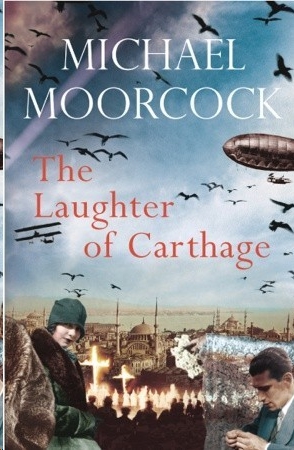
The Laughter of Carthage
- Автор: Муркок Майкл
- Серия: Between The Wars #2
- Язык: английский
- Жанр: Научная фантастика

Электронная книга - «The Laughter of Carthage». Краткое содержание книги:
Engineer, braggart, addict, Pyat is a magnificent invention, a genius of innocent vituperation: his finest achievement (and that of the author) is that his own warped and deluded vision is powerful enough to redefine reality.
By morning, when we parted, there was no message for me at the hotel. Neither Major Nye nor Mrs Cornelius was anywhere to be found. My messenger had not seen them since they had dined together the previous evening. I was glad she continued to cultivate the British officer. She knew exactly whom to seek out when an emergency arose. She had an unerring nose for power, even when it was in the least obvious guise. I was confident we must soon be on our way to London.
I slept until noon, then went to La Rotonde for lunch. I was curious to see if Sonia’s speculations had proven groundless and I planned to meet one of my new friends, a Bulgarian engraver specialising in visas. At that moment I felt wonderfully content, in perfect control of myself and my world. I remember whistling Marching Through Georgia (Jack Bragg’s sole contribution to my repertoire) as I swung my cane and moved on light feet down the Grande Rue towards La Rotonde. Mind and emotions were thoroughly balanced; my sense of proportion had never been better, and my perspective on life was excellent. I was a man at one with himself and knew no hint of care.
It remains, therefore, a source of profound puzzlement to me how it was possible, only a few hours later, to find myself inescapably in the power of an all-consuming obsession; an obsession which would dominate the rest of my life and determine almost every aspect of my destiny. I do not regret what happened; I simply do not understand how I could become the victim of such an impossible coincidence. I sometimes look to ancient Greek mythology and see myself as some doomed hero upon whom Zeus has placed a curse and thus began a remorseless chain of consequences which must decide the ultimate fate of gods and mortals alike.
Wheldrake, greatest and most neglected of Victoria’s poets, speaks for me in English far more eloquent than mine (but then he also knew the dreadful suffering and humiliation which compulsion can bring to a man):
O, Prometheus, by what subtle glamour
Was thy power constrain’d?
SIX
I AM A RATIONALIST. I have always been a rationalist. I believe in the power of the human imagination, in scientific investigation, analysis and description, in the Christian philosophy of humane tolerance and self-discipline. Other more obscure forms of mysticism are to me at once foolish and deeply misanthropic. It is true I have always had a greater capacity to love the world than to love most of the individuals in it; but I am not like these hippies who worship gods from Space and tell you they were Sir William Scott in a previous life; neither will I listen to silly girls who talk of poltergeists, hauntings and psychic perception. Yet I probably possess a greater accumulation of evidence for the belief in reincarnation (or even less likely phenomena) than anyone alive. My experience in Constantinople might have shaken a man with less character and unbalanced him for the rest of his days. Only an overriding, saving sanity, an improving understanding of the meaning and power of prayer, has helped me maintain my reason. It would be self-deceptive, at very least, for me to claim I was always so stable. The shock of a new country and culture, my youth, my realisation that I was both an exile and an unwelcome guest, must all have contributed to my state of mind. I was well-educated. I knew many languages. I had mastered the power of flight; but I was also something of a hothouse plant. I received a diploma from the St Petersburg Institute by the time I was sixteen. I was, at twenty, both a Master of Science and a Colonel in the Volunteer Army. My brain, as we used to say, had grown faster than my soul. They took you, Esmé, in your youth and in your innocence. They took you away from me. They transformed you into a whore and gave you a hard, grinning mask. You became a bandit’s camp-follower, an anarchist, you who had lived only to serve the sick and needy; you became a cynic who saw love as the arch-folly and the past as a stupid illusion. Yet did we not smell the lilacs together in the old parks above Kirilovskaya, as the sonorous bells of St Andrew’s pealed the Easter jubilation? Can you deny we ran bare-legged, hand in hand, through the grassy gorges of Kiev while the sun made all her buildings soft and golden? We sat under autumn oaks, did we not, and let the red leaves cover us? Was all that an illusion, Esmé? Or must it be called one now, because it cannot be reclaimed? Wann werde ich sie wieder sehen? You were fucked so much you had callouses on your cunt. But you came back to me. Perhaps God sent you. You came back disguised as a harlot and were transformed into the tender, loving child who had admired and supported me in my youthful idealism. You were restored, purified, made whole; and it was granted to me that I should be the medium of your salvation. Esmé, my aspiration, my angel! My muse! God grants few of us the opportunity to relive the past, redeem our mistakes, take advantage of a happiness we usually only value when we have lost it. I am not ungrateful, God. I thank You and am repentant that I thought in those days You played a trick on me. I thought You unjust to bestow such a gift, then take it away again, dooming me to a lifetime of miserable disappointment, a hopeless Quest, to change my whole perspective of life. Is it my punishment, to suffer for all of them? Is that my punishment, God? I have wandered the Earth praying for an answer. Wie lange mtissen wir warten? They accused me of so many crimes. They whipped me with their Cossack quirts. They humiliated and tortured me. They imprisoned me. They mocked me. They called me such terrible names. They cannot understand.