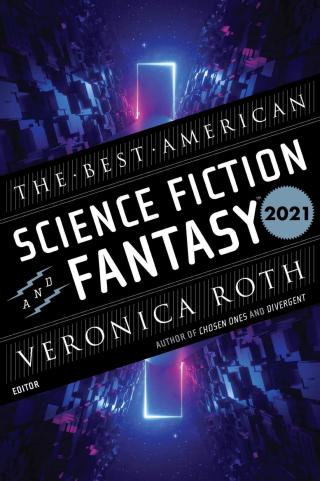
The Best American Science Fiction and Fantasy 2021
- Автор: Рот Вероника, Адамс Джон Джозеф
- Год: 2021
- Язык: английский
- Год: HMH Books : Mariner
- ISBN: 9780358470076
- Жанр: Малые литературные формы прозы

Электронная книга - «The Best American Science Fiction and Fantasy 2021». Краткое содержание книги:
This year’s selection of science fiction and fantasy stories, chosen by series editor John Joseph Adams and bestselling author of the Divergent series Veronica Roth, showcases a crop of authors that are willing to experiment and tantalize readers with new takes on classic themes and by exchanging the ordinary for the avant-garde. Folktales and lore come alive, the dead rise, the depths of space are traversed, and magic threads itself through singular moments of love and loss, illuminating the circulatory nature of life, death, the in-between, and the hereafter.
The Best American Science Fiction and Fantasy 2021 captures the all-too-real cataclysm of human nature, claiming its place in the series with compelling prose, lyrical composition, and curiosity’s never-ending pursuit of discovering the unknown.
He could have been just about anyone in the crew. Nonetheless, she felt certain that this was Dr. Marchere.
Alice walked up to the nearest door, and when it wouldn’t open, tried her override code. That didn’t work either, so she knocked.
She startled him; he nearly dropped the torch, which would have been very bad had it been lit.
“Dr. Marchere?” she shouted.
He waved, put down the torch, waddled over, and opened the door.
“Very sorry, I’m extremely busy, can you come back later?” he asked.
“I really can’t,” she said. “I’m here to rescue the ship.”
“I . . . see. And you are?”
“Corporal Alice Aste. I’m with the Security Force, and—”
“All right, all right, come in. Rescue! Ha-ha. Yes. That would be something.”
She stepped into the room, which was awash in an atonal cacophony of pings, whirrs, and clangs. He took off his gloves and led her to a table in the center of all of it. On the table was a coffee mug, a cold pot of coffee, and a plate of doughnuts.
“I would offer you something other than doughnuts,” he said, “but the food replicator can only make these, and only if one asks for bicarbonate of soda. I haven’t worked out what one is supposed to request in order to get other foods, so this is what I have. Now, you’ve exactly seventeen minutes, and then I’ll have to get back. I’m running thirty-eight experiments, and as you can see, all of my colleagues have already left.”
“Where did they go?”
“They left, as I said. You’re not from the Erwin, is that right?”
“The Rosen is nearby. If we can’t get the Erwin’s engine running, we’ll have to get the Rosen here for a tow. I can’t hail them for . . . some reason, but I can try calling them from my shuttle. I just need to understand what’s happening here, first. The computer . . . I’m sorry, this will sound insane, but in narrative mode, whatever that is, the computer said that this all began when Dr. Louis Marchere dropped a coffee mug. You are Dr. Louis Marchere, aren’t you?”
“I am! And that is amazing.”
“Which part?”
“All of it! I’m amazed you’ve lasted this long. Have you come across anyone else?”
“The captain and I had a long conversation that made no sense and confused everything much more.”
“Oh excellent, the captain is still here. I was sure I was the last one left.”
“He said he thinks the crew might be in their quarters, but is afraid to check, because he thinks if he does so, they might be dead and it will be his fault.” She laughed then, to see if Marchere was inspired to laugh as well. He was not.
“Yes, that’s eminently reasonable on his part,” he said. “Narrative mode, you say? That’s a new one. I accidentally stumbled upon theatrical mode yesterday, which was odd enough.”
“Switching to theatrical mode,” the computer said.
Marchere: No, I didn’t mean for that. Oh well, here we are. Welcome to theatrical mode.
Alice: Oh, this is very strange.
Marchere: Yes, well, now we’re here. It’s not terrible. I enjoyed it during a soliloquy, but after became quite frustrated.
(Marchere takes a bite of a doughnut.)
Marchere: There, you see, it’s exhausting, having your own actions read back to you. I became obsessed with the question of whether the computer was describing what I was doing, or if I was doing what the computer instructed me to do. Did I just bite this doughnut because that was what the stage business described, or did the stage business capture my actions?
(Alice looks confused.)
Alice: Weird, it’s in present tense. And the computer keeps announcing who’s speaking, like we don’t already know. It was doing that before too, in narrative mode, only not every time.
Marchere: The fact that it’s in present tense is what makes it so confounding. That would argue in favor of it dictating my actions instead of the other way around, which would contravene the concept of free will entirely, and that’s terribly frustrating.
Alice: I shot a man on the bridge before pulling the trigger on my blaster. Captain Hadder said it was because cause-and-effect had been malfunctioning all day. That sounds like a similar problem. Can we . . . turn this off?
Marchere: Computer, end theatrical mode.
“Ending theatrical mode,” the computer said.
“Thank you,” Alice said. “Now can you please explain what’s happened here? Where did everyone go, why are you running all of these experiments, where are you even getting the power to run all of these experiments?”
“Do you want for me to answer all of those at the same time, or is there a particular order you’d like for me to honor?”
“Start with what’s going on. I guess.”
“All right. Do you know what scientific theory states that the laws of physics are the same everywhere?”
“No, I don’t.”
“Good, because there isn’t one. We’ve always just assumed it to be so, because it did us no good to assume otherwise. It was a poor assumption.”
“You’re saying the laws of physics don’t apply to this quadrant?”
“I mean the Void we’re next to, primarily, but as you must have worked out, there have been local alterations. We’re right on the event horizon of a portion of space in which nothing we’ve previously proven to be true is necessarily still true. That’s why I’m running all these experiments. I’m trying to work out what is true in this particular region of space.”
“That sounds ridiculous.”
“Oh, absolutely. It’s magnificently ridiculous. Yesterday, I positively identified a particle’s exact location and velocity. This morning, I tested the wave function collapse of light, but it refused to collapse. Later, I managed to measure the speed of light from a moving object compared to the speed of light from a stationary one, and discovered the one from the moving object was faster. I’ve also discovered electrons a half-quanta apart, and a few hours ago the supercollider detected an element between carbon and nitrogen, and a neutron with a negative charge. And this morning, for five seconds, all the oxygen in the other room—thankfully, I was in this one—gathered in one corner. These are all impossible, ridiculous things.”
“But that can’t be right. It’s only a computer malfunction.”
“The computer on this ship is working perfectly,” he said, “in that it’s describing an objective reality we cannot grasp. My equipment is working perfectly as well. It’s our perception that’s having trouble catching up. Now, I have to get back to my work before it’s too late.”
“Too late for what, Doctor?” she asked. “What exactly happened to your coworkers? Where is everyone else?”
“Ah. They don’t exist any longer.”
“You mean, they’re dead?”
“I prefer it the way I said it. Are you familiar with the anthropic principle?”
“I heard something like that. The captain said his bridge crew went to the Anthropene Principality. Is that the same thing?”